

Intentional living · Kindness in practice
Creating good karma begins with a question you can bring into ordinary life: What am I putting into this moment? A thoughtful word, an honest choice or a little practical help can become a spiritual practice when you offer it with care.
Karma has deep roots in Hindu and Buddhist traditions, although those traditions do not explain it in exactly the same way. You may understand it as a spiritual principle, a reminder that choices have consequences, or both. Either way, living with greater intention need not mean waiting for a dramatic sign. You can begin with the person in front of you and the next decision within your reach.
What is karma?
The Sanskrit word karma means action. In Hindu teachings, karma is connected with action, its consequences and rebirth. The Hindu American Foundation’s explanation of karma emphasizes that present choices matter and describes selfless action without attachment to its reward. This is richer than the everyday slogan “what goes around comes around.”
In Buddhist teaching, intention is central to kamma, the Pali term. Buddhist teacher Thanissaro Bhikkhu’s discussion of karma and mindfulness highlights learning from actions and the possibilities of choices in the present. These perspectives have distinct spiritual contexts; they should not be reduced to a single rule for predicting someone’s future.
For a practical daily approach, consider intention, action and impact together. Wanting to help is a beginning. Listening to what help is actually welcome, and noticing its effect, completes more of the picture.
Why does good karma matter in everyday life?
While we cannot control everything that happens to us, we can often choose how we respond and how we treat others. Kindness, honesty and accountability give those choices a direction. They can support trust and contribute to a more caring community, even when nobody notices or thanks us.
This approach also takes pressure off spiritual practice. You do not have to earn a flawless future. You are cultivating a way of living that feels aligned with your values, one imperfect but meaningful choice at a time.
How to create good karma: five practices
1. Practice kindness and compassion
One of the simplest ways to bring good karma into daily life is through kindness and compassion. This can be as simple as holding the door open for someone, offering a kind word or helping a neighbor in need. Small acts matter because they meet real people in real moments.
Try it: When someone cuts you off in traffic, take a breath rather than escalating the situation. If it feels natural, offer a silent wish for everyone to get home safely. You are not approving unsafe driving; you are choosing your own next action.
Let kindness include listening. Before taking over someone’s task, ask, “Would a hand with this be helpful?” Respecting a “no” is a caring act too. You can be generous without assuming you know what another person needs.
2. Be honest and act with integrity
Whether in personal relationships, at work or in day-to-day interactions, being truthful and living in alignment with your values fosters trust and respect. Integrity is especially meaningful when doing the right thing is inconvenient or unlikely to bring recognition.
Try it: If you find a wallet, take sensible steps to return it through an appropriate lost-property service rather than keeping the money. If you receive credit for a colleague’s work, name their contribution. Both choices respect something that belongs to someone else.
Honesty does not require harshness. You can say, “I cannot commit to that this week,” without inventing an excuse or delivering a hurtful speech. A clear, respectful answer is often kinder than a promise you cannot keep.
3. Practice gratitude
Start a gratitude journal or simply take a few moments each day to reflect on the good things in your life. Gratitude can be part of a spiritual practice of noticing: who helped you, what you enjoyed, and what you might otherwise take for granted.
Try it: Each morning, write down three things you appreciate. Be specific: a neighbor checking in, a warm meal, or a quiet moment before work. When appropriate, turn one of those observations into a thank-you message or a small act of care.
There is no need to use gratitude to silence sadness. “I am grateful for my friend, and I am having a hard day” can both be true. Appreciation is an invitation to notice what sustains you, not a requirement to deny what hurts.
4. Help others without expecting a reward
Volunteering at a local shelter, donating to a charity or offering a friend a listening ear are practical ways to contribute. Choose help that matches both a genuine need and your available time, energy or resources.
Try it: Ask an animal shelter what volunteers actually do and what commitment is needed before offering an afternoon. If volunteering is not possible, a useful alternative might be sharing its verified needs list or helping a neighbor carry groceries.
Give without turning the act into a bargain with the universe. A donation does not purchase good luck, and helping someone does not make them owe you affection. The kindness has value in the care itself. Sustainable generosity also leaves room for your own essential needs.
5. Explore forgiveness without giving up your boundaries
Forgiveness can be meaningful for people who choose it. You might want to loosen the hold of an old argument, stop rehearsing a hurtful exchange, or offer yourself compassion for a mistake you are working to repair.
Try it: If a friend has wronged you, consider what you need before deciding whether to reconnect. That may be an apology, a changed behavior, a period of distance or no further contact. Forgiveness, if you want it, does not mean excusing what happened or restoring access to your life.
Do not rush this practice. Anger and grief are not spiritual failures, and nobody needs to forgive abuse to be deserving of peace. A boundary can be an expression of compassion toward yourself.
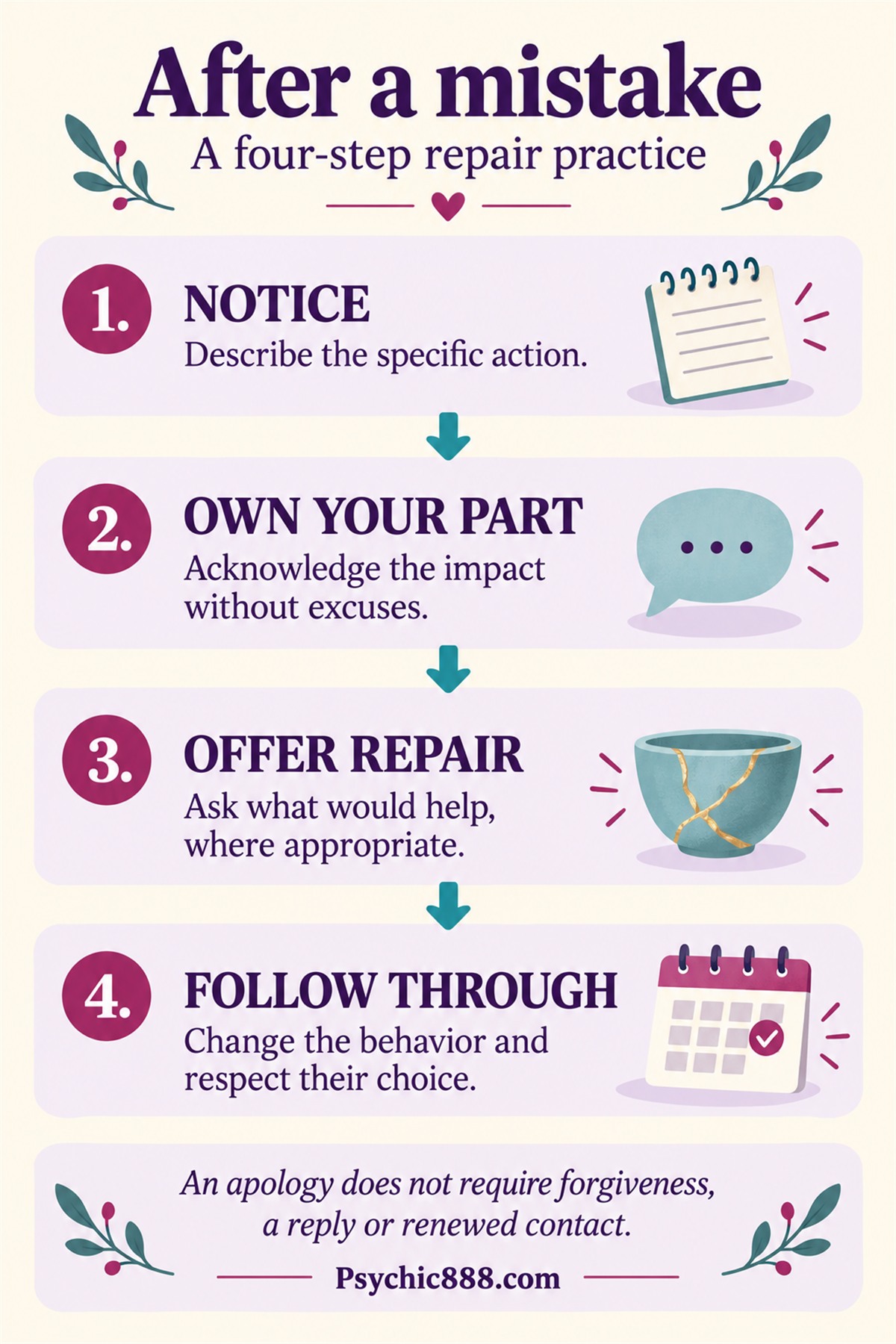
When you make a mistake: a four-step repair practice
Living intentionally does not mean you will never lose patience, break a promise or speak carelessly. What matters next is more useful than keeping a mental score of whether you are a “good” or “bad” person.
- Notice what happened. Describe the specific action without exaggerating or minimizing it. “I interrupted you three times” is clearer than “Everything is my fault.”
- Own your part. Acknowledge the impact without making the other person responsible for your reaction. Avoid adding “but you made me” to an apology.
- Offer a practical repair. Ask what would help, where appropriate. Replace a damaged item, correct misinformation or agree to a clearer way of communicating.
- Follow through and respect their choice. Change the behavior over time. An apology does not require someone to forgive you, respond or resume contact.
A simple example is: “I promised to call and did not follow through. I am sorry I left you waiting. Next time, I will let you know before the agreed time if I cannot make it.” The useful part is not a perfect speech; it is a realistic change you can keep.
If expressing yourself is difficult, the reflection exercises in our blue aura and communication guide can offer a spiritual starting point for finding your words. The conversation itself still needs honesty, consent and care.
How to maintain good karma over time
Be mindful of your thoughts without fearing them
Practicing mindfulness and staying aware of your mental patterns can help you pause before reacting. When you catch yourself judging someone, you might ask, “What do I know, and what am I assuming?” That question can make room for a more compassionate response.
A fleeting negative or unwanted thought is not the same as choosing to harm someone. You do not need to monitor every thought or worry that it will bring punishment. Bring your attention back to what you choose to say and do.
Our guide to listening to your intuition offers ways to reflect on impressions while leaving room for evidence and other perspectives. A feeling can invite a pause; it does not have to become a verdict about another person.
Embrace patience and humility
In a world that often values immediate results and recognition, patience and humility make room for learning. You can work toward a goal while admitting you do not know everything, seeking feedback and recognizing other people’s contributions.
Try it: If you are working toward a promotion, ask what skills or responsibilities you need to develop. Keep doing reliable work, but do not treat the promotion as a spiritual reward you are owed. Patience can sit alongside practical planning, fair expectations and a decision to seek another opportunity.
Cultivate self-love and compassion
Creating good karma is not only about how you treat others; it also invites care toward yourself. Make time for self-care, whether that is a quiet meditation, comfortable movement or relaxing with a good book. Rest is not something you must earn by exhausting yourself for others.
If you enjoy spiritual routines, explore our psychic-inspired self-care practices for gentle card reflection, grounding and journaling. Choose what feels nourishing rather than building another demanding checklist.
A short evening reflection
For one week, try three lines in a notebook. Keep the answers ordinary and specific:
- Where did I offer care today? Notice a real action, however small.
- Where could I respond differently? Identify one choice without turning it into self-criticism.
- What is one kind action for tomorrow? Choose something achievable, such as returning a message or giving someone your full attention.
If you miss a day, begin again. The purpose is to notice your direction, not produce a perfect record. You may discover that the most meaningful choices are quiet ones you would never post online.
Living a life of positive karma
Creating good karma is not about seeking rewards or controlling your future. It is about cultivating a way of being that makes space for compassion, honesty, gratitude and responsibility. Your spiritual beliefs can give those values depth; your everyday actions give them a place to live.
There will be ups and downs, but each day offers another opportunity to plant a seed of care. Start small, give thoughtfully, repair what you can, and remember that kindness includes you.
This article beautifully encapsulates the essence of karma and its practical applications in modern life. A must-read for anyone looking to cultivate a more intentional and fulfilling existence.
‘Every action has a consequence’ — no kidding! Next, you’ll tell me water is wet and fire is hot. Thanks for stating the obvious.
While the concept of karma is intriguing, it’s rather naive to believe that every action has a corresponding reaction. Life is far more chaotic and unpredictable than this simplistic view suggests.
Very informative! I appreciate the detailed examples provided. They offer concrete ways to incorporate positive actions into daily life, making the abstract concept of karma much more tangible.
‘Forgive and let go of grudges.’ Easy for you to say! Can I also get a magic wand to instantly forget all past wrongs? That would be great!
‘Generate good karma by helping others without expecting anything in return’ — says the article while clearly expecting us to follow its advice for our own benefit. Oh, the irony!
‘Karma serves as a reminder that we have control over our own lives.’ Indeed, this perspective can be incredibly empowering. However, it’s important not to overlook structural inequalities that limit individual agency.
This article offers some valid points but fails to address the complexities and nuances of moral causation. The idea that good actions will always yield positive results oversimplifies human experience.