

People who identify as psychic describe different gifts, interests and experiences. Working with other people also calls for ordinary skills: good communication, self-discipline, time management and care for the person listening. Spiritual curiosity and practical responsibility can grow together.
If you want to explore your own sensitivity, you do not need to promise yourself a reliable supernatural gift. Begin with something more welcoming: a comfortable practice in which you can notice, reflect and remain free to change your mind. These seven tips keep the original themes of breathing, relaxation, awareness, patterns, experimentation and personal strengths.
Seven foundations for a thoughtful psychic practice
1. Breathe comfortably, without forcing an experience
A brief pause can help you arrive at your practice instead of rushing straight into interpretation. Sit somewhere familiar and notice a few natural breaths. Keep your eyes open if you prefer. You do not have to breathe unusually deeply, hold your breath or follow a demanding schedule.
The NCCIH overview of relaxation techniques describes breathing exercises and progressive muscle relaxation as relaxation approaches. That does not establish that they open psychic faculties or make impressions accurate.
Let the aim be ordinary comfort and attention. If focusing on breathing feels unpleasant, look at a nearby object or listen to the sounds in the room instead. Stop if you become dizzy, anxious or uncomfortable. Five sessions a day are not a requirement for spiritual development.
2. Relax without ignoring your body’s needs
Take care of simple needs before you start: a comfortable seat, water if you are thirsty and a position that does not hurt. An itch or a tired muscle is not an obstacle you must defeat to prove commitment.
You might gently release tension in your shoulders or hands. If muscle tensing is painful or unsuitable for you, skip it; noticing the chair supporting you is another option. There is no need to work through every part of the body or reach a particular state.
NCCIH notes that relaxation practices can sometimes bring unwanted experiences, including increased anxiety. You can end a session, return to a familiar activity and seek qualified support if distress persists. A practice should not replace healthcare or become a reason to overlook symptoms.
3. Become aware of what is actually around you
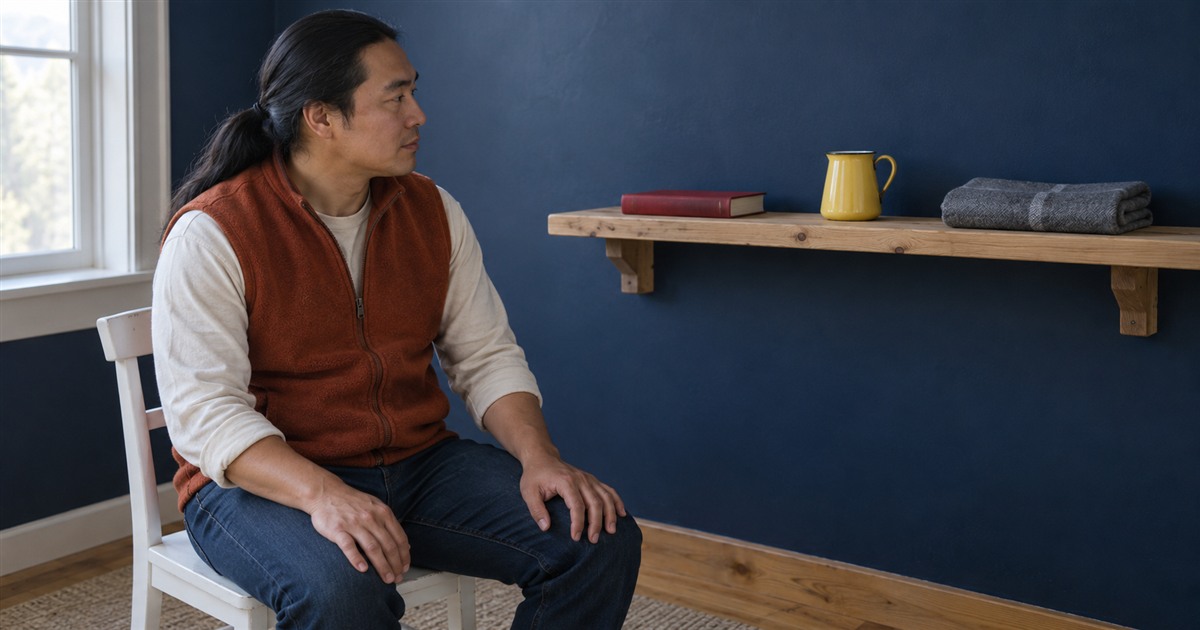
The original observation-and-memory exercise is a useful place to start. Choose a familiar, ordinary scene: a shelf, a table or the view from a safe seat. Look comfortably, without staring or straining your eyes. Notice a few details, then look away and describe what you remember.
Look back and check. Perhaps you remembered a red book correctly but guessed the number of cups. Write both. The exercise is about describing attention and recall, not proving that you can see hidden information.
Keep observation separate from explanation. “My friend paused before replying” is something you noticed. “They are angry with me” is a possibility to check respectfully, not knowledge the pause supplies. If visual impressions interest you specifically, our clairvoyance exercise guide explores imagination, passing images and ordinary observation in more detail.
4. Seek patterns, and leave room for nonpatterns
Cycles in nature can be a lovely focus for reflection. You may enjoy noticing seasonal changes, light at a window or the routines that shape your week. Not every coincidence needs a hidden explanation, however, and an apparent pattern does not automatically tell you what will happen next.
Try a modest question: “When do I find this practice comfortable?” You might notice that a short session after lunch suits you better than one when you are tired. That can guide a practical adjustment without turning the result into a universal rule.
If moon phases or other spiritual symbols are meaningful to you, you may include them in a private note. Do not assume they caused an experience simply because they occurred at the same time. Include days when the expected connection was absent.
5. Experiment with the routine, not with other people’s lives
A small journal can help you compare what you intended with what you actually experienced. Choose one manageable change, such as trying a shorter session or using a quieter seat. Keep the question about your comfort, attention or ability to describe an experience.
Write down an impression before reviewing later events. Preserve its original wording and include misses, uncertain outcomes and ordinary explanations. “I felt something important might happen” is too open-ended to become a precise prediction after the fact.
You can call a practice meaningful without calling it proof. Do not use experiments to diagnose illness, judge a partner’s faithfulness, decide an investment or test whether someone is secretly thinking about you. Other people are not targets for uninvited readings.
6. Identify strengths without ranking gifts
You may feel drawn to images, words, dreams, compassionate listening or a sense of spiritual connection. Some people use labels such as clairvoyant, clairaudient or empath for these experiences. You do not have to adopt a label immediately or compare yourself with someone whose experiences sound more dramatic.
Ask what you can describe clearly and what you enjoy doing. Perhaps you remember visual details, put feelings into words or listen patiently. Those ordinary strengths are valuable whether or not you interpret them spiritually.
Being uncertain does not make you less worthy, and envy need not become evidence that you are ungrateful. Our guide to using intuition as a gift considers how spiritual language can sit alongside judgment, kindness and everyday choices.
7. Use your strengths with permission and care
Give a strength a respectful outlet. If you enjoy images, make a private sketch. If words come easily, write a short reflection. If listening is your strength, ask someone whether they want company, practical help or simply a chance to talk.
Listening to a person does not mean reading their mind. An imagined scene does not reveal a stranger’s location, and a spiritual impression does not establish contact with a particular being. You can explore beliefs about guides or angels without presenting your interpretation as information another person must accept.
If you share an impression, ask permission first and make it easy to decline. Avoid alarming statements, pressure to buy a service or advice beyond your competence. Respectful personal boundaries matter as much as any practice you choose.
A short practice note you can reuse
You do not need a detailed log of every thought. One brief entry after a chosen practice is enough. Use these five lines, adapting or leaving out anything that does not help:
- Intention: what you wanted to explore, such as describing the room more carefully.
- Practice: what you did and whether it felt comfortable.
- Observation: what you actually noticed or remembered.
- Interpretation: a possible meaning, kept separate from the observation.
- Review: what you checked, what did not match and what you would change.
For example, you might write: “I looked at my desk, then listed what I remembered. I recalled the notebook color but missed a cup. The notebook reminded me of wanting time to write. Next time I will keep the exercise short.” This is a sample entry, not a report of psychic results.
Keep notes private, especially when they mention another person. Avoid collecting personal details to make a reading seem more convincing. You can also stop journaling if recording and checking begin to feel compulsory.
Choose a gentle next step, not a deadline for a gift
Pick one foundation that feels useful and leave the others for another time. You might try ordinary observation today and decide later whether a journal suits you. No special purchase, repeated daily quota or dramatic experience is required.
A worthwhile practice can leave you better able to describe what happened, acknowledge uncertainty and respect another person’s choices. It need not produce a prediction. Rest, work, relationships and practical information still belong in your life.
Let curiosity stay warm and grounded. You are free to enjoy spiritual reflection, revise an interpretation and choose not to continue. Developing a thoughtful practice includes knowing when enough is enough.
The article provides a comprehensive guide on developing psychic abilities, emphasizing both mental and physical preparation. The step-by-step approach is practical and easy to follow.
While the article is well-written, one should also consider the psychological aspects and potential for self-deception in the development of so-called psychic gifts.
It’s interesting to see the focus on patterns and experimentation. This aligns well with scientific methods and could provide measurable insights into psychic phenomena.
The emphasis on breathing and physical relaxation as foundational steps is crucial. These techniques can benefit anyone, not just aspiring psychics.
The idea that everyone has a seed of spiritual wisdom is a comforting thought. It encourages people to explore their inner potential, regardless of the outcome.
Identifying and using one’s strengths is a universal principle that applies to many areas of life, not just psychic development.
It’s also a reminder that everyone’s gifts are unique and equally valuable, promoting a sense of self-worth and acceptance.
Absolutely. Focusing on innate strengths can lead to greater personal and professional fulfillment.
The suggestion to keep a journal and document experiences is particularly valuable. This practice can help in identifying recurring themes and patterns.
I agree. Journaling can be a powerful tool for both self-reflection and tracking progress over time.
The approach of treating psychic abilities as skills that can be developed through practice and observation is quite rational and grounded.