

Troubling readings · ending pressure · practical next steps
A psychic reading may leave you with a new perspective or a question to consider. It should not leave you feeling that tragedy can only be avoided by paying more money. If a reader frightens, shames or pressures you, you can stop the conversation without first proving whether they have a spiritual gift.
There are definitely some red flags to watch out for when visiting a psychic or anyone else involved in the metaphysical world. The five statements below are examples of claims that deserve a firm pause. They are not reports about a particular reader, and you do not need to hear all five before deciding to leave.
This guide focuses on responding after something troubling has been said. If you are still choosing a service, our guide to checking a reader’s conduct and service terms covers the questions to ask before booking.
Five statements that are a reason to step back
1. “You are possessed or cursed, and only I can fix it.”
A frightening claim followed by a paid remedy puts you under pressure. A demand for secrecy—especially a warning that telling anyone will make the danger worse—makes it harder to check the situation with someone you trust.
You do not need to settle a spiritual debate to refuse the purchase. A reading does not establish possession or a curse, and paying for an “exclusive” remedy does not establish protection. Clear compensation for an agreed service is different from repeated charges presented as the only way to keep you safe.
Try: “I am not buying that service. I am ending this conversation.” You do not owe the reader details about who you will speak to next.
2. “Your spouse is cheating, stealing or planning to harm you.”
A reader’s interpretation is not evidence of another person’s private actions or intentions. Specific accusations can create fear and damage trust, even when delivered confidently or attached to a dramatic card image.
Do not confront someone solely because a reading made an accusation. Separate the reader’s words from anything you have actually observed. If you have a real-world safety concern, seek appropriate support based on that concern rather than paying for another prediction.
You can say, “I will not make an accusation on the basis of this reading.” If immediate danger is present, prioritize getting to safety and local emergency help; the reading is not the authority deciding whether danger is real.
3. “You have been bad, and you should be ashamed.”
There is a difference between being matter-of-fact about a situation and being hateful. A consultation can include an uncomfortable question without insults, humiliation or pressure to disclose intimate details.
A good psychic is not there to berate you. You can reflect honestly on a mistake, make amends where appropriate and still refuse a conversation that attacks your worth. You do not have to buy another session to prove that you are sorry, spiritually open or deserving of care.
Try: “I do not want to be spoken to that way. Please end the session.” Our guide to putting boundaries into practice offers further ways to express a limit.
4. “You have a serious disease, or someone will die on a particular date.”
A psychic reading cannot establish a medical diagnosis or a lifespan. Neither a precise prediction nor a vague suggestion that a family member is ill is a substitute for appropriate healthcare.
If you have symptoms or a health concern, discuss those with a qualified healthcare professional. Tell them what is actually happening, not just what the reader predicted. Do not stop prescribed care or buy a spiritual treatment because someone claims to know the outcome.
A frightening statement can be upsetting even when you know it is not evidence. Ask a trusted person for support if you need help settling afterward. You can end the reading without persuading the reader to retract the claim.
5. “Nothing can change. You have no choice.”
You have choices, and you get to choose your own path. That does not mean every circumstance is within your control or that change is easy. Time, money, health, safety and other people’s decisions can place real limits on what is possible.
Those limits do not give a reader authority to dictate your life. A useful reflection leaves room for uncertainty, practical options and qualified advice. It should not require you to tolerate harm, abandon support or consult the reader before every ordinary decision.
Try: “I will consider my options outside this session.” Taking a break is also an option, even if you valued an earlier reading with the same person.
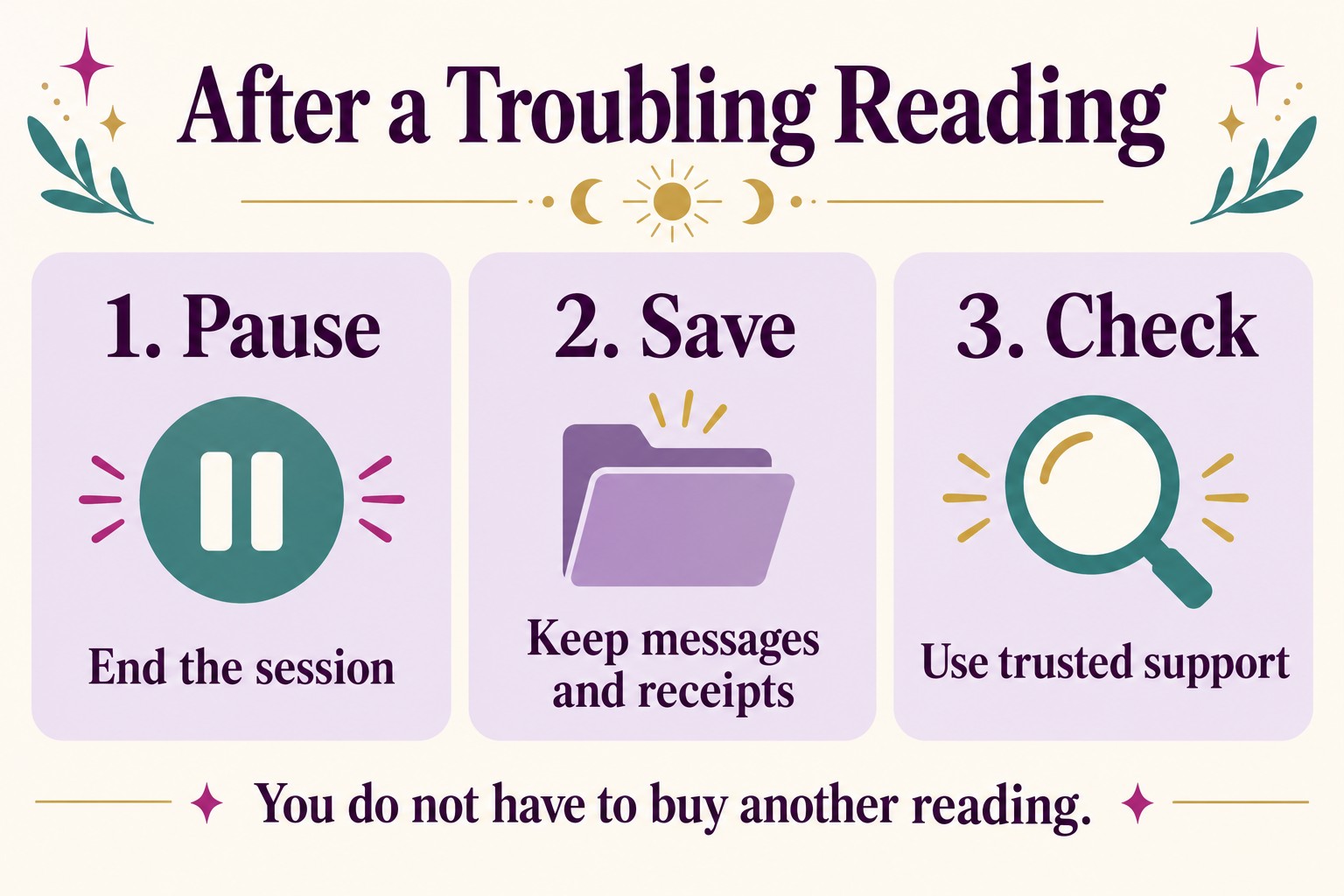
After a troubling reading: pause, save, check
The reminder above has three practical steps. You do not have to buy another reading.
- Pause: end the session. Use the service’s actual disconnect or ending procedure, not only a verbal request. Stop additional purchases while you consider what happened. If you are physically present and feel unsafe, prioritize leaving safely rather than debating.
- Save: keep messages and receipts. Preserve relevant claims, payment records, the service description and any request for more money. Note dates and what you asked the service to do. Keep records private rather than posting someone’s personal details online.
- Check: use trusted support. Speak to someone who can help you think without adding fear. For payment concerns, use the provider’s official complaint route and your payment company’s known contact details. For health, legal or safety concerns, choose support qualified for that issue.
For example, a hypothetical reader might claim that stopping a paid cleansing will harm your family. Your next step need not be another purchase: end contact, keep the message and discuss the payment and threat through appropriate channels. The claim itself is not evidence that the threatened spiritual harm will occur.
If money or account details are involved
If you suspect a scam, contact the bank, card issuer or payment company promptly, explain accurately what happened and ask about available options. The FTC’s guidance for people who were scammed gives steps for different payment methods and information disclosures. A refund or reversal is not guaranteed.
Use contact information from the company’s known app, website or the back of your card, not a new number supplied by the suspected scammer. Describe a payment you made under deception differently from a transaction you did not authorize; do not change the facts to fit a complaint.
If you shared passwords, account access or identity information, follow the FTC guidance relevant to that information and contact the affected company. In the United States, suspected scams can be reported at ReportFraud.ftc.gov; elsewhere, use the appropriate local consumer-protection route.
Be cautious about a second person promising to recover your money for an upfront fee. The FTC warns about refund and recovery scams that target people who have already lost money. A new claim of special access is not a reason to pay again.
Leave room for your own judgment
Ending an upsetting reading does not require abandoning your spiritual beliefs. You can enjoy tarot, intuitive reflection or prayer while refusing pressure and choosing your own support.
If repeated readings have made it harder to decide without reassurance, our guide to setting limits and taking a pause explores practical choices without diagnosing you. You can decide not to book another reader at all.
Let the next step be one you can understand and freely choose. Your safety, dignity and ordinary decision-making do not depend on satisfying a reader’s demands.
The advice to walk away if a psychic demands large sums of money for dubious reasons is sound. Ethical standards should be maintained in all professions, including psychic readings.
This article serves as a good reminder to treat psychic readings with caution and seek second opinions when faced with alarming claims.
The article brings into light some serious concerns that one should be cautious about when dealing with psychics. It’s important to distinguish between genuine advice and manipulative tactics.
The distinction between general advice and overly specific, fear-inducing claims is well made. A professional psychic should be more of a guide than a fear monger.
Indeed, the role of a psychic should be to provide clarity and guidance, not to instill fear or extract money through coercion.
Highlighting the importance of honesty and ethical conduct in the psychic profession is essential. People should be aware of the red flags mentioned.
The examples provided are quite alarming. It’s necessary to remain vigilant and not fall prey to fear tactics often used by unscrupulous individuals.
It’s crucial to approach any form of metaphysical consultation with a healthy dose of skepticism. The points mentioned about dubious claims are very pertinent.
Pointing out the negative tactics some psychics use to manipulate their clients is important. Awareness can prevent people from being exploited.
Absolutely, people need to be critical of any claims that seem too dire or require excessive payments to resolve. Ethical behavior should be non-negotiable.