

PSYCHIC HISTORY & THE CIA ARCHIVES
The CIA really did investigate psychic phenomena. For readers interested in intuition, that is a fascinating piece of history: questions often associated with spiritual exploration also attracted intelligence researchers. The important distinction is between investigating an idea and establishing that it works reliably.
In January 2017, the CIA made approximately 930,000 declassified documents, containing more than 12 million pages, available online. Its announcement about the CREST archive included STAR GATE remote-viewing files among many collections. Those totals describe the wider archive—not 12 million pages devoted to psychic spies.
What was remote viewing meant to explore?
Remote viewing refers here to the proposed ability to describe a distant or unseen target without ordinary access to it. Researchers wanted to know whether such impressions could supply information useful to intelligence work. That is more specific than the broad idea of being sensitive, intuitive or spiritually aware.
A person might describe a shape, landscape or image and experience it as an intuitive impression. The next question is whether that description identifies the intended target under conditions that exclude ordinary clues. Feeling certain about an image and demonstrating dependable access to information are not the same thing.
Remote viewing is also not a synonym for every psychic practice. Tarot interpretation, mediumship, intuitive counseling and claimed perception of hidden targets involve different questions. Our guide to understanding psychic experiences offers a broader starting point for personal exploration.
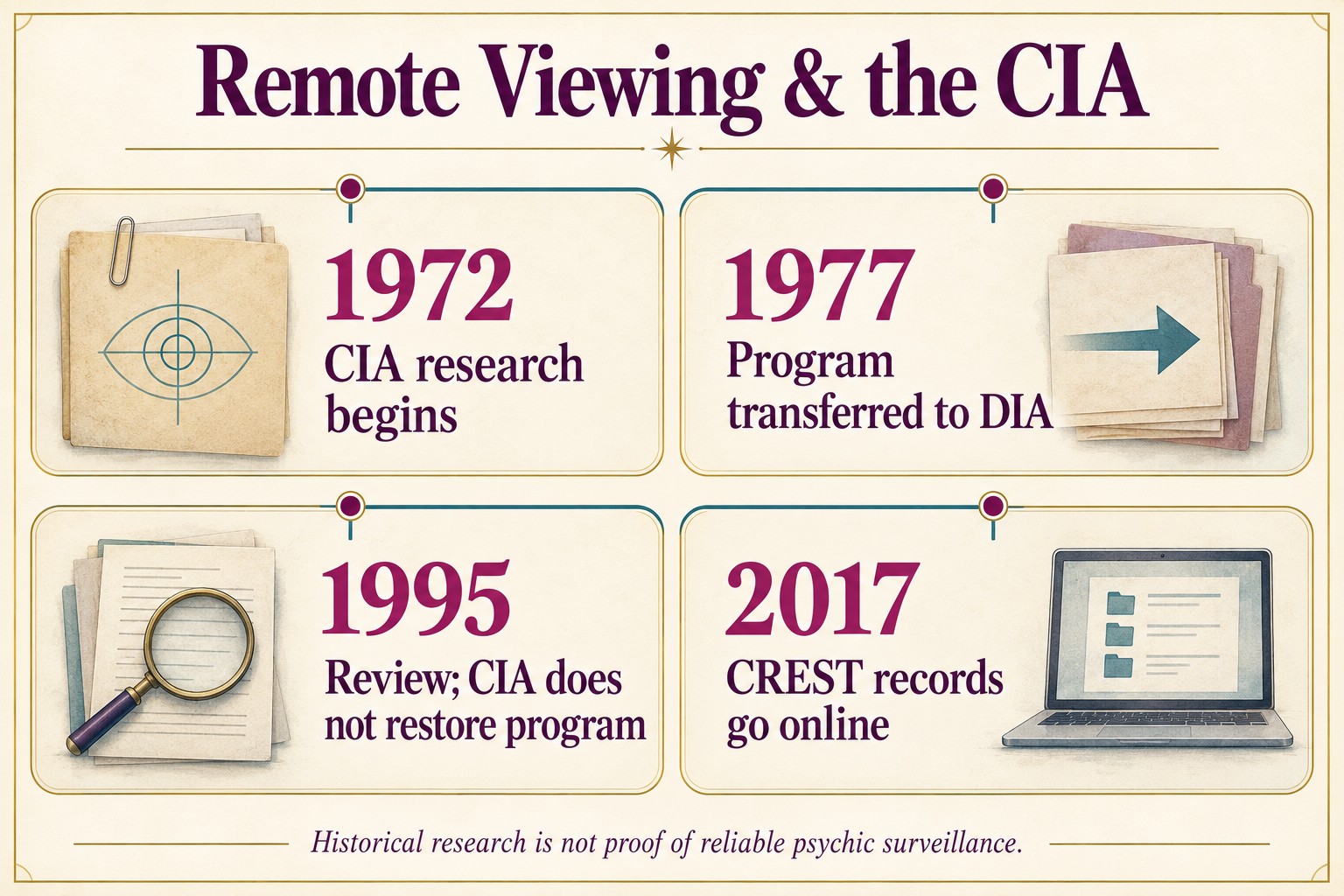
Four dates that make the story easier to follow
The CIA’s historical explanation of its psychic research describes this sequence:
- 1972: CIA research into psychic phenomena began that summer.
- 1977: the CIA ended its research and transferred the program to the Defense Intelligence Agency.
- 1995: an independent evaluation was completed after the program returned to the CIA for another look. The CIA did not restore it.
- 2017: the broader CREST collection became accessible online, bringing older material to a much wider audience.
This sequence explains why an article published decades after an experiment can sound like breaking news. A newly accessible file may be new to its reader without describing a new operation. When a headline says “secret program revealed,” the date inside the document matters just as much as the date of the headline.
Where does Uri Geller fit into the archive story?
Uri Geller is one of the best-known names associated with public interest in psychic research. A CIA Reading Room search record identifies a Stanford Research Institute parapsychology report from August 1973 containing experiments involving Geller. The document identifier is CIA-RDP96-00787R000100070001-5.
It is worth distinguishing three things: an experiment’s description, the investigators’ interpretation and a later agency decision. A positive sentence in an early report should not be stretched into a claim that every later reviewer agreed, that a specific performer was a dependable spy or that all psychic abilities were proved.
Detailed stories about copied drawings are best read alongside the original session record, including unsuccessful attempts and testing conditions. A memorable match on its own does not explain how targets were selected, how responses were scored or which ordinary clues were excluded. Readers deserve the whole context rather than a string of dramatic quotations.
You can use the identifier above when searching the CIA’s Electronic Reading Room. If a document link takes you to the archive landing page, search by its identifier or title instead of assuming the file’s contents have changed.
What did the later review mean?
The CIA’s historical summary says the 1995 evaluation found intriguing results but judged remote viewing too inconsistent for intelligence use. The agency chose not to restart the program. That operational conclusion is central to the story; it should not disappear behind the more exciting early experiments.
A laboratory question and an operational question are different. An unusual result can prompt further curiosity. An intelligence method must also produce information consistently enough to guide decisions. That distinction allows a reader to take the history seriously without treating archive possession as a government guarantee.
For believers, the record can remain interesting without becoming a certificate of personal ability. Your sense of meaning, your experience in a reading and the reliability of a claimed surveillance method are separate topics. None needs to be forced into a single yes-or-no verdict about every spiritual experience.
How to read a declassified psychic document thoughtfully
1. Check who wrote it
An archive can contain reports, correspondence, proposals and collected articles. Ask whether the page is an agency assessment, a contractor’s report or someone else’s account. Being stored in an official collection does not make every statement an official endorsement.
2. Keep the dates separate
Note when the work took place, when the document was written and when it became publicly accessible. This small habit prevents old research from being mistaken for an active program.
3. Read conclusions beside examples
Notice what the writer calls a success, what did not work and what limitations are acknowledged. Avoid using one favorable passage to cancel every qualification elsewhere in the record.
4. Separate history from a sales claim
If a course or reader advertises “CIA-proven” powers, ask what specific record supports that wording. Historical interest is not a promise that a paid service can reveal private information, predict events or deliver the same result to every person.
Before booking spiritual guidance, consider what a respectful reading should involve: clear terms, space for uncertainty and freedom to make your own decisions. For everyday practice, using intuition with discernment can be more useful than trying to turn a historical headline into proof.
The enduring appeal of this story is curiosity. People asked unusual questions and left a record that others can explore. A warm, open-minded reading of that history can appreciate its possibilities while staying honest about what the documents establish—and what they do not.
It would be important to compare Geller’s claimed abilities with controlled scientific studies on remote viewing to determine the validity of his results.
Agreed, replicability and adherence to scientific methodology are key factors in validating such claims.
The historical context of the Cold War likely influenced the CIA’s willingness to investigate such extraordinary claims. They were looking for any potential advantage.
The Stargate Project certainly sheds light on the lengths intelligence agencies go to explore unconventional methods. It’s interesting to see how serious the CIA took these claims.
Declassified documents like these offer fascinating insights into the unconventional approaches considered during the Cold War era. It highlights a unique aspect of espionage history.
The variability in Geller’s performance raises questions about the objectivity and consistency of the tests. More transparent methodology would be needed for credible evaluation.
The psychological aspect of Geller performing better without skeptical observers present could suggest a strong influence of environmental factors on his performance.
While Geller’s results are intriguing, they could also be attributed to chance and clever guesswork. More rigorous scientific scrutiny would be needed to make definitive conclusions.
The notion that the CIA would invest resources into this type of research is both fascinating and somewhat unsettling. How much was driven by genuine belief versus desperation for an edge?