

LOVE & CONNECTION / CARE THAT FEELS PERSONAL
You bring your partner a thoughtful gift, but what they wanted was a little uninterrupted time together. They finish a household task for you, while you are longing to hear, “I see how hard you have been trying.” Neither gesture has to be wrong. Sometimes the invitation is to understand more clearly what makes care feel personal.
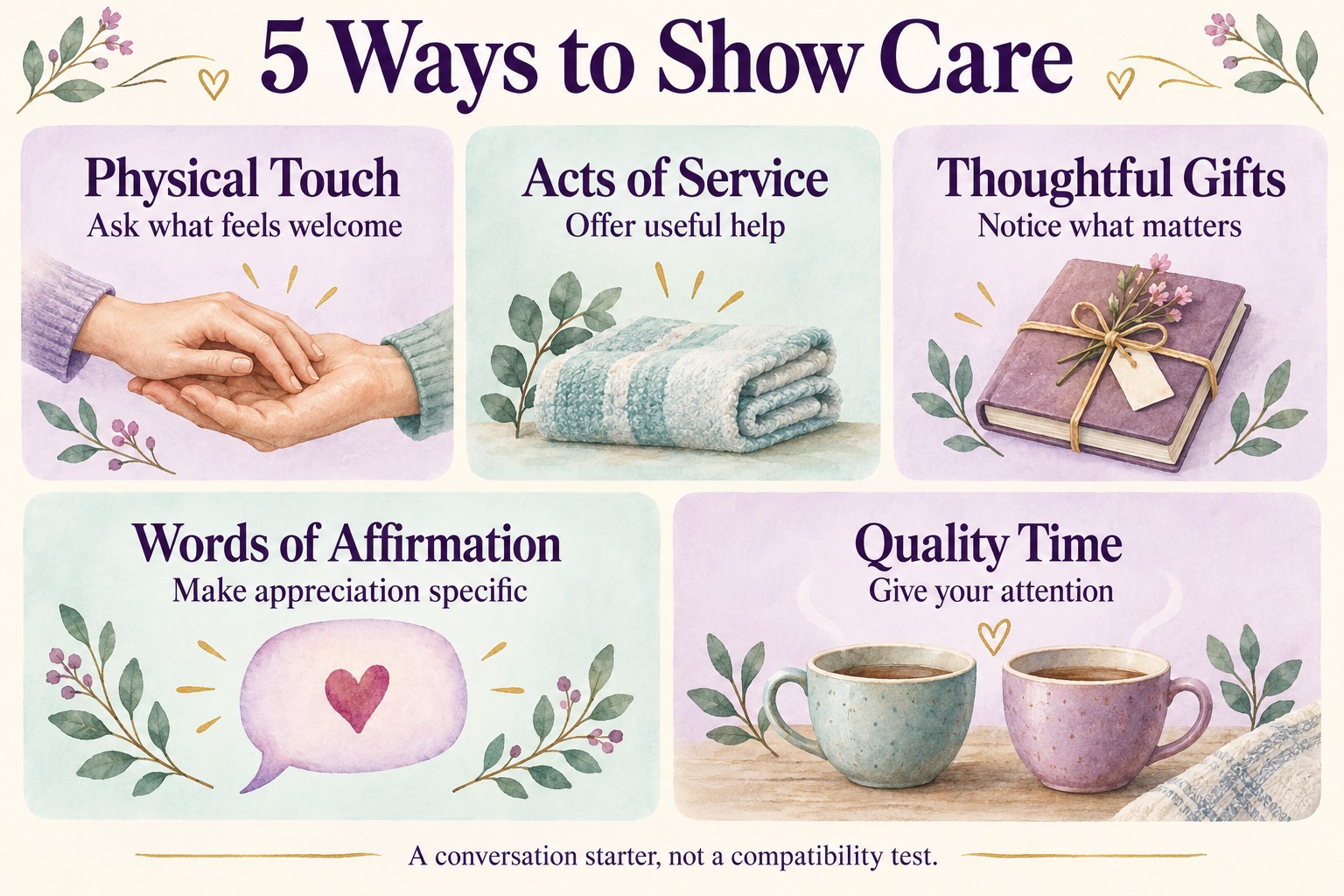
Love languages can give you an accessible way to start that conversation. The familiar five categories are physical touch, acts of service, gifts, words of affirmation and quality time. You can draw from all of them, and your preferences may change with your circumstances. The point is not to find a perfect label; it is to become more attentive to each other.
Use love languages as a starting point, not a fixed identity
Gary Chapman popularized this framework. His official explanation of the five love languages describes different ways people express and receive affection. These categories can help you name needs that otherwise remain vague: reassurance, companionship, practical help or feeling remembered.
However, you do not have to possess one primary language, and these five categories do not cover everything a relationship needs. A review by relationship researchers Impett, Park and Muise found limited support for the model’s central assumptions, including the idea that matching a preferred language is the key to greater satisfaction. Use the model flexibly rather than as a compatibility score or a promise that one gesture will fix a relationship.
You may enjoy gifts but need reliability even more. You may love cuddling and still want space when overwhelmed. How you naturally give care can also differ from how you want to receive it. A direct question gives your intuition something real to work with.
The five love languages, with requests you can actually use
1. Physical touch: ask what feels welcome
Physical affection can include holding hands, a hug, sitting close or a gentle shoulder touch. It does not automatically mean sex. Nor does enjoying touch mean someone wants it at every moment or from every person.
Ask about comfort instead of guessing: “Would you like a hug, or would some space feel better?” A partner’s preference is not a standing permission slip. As love is respect’s consent guidance explains, consent requires communication and can change even within an established relationship.
A specific request: “I enjoy holding hands on our walks. Would that feel comfortable for you?” If the answer is no, look for another way to connect. Affection should not become something someone must endure to prove their love.
2. Acts of service: offer help that is genuinely helpful
A drink brought during a busy morning, a meal prepared together or help with an agreed task can say, “Your day matters to me.” The most useful act is not necessarily the largest one. It is often the one that meets a real need.
Check first rather than reorganizing someone’s belongings or taking over a task they wanted to do themselves. “Would handling dinner help, or is there something else you need?” is warmer than assuming you know best.
A specific request: “Could we agree on who handles the dishes tonight? I would appreciate not having to remind you.” Shared responsibilities deserve a fair arrangement; routine household labor should not be treated as a favor that earns affection in return.
3. Gifts: let thoughtfulness matter more than cost
A meaningful gift can show that you noticed an interest or remembered a detail. A borrowed book recommendation, a handmade note or a small item connected to a shared memory may feel more personal than an expensive surprise.
Avoid assuming that receiving gifts is the most common preference or that someone who enjoys them is materialistic. Ask what feels thoughtful and what feels burdensome. Some people prefer experiences, consumable items or no gifts at all.
A specific request: “For my birthday, I would love a small book you think I would enjoy. Please keep it within our budget.” Agree on spending limits and never treat a gift as creating a debt, sexual obligation or reason to overlook hurtful behavior.
4. Words of affirmation: make appreciation specific
Kind words become more meaningful when they show attention. “I appreciated how you listened without rushing me” says more than a compliment offered on autopilot. Encouragement can recognize effort, character or an ordinary act of kindness.
Some people enjoy spoken affection; others find a private written note easier to take in. Public praise may embarrass a person who loves a quiet message. Ask which form feels natural rather than deciding they should enjoy yours.
A specific request: “It helps me when you say what you appreciate about our relationship. Could we share one example this evening?” Honest appreciation should accompany reliable behavior, not replace accountability or an apology.
5. Quality time: offer attention, not constant access
Quality time might be a walk, a shared meal, a quiet hobby or a conversation without competing screens. It does not have to mean an elaborate date or hours of eye contact. The important question is whether both people experience the time as connection.
Discuss what helps you feel present. One person may want to talk; another may enjoy doing something side by side. Work, caregiving, disability and fatigue can affect what is possible. A small agreed plan is often kinder than an ideal neither person can maintain.
A specific request: “Could we have twenty minutes together after dinner, with our phones away unless something urgent comes up?” Time apart, friendships and personal interests can coexist with affection. Quality time should not become a demand for constant availability.
Discover your preferences through real moments
You do not need a paid assessment to begin noticing what matters to you. Think about recent experiences rather than trying to choose the identity you believe a romantic partner should have.
- Recall a moment of care. What did someone do, and why did it matter?
- Notice the context. Were you tired, celebrating, worried or wanting companionship?
- Separate the gesture from its meaning. Was the gift important, or did being remembered make it special?
- Notice a missing need. Would practical help, reassurance, rest or clearer communication have made a difference?
- Make one request. Choose something concrete, affordable and freely agreed.
For example, loving a surprise lunch might reflect several things at once: a gift, help during a busy day and time together. You do not have to force that experience into a single box. If you want more everyday ideas, our guide to showing someone you love them offers a wider range of caring gestures.
A short couples exercise: one request, one week
Choose a calm moment when neither person feels cornered. Each of you can answer these four prompts:
- “I felt cared for when…” Give a recent, specific example.
- “Right now I could use…” Name a need without accusing your partner of never caring.
- “A manageable way to offer that would be…” Suggest one action, not a complete personality change.
- “What would help you?” Make room for their request and limits too.
Agree to try one small action each over the next week, then check in. “Did that feel helpful?” is more informative than “Did I speak your language correctly?” Adjust the plan if the gesture did not land as intended.
Suppose one partner wants reassurance and the other wants help during busy evenings. They might agree to a private appreciative message and a shared dinner plan. Neither must become the other’s type; both are learning what care looks like in their actual lives. Our article on building a genuine relationship explores the wider importance of honesty and mutual effort.
Let intuition deepen the conversation, not replace it
If you believe in intuition, notice when a gesture feels sincere, when you feel relaxed enough to receive it and when you need to ask a question. Treat an impression as an invitation to communicate, not proof that you know a partner’s hidden needs.
A self-focused tarot exercise can support this reflection. Draw three cards with these prompts: What kind of care am I seeking? What can I offer freely? What conversation would bring clarity? Write down a personal association from each image and turn it into one ordinary action. This is a reflection exercise, not a way to determine someone else’s feelings or obtain their consent.
For instance, a card showing shared work might prompt you to discuss household responsibilities; a solitary figure might remind you to ask for quiet time. The meaning becomes useful through the conversation you choose to have. Our guide to listening to your intuition offers more ways to distinguish a feeling from a conclusion.
Different preferences can still leave room for love
You and your partner do not have to prefer the same gestures. What matters is whether you can listen, make reasonable adjustments and respect each other’s limits. Love languages are not a reason to excuse controlling behavior, dishonesty, coercion or consistently one-sided effort.
When a request is not possible, look for an alternative rather than turning it into a test. When the problem is trust or safety, a gift or date night cannot resolve it on its own. Our article on recognizing a relationship that is right for you can help you consider that broader picture.
The most useful outcome is simple: you know a little more about what makes each other feel valued, and you have a kinder, clearer way to ask. Let the five categories open possibilities, then let the real person in front of you guide the next step.
The breakdown of each love language is helpful. It clarifies how people can express and receive love in various forms.
Using intuition to understand one’s love language is a practical approach. It might take time, but it could lead to stronger relationships.
It’s interesting how each love language caters to different emotional needs. This could be beneficial in both personal and professional relationships.
Understanding love languages appears to be essential in fostering better relationships. The article provides a comprehensive overview.
The idea that love languages don’t have to match between partners is reassuring. Understanding and compromise can enhance relational dynamics.
The article emphasizes the importance of knowing both your own and your partner’s love language. This could be a useful strategy for relationship improvement.
The concept of love languages seems intuitive yet profound. It would be interesting to see scientific studies backing this framework.
I wonder how common it is for people to have a combination of love languages. Does the article address how to manage multiple languages in one relationship?