


Your hands can be an inviting place to begin a little self-reflection. Palmistry, also called hand reading, interprets the lines and features of the hands through a traditional symbolic vocabulary. You might approach it as a spiritual conversation, an enjoyable curiosity or a quiet journaling exercise.
You do not need a “perfect” palm or dramatic markings to take part. A gentle reading begins with noticing what is actually visible, then asking whether an interpretation offers anything useful. It should leave room for your experience and choices—not tell you that your future is already sealed.
What palmistry looks at
A palm reader may consider the major palm lines, the fleshy areas known as mounts, the fingers, the thumb and the overall hand shape. Different traditions give these features different meanings. A beginner can start with the major lines without trying to decode every small crease.
Historical books such as Cheiro’s Palmistry for All, published in 1916, document familiar line names and interpretations. They also contain medical, lifespan and character judgments that should not be treated as facts about a person. The useful distinction is between learning the symbolism and accepting every old prediction.
Your palm is not a medical report, an intelligence score or a promise of wealth. No line obliges you to marry, stay in a relationship or follow a particular career. Keep the reading in the realm of optional reflection.
Begin with five comfortable observation steps
- Choose ordinary, clear light. Rest your hand on a comfortable surface, palm up. You do not need special candles, oils or tools.
- Relax the hand. Let your fingers sit naturally. Do not pull them apart or force the thumb backward to create a shape.
- Find the broad patterns first. Notice the larger curves and lines before looking at tiny branches. Faint lines are not a failure or a warning.
- Look at both hands. Note similarities and differences without deciding that one hand is “good” and the other is “bad.”
- Write down an observation before a meaning. “This crease curves around my thumb” is an observation. “It invites me to think about my routines” is an interpretation.
If you are looking at someone else’s palm, ask permission first. Ask separately before touching their hand or taking a photograph, and respect a no. A reading can happen without physical contact.
The four major palm lines
These descriptions are orientation points, not requirements every hand must satisfy. Lines can be faint, curved, interrupted or hard to distinguish. You can leave a feature undecided instead of assigning it an alarming meaning.
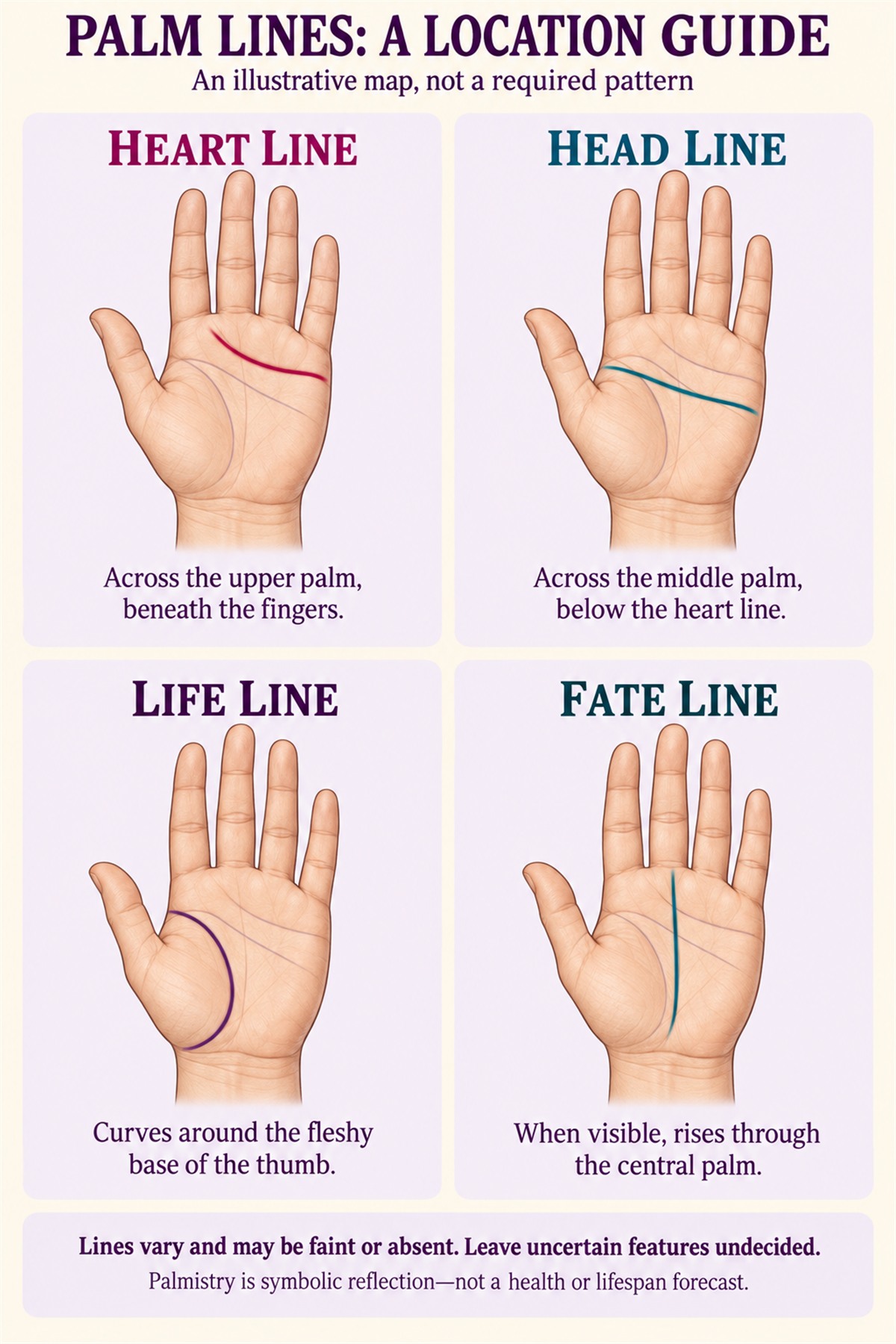
1. Life line: routines, energy and everyday support
The life line is the curve around the fleshy base of the thumb. In a symbolic reading, it is often associated with vitality and the way someone moves through life. A grounded way to explore that theme is to consider your everyday rhythm rather than predict events.
Reflection: What helps me feel supported in an ordinary week? You might think about rest, company, time outdoors or a manageable schedule.
A short life line does not mean a short life. A break is not a diagnosis or a dated prediction of danger. Actual health concerns belong with a qualified healthcare professional, not a palm interpretation.
2. Head line: thinking, learning and decisions
The head line generally runs across the middle of the palm, below the heart line, from the thumb-side area toward the opposite side. Palmistry traditions connect it with thinking and mental approach. Straight and sloping lines may be given practical and imaginative themes, but neither is a better kind of mind.
Reflection: When facing a decision, do I need more facts, more room to imagine or a conversation with someone I trust?
Do not use line length or shape to rank intelligence, judge someone’s ability or label their mental health. Your learning, circumstances and actual behavior matter more than a crease.
3. Heart line: affection, connection and boundaries
The heart line is usually the upper major line beneath the fingers, extending across from the little-finger side toward the index- or middle-finger area. Its traditional themes include affection and emotional connection.
Reflection: How do I express care, and what helps me receive it? A second question might be: where would a clearer boundary make a relationship kinder?
This line cannot tell you whether another person is faithful, whether someone secretly loves you or when you will meet a soulmate. Listen to what people say and do, and let mutual consent guide relationship choices.
4. Fate line: direction, work and changing priorities
The fate line, when visible, is a more vertical line through the central palm, often running upward toward the middle finger. Some hands show it clearly; others do not. Readers may use it to discuss purpose, work or a sense of direction.
Reflection: What am I choosing to build, and what practical step would help me move toward it?
An absent or faint fate line does not mean that you lack purpose. A branching line does not guarantee a career change. You can change direction without waiting for permission from your palm.
Which hand should you read?
Some readers compare the dominant hand with current habits and choices, and the non-dominant hand with potential or background influences. Others use a different convention. Ask a reader how they interpret the two hands before assuming everyone follows the same system.
You do not need a rigid “men use this hand, women use that hand” rule. Nor should you turn differences between your hands into conclusions about inherited personality. A helpful comparison simply notices the features and explores what, if anything, resonates.
Beyond the main lines, our guide to thumb palmistry explores symbolic hand features in more detail. For wrist creases, see palmistry bracelet lines. Those are separate areas of the tradition; you do not have to learn them all in one sitting.
Turn a reading into one useful action
Keep a short four-line note:
- What I noticed: describe a visible feature without assigning a verdict.
- The symbolic theme: name the idea being explored, such as connection or direction.
- What fits my real life: include something specific—or write “nothing comes to mind.”
- One choice I can make: select a small, practical action.
For example, you might notice a curving line, explore the theme of emotional connection and decide to arrange a conversation with a friend. The value is in the thoughtful choice, not in claiming that the line caused or predicted it. If an interpretation does not fit, you can set it aside.
Choose a reader who leaves you free to choose
A considerate reader explains their approach, agrees on the price and time beforehand, and welcomes questions. Our guide to preparing for a psychic reading can help you choose a focus and keep your boundaries clear.
Pause if someone gives you a death date, insists your palm proves illness, promises a guaranteed romantic outcome or says you must pay extra to remove a curse. You can end the conversation without proving the reader wrong. Do not replace medical, legal or financial advice with hand reading.
Enjoy palmistry at a pace that feels comfortable. Your hand can be a starting point for a meaningful question, but it is not a sentence you have to live out. Leave the reading with curiosity, kindness toward yourself and room for what you choose next.
The article provides a balanced view on the potential and the controversies surrounding parapsychology. It will be fascinating to see how future research unfolds.
The division of psi experiences into psi-gamma and psi-kappa categories is intriguing. It helps in understanding the distinct types of phenomena being studied.
The article mentions that many people dismiss these events as unexplainable or false. This skepticism makes it crucial for parapsychologists to present rigorous evidence to support their claims.
The use of Zener cards for ESP testing is an interesting method. It seems like a controlled way to measure something that is inherently difficult to quantify.
The historical context given about oracles and seers offers an interesting perspective on the field of parapsychology. It seems like the modern methods aim to bring more rigor to these ancient practices.
Adding scientific controls and statistics to the experiments could indeed help in legitimizing the field. It will be interesting to see how this approach impacts public perception over time.
The challenge of defining these paranormal events scientifically is evident. It underscores the need for ongoing rigorous research to either prove or disprove these phenomena convincingly.
Documenting changes in brain activity during psychic tests is a promising development. It provides a tangible metric to analyze these phenomena.
I agree; this approach could help in bridging the gap between anecdotal accounts and empirical evidence.
Indeed, such physical measures could add a new layer of validation to the experiments conducted in this field.