

INTENSE CONNECTIONS / SPIRITUAL MEANING & SELF-RESPECT
Sometimes you meet someone and feel a spark of recognition: familiarity, attraction or a sense of coming home. You may describe that feeling in spiritual language, including a karmic connection. The feeling can be powerful without telling you whether the relationship will be caring, compatible or safe.
This article’s “pretentious kind of love” is about the gap between the promise of a connection and how the relationship actually works. It is not a diagnosis of another person’s character, and it cannot determine whether a bond comes from a past life.
If someone pulls you close, pushes you away or repeatedly hurts you, you do not have to settle the spiritual label before taking your experience seriously. Affection and self-protection can exist together.
A karmic label should not become an obligation
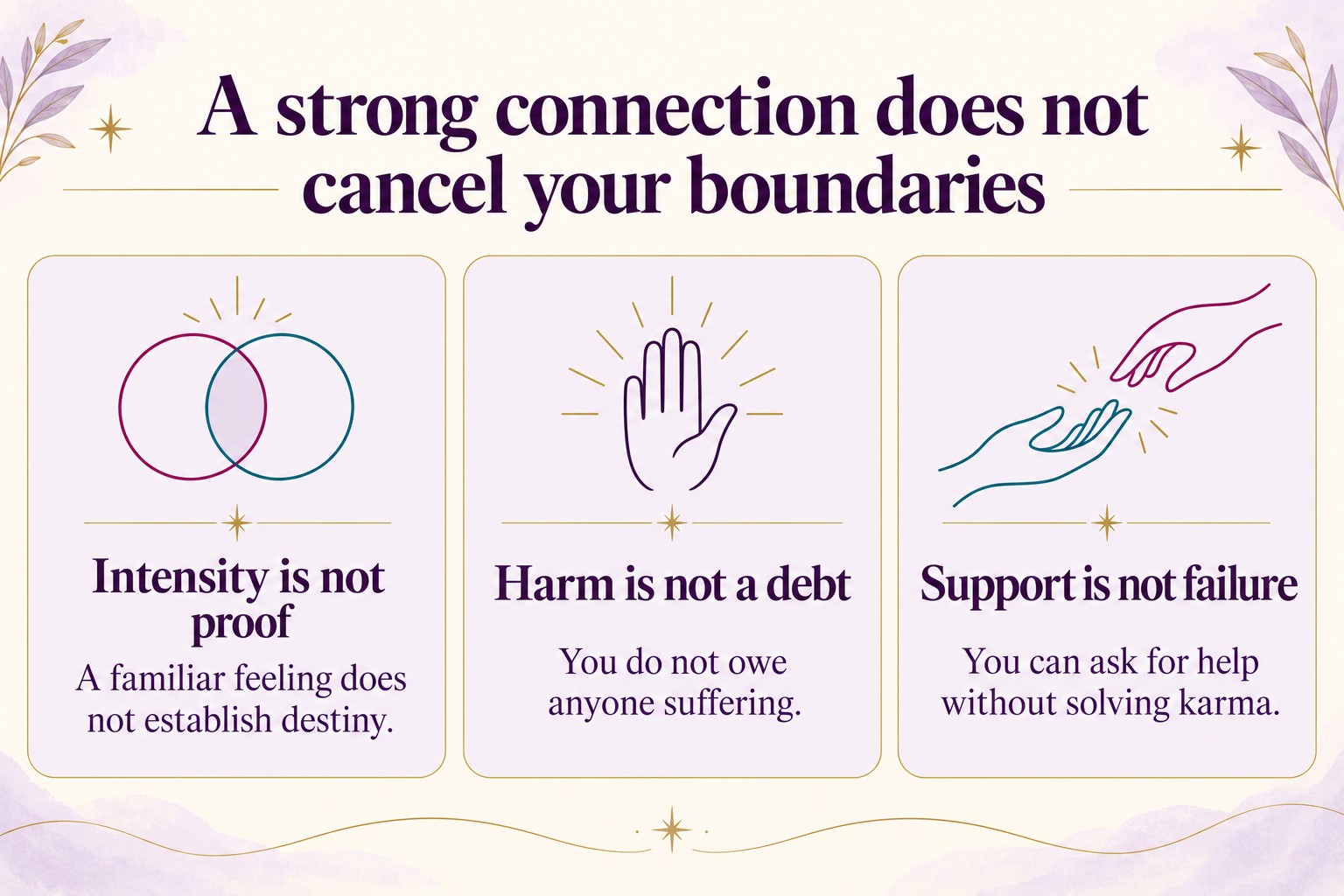
People use “karmic relationship” in different ways, often to describe an intense bond or a pattern they want to understand. You may find the language meaningful, but it cannot establish a shared destiny, an unpaid debt or a lesson you must endure before leaving.
You also do not have to decide whether someone is a karmic partner, soulmate or twin flame to assess their behavior. None of those labels makes consent optional or turns mistreatment into necessary growth.
If spiritual reflection helps you, bring the question back to your present life: “What do I need to feel respected?” or “Which choices remain mine?” Our guide to good karma offers an everyday ethical focus rather than a reason to blame yourself for harm.
You can learn something from an experience without calling the harm necessary, thanking the person who caused it or returning to the relationship. Meaning-making is yours to choose, not a duty someone else can impose.
Notice the difference between attraction and care
An intense beginning may include constant thoughts about someone, excitement, nervousness or strong physical attraction. Those feelings alone do not show that the relationship is unhealthy, and they are not proof that it is destined.
Look at what happens as the connection develops. Can you disagree? Does a “no” remain a “no”? Are plans and expectations clear? Is affection accompanied by ordinary consideration, or does warmth appear mainly when the other person wants something?
“I am not ready for a relationship” may be an honest statement of unavailability. You do not need to translate it into a hidden invitation or accuse the person of lying. Decide whether the relationship they actually offer is one you want.
Similarly, being busy or having a painful history does not excuse humiliation, threats or control. Compassion for someone’s difficulties does not require sacrificing your own safety or waiting indefinitely for the arrangement to change.
Recognize concerning behavior without grading yourself
The original article named jealousy, hurtful words, giving up interests, money problems, dishonesty and repeated breakups. Those concerns are better examined as specific behavior than treated as a checklist proving a karmic bond.
- Your life becomes smaller: You are pressured to stop seeing friends, abandon interests or account for movements in ways you did not freely agree to.
- Resources become a means of control: Someone restricts access to money, pressures you into payments or interferes with work.
- Affection comes with pressure: Kindness is followed by demands, unwanted sexual contact or punishment when you refuse.
- Words and actions repeatedly conflict: Promises or apologies are not followed by the change you were told to expect.
- Fear enters ordinary choices: You worry that disagreement will bring threats, intimidation or retaliation.
The National Domestic Violence Hotline’s warning-sign guidance describes control, isolation, intimidation and other abusive behaviors. You do not need every sign—or physical violence—to seek support.
Weight changes, depression or anxiety are not tests for a karmic relationship. If you notice changes in your health or functioning, seek appropriate health support rather than trying to interpret them only through a spiritual label.
For a broader behavior-focused discussion, see our guide to unhealthy relationship patterns. A checklist can prompt reflection; it cannot assess your entire situation or dictate a safe next step.
Returning does not mean you caused the harm
You may know that a relationship hurts and still miss the person, answer a message or hope the next apology will be different. That conflict deserves compassion, not criticism. Attachment, practical needs and fear can make decisions complicated.
The Hotline explains that abusive behavior involves power and control and that you are not responsible for a partner’s abusive actions. Being harmed is not evidence that you failed to love yourself or attracted the wrong energy.
You can care about someone and decide not to continue the relationship. You can also need help making that decision workable. Neither requires proving that your feelings were fake, that you “should have known” or that the other person has a dark spiritual presence.
Change should be assessed through sustained behavior and accountability, not a dramatic promise or a prediction that the karmic cycle is ending. You do not owe someone continued access while they work on themselves.
Choose an ordinary boundary—or safety support
If the relationship is disappointing but you do not fear retaliation, a clear boundary may help you decide what happens next: “I want a relationship with consistent plans. I am not available for this on-and-off arrangement.” You can step back without convincing the other person that your interpretation is correct.
If there are threats, coercion or fear, a confrontation or sudden announced departure may be unsafe. Seek individualized support rather than treating one script as the right answer for everyone.
The Hotline’s personal safety-plan resource addresses safety while experiencing abuse, preparing to leave and after leaving. Consider contacting a domestic-abuse advocate from a safer device if your communications may be monitored. Notes about the relationship may also create risk if discovered.
In the United States, call 800-799-SAFE (7233) or text START to 88788. In immediate danger, contact your local emergency service. Outside the United States, use a local domestic-abuse support organization. You can ask for support even if you are unsure what to call the situation.
Our guide to stepping away from a harmful relationship offers additional reflection, but spiritual advice is not a replacement for practical safety planning.
Your own path does not require a debt to be repaid
When it is safe, consider three present-tense questions: What is happening? What do I need? Who could help? You can think about them privately without keeping a written record if that would be risky.
For example, “They keep canceling and ask me to wait indefinitely” is an observation. “I need a relationship that is available now” names a need. “I can talk with a trusted friend about stepping back” identifies support. This is an illustrative reflection, not a demand to confront someone who frightens you.
A prayer, meditation or psychic conversation may help you reflect on your own hopes. It cannot establish another person’s private motives, guarantee change or tell you that suffering is spiritually required. Be cautious of anyone charging to remove a curse or clear a debt they claim binds you to a partner.
You deserve care before you feel completely confident, healed or spiritually certain. An intense connection does not cancel your boundaries, and you do not have to walk your next steps alone.
The article brings to light the importance of self-reflection when dealing with challenging relationships.
The concept of karmic relationships can offer a new perspective on personal connections and their complexities.
It’s interesting how the idea of karmic relationships can explain certain toxic patterns we observe in romantic entanglements.
I appreciate the detailed characteristics outlined here. It provides a framework to evaluate relationships objectively.
There is value in understanding the nature of our connections with others, especially when they are detrimental.
The article’s insight into the temporary nature of karmic relationships is quite enlightening.
Understanding the difference between karmic relationships and true connections can be liberating for many.
Self-awareness and personal growth seem to be key themes in navigating these types of relationships.
Indeed, being aware of one’s own patterns is crucial for avoiding toxic entanglements.