

Chakra reflection • Relationships • Shared understanding
Spiritual language can help you notice what feels difficult to put into words. You might describe a relationship as grounded, openhearted or out of balance. If chakra teachings are meaningful to you, their symbolism can offer a gentle starting point for exploring what you need and how you connect.
The useful step is translating that symbolism into something recognizable: a request for reliability, a conversation about affection, or permission to express a different opinion. You do not need to diagnose a partner’s energy to understand your own experience.
Use chakras as themes, not verdicts about your partner
The seven-chakra framework below uses common contemporary spiritual associations. It is a reflection tool, not a test of compatibility, a medical assessment or proof that a relationship is destined. Different teachers describe chakras differently; you can use the themes that fit your beliefs without treating them as universal rules.
Jealousy, tiredness, changing sexual interest or wanting to leave a relationship does not establish that a chakra is blocked. Each experience deserves its own context. Begin with what happened and what you need, rather than deciding that an invisible problem explains everything.
For an introduction to the framework, explore our guide to the seven chakras. Here, the focus is how to turn each theme into a relationship question and an everyday action.
Seven chakra themes for relationship reflection
Choose one theme that speaks to a current situation. You do not have to review all seven at once or get your partner to use the same spiritual vocabulary.
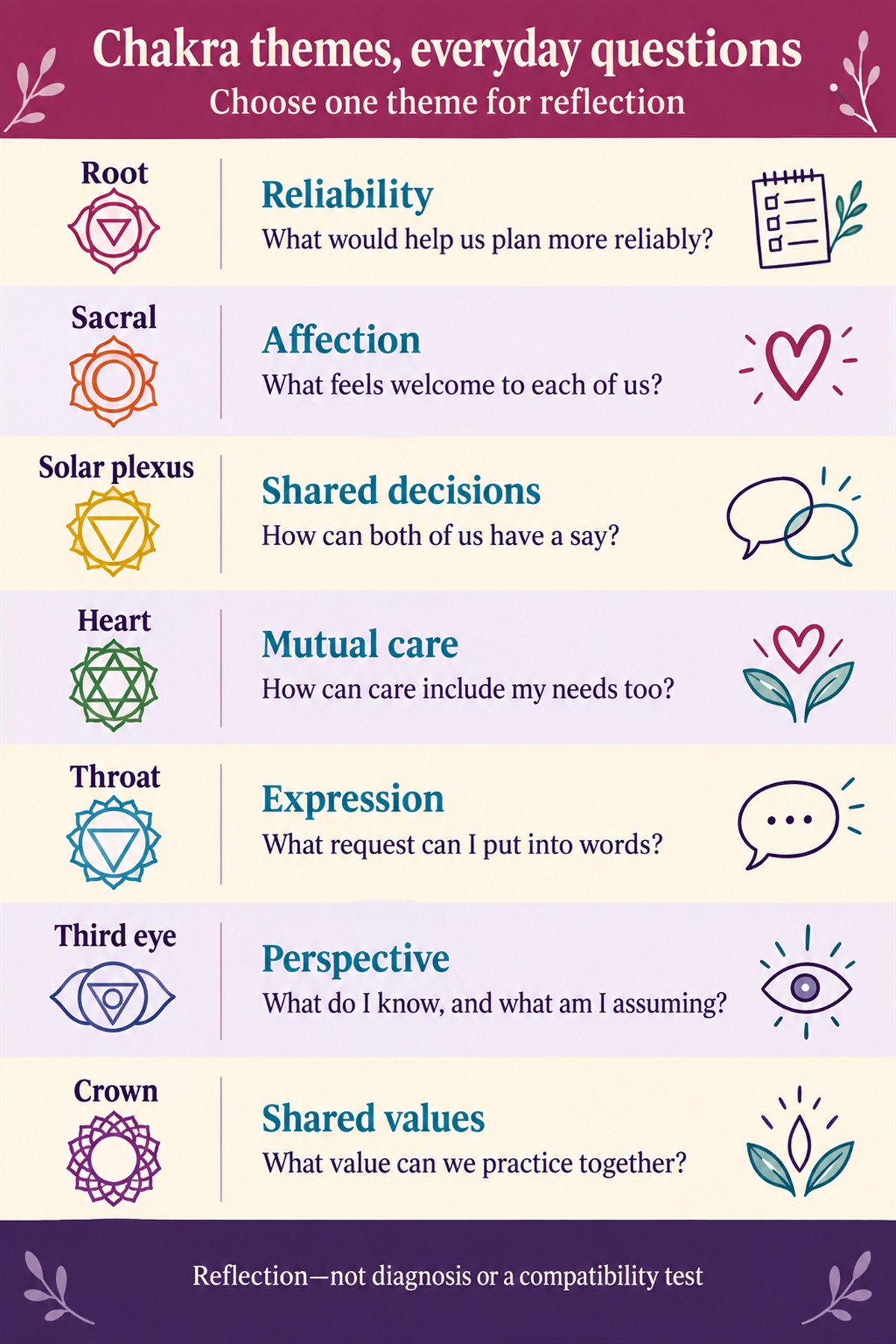
1. Root chakra: reliability and practical support
The root theme can invite you to consider what helps daily life feel steady. In a relationship, that may involve dependable plans, clarity about responsibilities or knowing where to turn for support.
Question: What arrangement would help me feel more supported?
Action: Discuss one recurring practical concern. If last-minute changes are difficult, ask, “Could we let each other know earlier when plans change?” Look at the response and follow-through, not whether you feel a particular energy sensation.
2. Sacral chakra: enjoyment, affection and choice
The sacral theme often includes creativity, pleasure and feeling. It can help you explore what forms of closeness you actually enjoy. Different preferences or levels of desire are not spiritual failures, and nobody owes intimacy to prove that a center is open.
Question: What kind of affection or shared activity feels welcome to each of us?
Action: Offer choices rather than assumptions: a walk, a meal, a hug if wanted, or some quiet time. Ask before touch and respect a changed answer. This theme belongs to people of every gender, not to a prescribed role of women giving and men taking.
3. Solar plexus: agency and shared decisions
The solar-plexus theme can represent personal choice and the confidence to act. Within a relationship, consider whether each person has a genuine voice. Taking initiative is different from automatically controlling the plan.
Question: Where do I need a clearer say, and where can I make more room for theirs?
Action: Identify one decision coming up and discuss how to make it together. You might each name a preference before considering options. Agreement should be freely chosen, not obtained through guilt or a claim of spiritual authority.
4. Heart chakra: care that includes yourself
The heart theme can invite kindness, appreciation and compassion. You can care about another person’s feelings without becoming responsible for meeting every need or absorbing every difficult mood.
Question: How can I offer care without leaving my own needs outside the relationship?
Action: Be specific about support: “I can listen for a while, and then I need to finish my work.” Receiving affection is not wrong, and asking for consideration is not evidence that you lack self-love. Care can travel both ways.
5. Throat chakra: expression and listening
The throat theme is a useful reminder to give a need words. A partner cannot respond to a request you have never made, and guessing what someone should know can leave both people frustrated.
Question: What have I been hoping they would understand without my saying it?
Action: Write one clear sentence, then choose an appropriate time to share it. “I would like us to plan an evening together” communicates more than “You should know what I need.” Also leave room to listen; expression is not only taking a turn to speak.
6. Third-eye chakra: discernment and perspective
The third-eye theme can invite you to notice an impression while checking what supports it. Intuition may help you recognize a concern, but it does not establish another person’s private thoughts or motives.
Question: What do I know, what am I interpreting, and what could I ask?
Action: Separate a fact from a story. “They canceled twice” is an observation; “They no longer care” is an interpretation. Ask for context where contact is welcome, and assess the pattern over time rather than searching for a sign that settles everything.
7. Crown chakra: meaning and room for different beliefs
The crown theme can invite reflection on values, purpose and connection beyond everyday tasks. A partnership may hold spiritual meaning even when the two people describe it differently.
Question: Which values can we practice together, even if our beliefs are not identical?
Action: Name one shared value and an ordinary expression of it. Kindness might mean checking before making a commitment on the other’s behalf. Gratitude might mean noticing a specific effort. Neither person has to adopt a spiritual practice to deserve respect.
Balance is not a fixed masculine–feminine formula
Some spiritual teachings use masculine and feminine as symbolic terms for different qualities. If those terms speak to you, use them as optional metaphors, not instructions about gender, anatomy or who should lead.
Initiative, creativity, receptivity, protection and tenderness can belong to anyone. A partner’s worth does not depend on appearing sufficiently masculine or feminine, and a woman’s emotions are not responsible for making a man respectful.
Instead, discuss what each person enjoys doing, what feels demanding and how responsibilities could be shared. One person may arrange outings while the other prefers planning meals; those preferences can change. The goal is an arrangement both choose, not a spiritual role neither can question.
Turn one theme into a useful agreement
Suppose you choose the throat theme because you miss unhurried time together. Rather than saying “Our throat chakras are blocked,” try a plain request: “I miss talking without other tasks going on. Would you like to have breakfast together on Saturday?”
If the answer is yes, agree on the practical details. If the timing does not work, ask whether another option does. If the other person does not want the same connection, that is information to respect—not a blockage you must remove.
For broader conversations and shared responsibilities, our guide to everyday partnership offers practical examples. If you prefer a quiet personal ritual first, explore spiritual care before a relationship conversation.
Let respect and safety guide the next step
The National Domestic Violence Hotline’s healthy-relationship guidance emphasizes communication, equality, boundaries and consent. Spiritual reflection should support those foundations, not excuse threats, control or pressure.
If you feel afraid of a partner, seek confidential individual support rather than trying a shared exercise or explaining the problem as your energy imbalance. For persistent physical or emotional symptoms, seek appropriate professional care; chakra reflection does not identify their cause or replace treatment.
You can enjoy spiritual symbolism without making it carry every answer. Let a chakra theme help you find a useful question, then give the answer a practical form: a clearer request, a shared plan, a boundary or a decision that respects your wellbeing.
Applying the chakra concept to relationship dynamics is an intriguing way to explore personal and mutual growth.
It’s interesting to consider how chakras might influence emotional and relational dynamics.
Indeed, it provides a unique perspective on relationship challenges.
The emphasis on self-respect and mutual respect in relationships is crucial.
I’ve read about chakras before, but this article gives a more practical application towards relationships.
The connection between chakras and relationship balance is quite thought-provoking.
Knowing which chakra is blocked could potentially help in resolving relational issues.
Yes, it offers a different way to approach and understand conflicts.
The idea that energy imbalances can affect relationships adds depth to the understanding of interpersonal dynamics.
Balancing chakras might be a useful tool for personal growth and improving relationships.
Agreed. Personal growth can significantly impact how we relate to others.
While useful, one should also consider scientific approaches to relationship counseling.