


PENDULUM PRACTICE / A GENTLE BEGINNING
A pendulum can bring a welcome sense of ritual to a quiet moment: you slow down, name a question and notice what comes up. If you are drawn to intuitive or spiritual practices, learning how to “program” one is a simple place to begin. You do not need a perfect technique, an expensive crystal or a dramatic response.
This guide shows you how to establish a personal signal map, keep a useful record and bring the experience back to your everyday choices. The aim is a calm, thoughtful practice—not handing your decisions over to a swinging object.
What does programming a pendulum mean?
In pendulum practice, programming usually means deciding which movements you will interpret as “yes,” “no” and “unclear.” Some practitioners set those conventions deliberately; others ask to see a movement and then record it. Neither approach makes a movement proof that a statement is true.
You might connect the exercise with your intuition, a prayer or an intention. You can respect that personal meaning while remembering that a pendulum also responds to subtle movements of the hand holding it. Research on the Chevreul pendulum effect examines how small finger movements can make a suspended pendulum swing, sometimes without the person noticing the movement. Knowing this helps you stay curious without treating every response as certainty.
What you need before your first session
- A pendulum or securely attached pendant on a chain or cord.
- A stable table, a comfortable chair and a few uninterrupted minutes.
- Paper and a pen for recording your signals and question.
- A willingness to accept “unclear” or to finish without an answer.
A quiet home office or kitchen table is perfectly suitable. If a candle, a brief prayer or a favourite cloth helps you settle, use it as an optional personal ritual—not a requirement. For another gentle starting point, explore using your senses to be mindful.
How to program a pendulum: six practical steps
1. Get comfortable
Sit where your feet and shoulders feel relaxed. Support your forearm or elbow on the table so you are not working hard to keep your arm in the air. Take a few easy breaths. If you are upset, rushed or strongly hoping for a particular answer, begin with a grounding pause rather than a question.
2. Let it settle
Hold the chain gently between your fingers, leaving enough length for the weight to hang freely. Keep the tip clear of the tabletop. Wait for the initial movement to settle. A comfortable grip matters more than holding the chain in an elaborate “correct” position.
3. Explore your signals
Choose a convention or invite a demonstration of “yes,” then “no,” then “unclear.” Possible movements include side to side, front to back and circular motion. No particular direction is universally required. Observe without deliberately pushing the weight; do not strain to keep your fingers absolutely motionless either.
If you cannot distinguish the signals, pause. You do not need to make the session work. Ambiguity is a useful observation, not a failure.
4. Record the pattern
Draw arrows or circles beside the words yes, no and unclear. Write down which hand you used and approximately where you held the chain. Check a simple, known statement if you wish, such as your own name—but do not mistake an expected response for evidence of predictive accuracy.
A signal map helps you describe the session consistently. It does not prove that you can uncover hidden information.
5. Ask one clear question
For the first session, stay with a low-stakes choice focused on your own reflection. For example, “Would I like to spend a few minutes journaling before I continue my day?” is gentler than asking for a prediction about a relationship, diagnosis or major financial commitment.
Ask one thing at a time. Avoid questions with two decisions joined together, and do not keep rephrasing a question until the movement matches your hope. If a richer question cannot fit into yes or no, write it in your journal instead.
6. Close and reflect
Set the pendulum down, write what you observed and choose a practical next step. That could be taking a walk, reading a guide or talking with someone. Close the session when you planned to, even if the result feels unfinished. You remain the person deciding what to do.
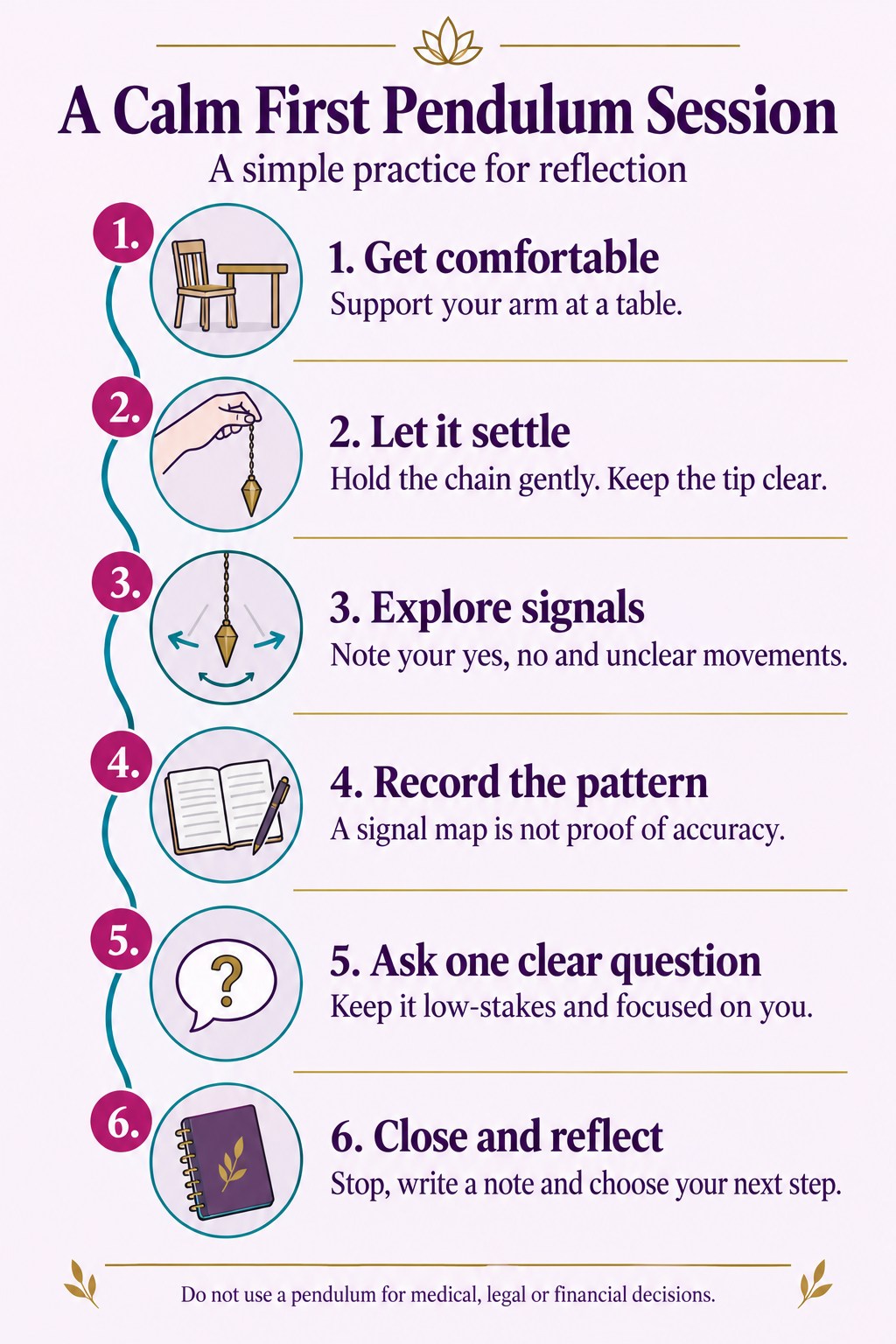
A signal map and journal example
Here is an illustrative example, not a universal set of directions or a report of a tested session:
| Journal field | Example entry |
|---|---|
| Signal convention | Yes: front to back. No: side to side. Unclear: still or mixed movement. |
| Question | Would I like to make room for ten minutes of quiet journaling? |
| Observation | I noticed a small front-to-back swing. |
| Personal reflection | The question reminded me that I have been wanting a quieter morning. |
| Practical next step | I will set aside ten minutes and notice whether that routine helps me. |
Keep observation and interpretation separate. “It moved in a circle” describes an event; “this means I should change my life” adds a meaning that deserves further thought. For a wider look at listening inward, read what your intuition may be trying to tell you.
When a session feels confusing
The movement is faint or changes direction
Check that the pendulum is not touching anything, loosen a tense grip and notice whether you are leaning awkwardly. If the pattern stays mixed, write “unclear.” There is no need to invent a message.
You feel pulled to ask again and again
Put the pendulum away for now. Repeated reassurance-seeking can make a reflective ritual feel stressful. Write the underlying concern as an open question: “What information would help me feel ready?” or “What conversation am I avoiding?”
You worry that the pendulum needs cleansing
Some practitioners enjoy symbolic cleansing as a fresh-start ritual. It is optional. Choose a method safe for the material; a dry cloth and a quiet intention avoid the damage that water or salt can cause to some metals and stones. You do not need to assume a confusing swing means an object has harmful energy.
Keep the practice supportive
A helpful ritual leaves you with more room to think, not less. Avoid using a pendulum to determine another person’s feelings, identify a supposed curse, diagnose illness or make decisions about medication, money, legal matters or safety. Those questions require trustworthy information, direct communication or qualified support.
If you enjoy working with symbolic tools, our introduction to tools of divination can help you explore other traditions. Thinking about booking a session with a reader? Start with what to know before a psychic reading so you can bring clear questions and comfortable boundaries.
15 frequently asked questions about pendulum programming
1. What does programming a pendulum mean?
It means choosing and recording a personal signal system, such as movements you will interpret as yes, no or unclear. It is a practice convention, not computer programming or a guarantee of accurate answers.
2. Do I need an expensive pendulum?
No. A comfortable, securely attached weight on a chain or cord is enough for exploring the practice. Choose something easy to hold rather than buying an object because someone promises special powers.
3. Can I use a necklace?
A securely attached pendant can work for a simple practice session. Check that the clasp and cord are sound and use an object that will not break if it drops.
4. Which hand should I use?
Try the hand that feels comfortable and relaxed. There is no need to force your non-dominant hand or to interpret your hand choice as a measure of spiritual ability.
5. How long should the chain be?
Start with a length that lets the weight hang freely above the paper while your hand remains comfortable. Adjust it gradually, then keep the same grip during that session.
6. What if my yes and no movements are the same?
Pause and let the pendulum settle. Try your signal-setting practice once more. If the distinction remains unclear, record it as unclear and return another day rather than forcing an answer.
7. Must yes always mean clockwise?
No. Practitioners use different conventions. What matters for your exercise is that you write down your chosen signals instead of changing their meaning to fit a hoped-for answer.
8. What should I do when the pendulum does not move?
Check that the weight hangs freely and your arm is comfortable. You can finish the session without an answer. Stillness is not evidence that you lack intuition or have done something spiritually wrong.
9. Can my signals change between sessions?
They can. Your grip, posture, expectations and small hand movements may vary. Recheck and record the pattern at the beginning instead of assuming it must stay fixed forever.
10. Should I cleanse my pendulum?
A symbolic cleansing ritual is optional if it suits your beliefs. A quiet intention or dry wipe may be enough. Check the material before using water, salt or smoke, which can damage some objects.
11. Can I ask about another person’s feelings?
A pendulum cannot establish someone else’s private thoughts or consent. Redirect the question toward your own needs and choices, then use respectful conversation to learn what the other person actually feels.
12. Can I use a pendulum to find a lost object?
Some people enjoy this as a low-stakes ritual, but it does not verify a location. Keep using practical search steps and do not interpret an unsuccessful search as a spiritual failure.
13. How often should I repeat the same question?
Avoid repeating it until you get the response you want. Write down the first session, pause and decide whether you need reflection, real-world information or a conversation instead.
14. Is a pendulum suitable for health or money decisions?
No. Do not use it to choose treatment, stop medication, assess safety, make investments or settle legal questions. Those decisions need reliable information and appropriate professional help.
15. What should I record in my journal?
Record the date, question, grip and signal map, the movement you noticed, your mood and one practical next step. Separate the observation from the meaning you give it.
You can approach your next session with a little more ease: settle, observe, record and reflect. Your spiritual interpretation can be meaningful without needing every movement to deliver an answer.
The suggestion to cleanse the pendulum’s energy after use is interesting. It indicates a belief in the transference of negative energy, which might be a topic for further study.
The importance of grounding oneself and having a clear heart and mind during the process is emphasized. This could be an interesting aspect to explore further.
Indeed, the psychological state of the user could affect the outcome. It might be worth investigating the consistency of results across different emotional states.
Holding the pendulum with the dominant hand and ensuring free movement are practical tips. It’s good to see such detailed instructions for beginners.
Practical instructions like these ensure that users have a clear guide to follow, potentially increasing the efficacy of their readings.
The focus on achieving a calm and collected state before using the pendulum is notable. It suggests that the mental state of the practitioner can significantly impact the accuracy of the readings.
The methodology of programming the pendulum as described seems to prioritize establishing a consistent framework for obtaining answers. It’s intriguing how the direction of swing can be standardized to yes or no responses.
I’m curious about the mechanism behind the pendulum’s movement. The article doesn’t go into the details of how individual energy influences the swing direction.
The recommendation to test the pendulum with known questions is a sound approach. It helps in establishing trust in the process before moving on to more complex queries.
The method for calibrating the pendulum to determine yes and no answers seems thorough. Repeating the process multiple times to ensure accuracy is a logical step.
Yes, consistency is key in any experimental setup. This repetition helps establish a reliable baseline for future readings.