
DIVINATION / FINDING YOUR WAY IN
A deck of cards, a pendulum or a well-used journal can make a spiritual practice feel wonderfully tangible. You have something to hold, a question to consider and a little space away from the day’s noise. If you are curious about divination tools, the best starting point is not owning every beautiful object—it is finding one approach that helps you listen and reflect.
Below, you will find the differences between common tools, a simple first-session exercise and ways to turn a meaningful reading into a useful next step.
What is a divination tool?
Divination is the interpretation of signs, symbols or patterns within a spiritual tradition. A tool provides a focus for that interpretation. For some practitioners, it supports a connection with their intuition or spiritual guidance; for others, it creates a language for exploring a question they have struggled to put into words.
A tool does not need to decide your future for you. You can welcome the meaning you find in a session while keeping important choices grounded in information, conversation and your own judgement.
Six approaches to explore
1. Tarot cards: stories and structured symbolism
Tarot offers rich imagery and a familiar framework for connecting one card with another. Many decks contain 78 cards, including 22 Major Arcana and 56 Minor Arcana cards. The V&A’s history of tarot describes the cards’ development from a game into later divinatory traditions.
For a first practice, pull one card and describe what you can actually see before looking up its meaning. Which figure, colour or gesture catches your attention? Then ask how that image relates to your question. You do not have to memorise a whole deck before beginning.
2. Oracle cards: a flexible theme-led practice
Oracle decks do not share a single fixed structure. One may focus on nature, another on affirmations or spiritual archetypes. Read the deck’s guidebook so you understand how its creator intends the cards to be used.
An oracle card can work well as a daily focus: read its message, notice which part resonates and write one action that expresses that theme. A card about patience might invite you to leave a conversation overnight rather than insisting on an immediate answer.
3. Pendulums: a simple signal-based ritual
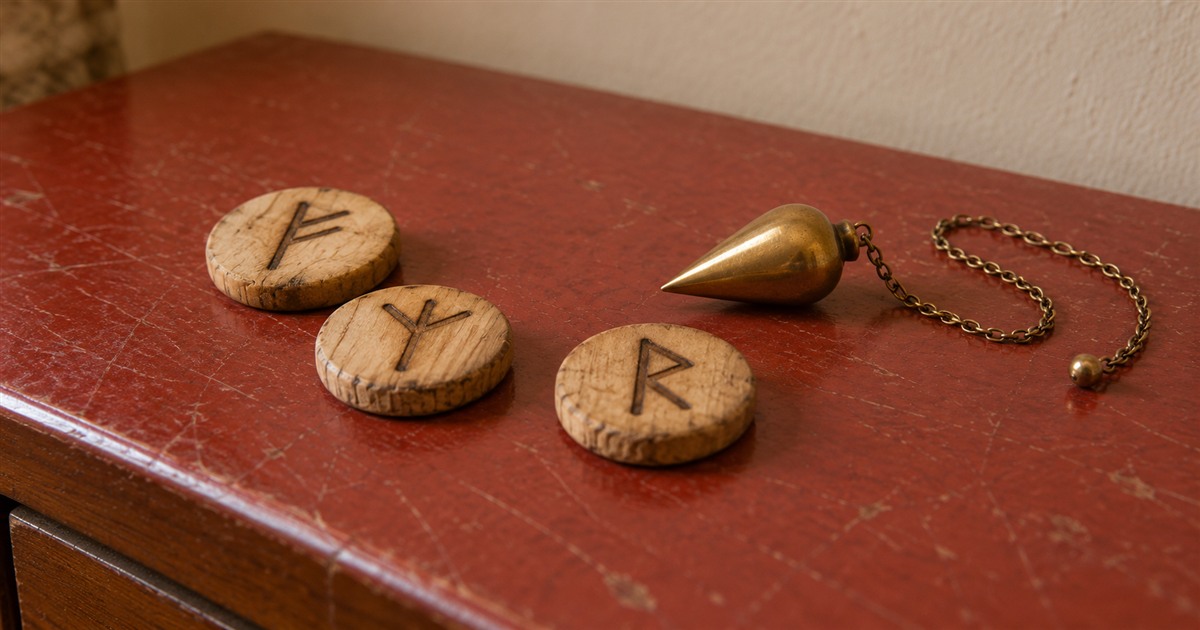
A pendulum is a suspended weight that swings as you hold its chain or cord. Practitioners may assign movements to yes, no and unclear. That limited format can make the practice approachable, but it can also encourage questions that are too narrow for a complicated situation.
Start with our six-step pendulum programming guide. Record your chosen signals, keep questions low-stakes and remember that small hand movements affect the swing. A movement is not a medical test or proof of someone else’s intentions.
4. Runes: working with a small set of symbols
Rune readings use marked pieces interpreted according to a chosen symbolic tradition. Sets and guidebooks differ, so establish which system you are learning rather than combining several lists of meanings without context.
One-symbol practice is enough at first: study the form, read the guidebook entry and write a personal association. Avoid carving or taking stones from places where collection is prohibited; a purchased or handmade set can serve the same reflective purpose.
5. Automatic writing: making room for words
Some spiritually minded people use automatic writing as a way of welcoming intuitive impressions or messages they associate with guidance. The practical exercise involves writing freely, then reading back with care.
You do not need a deep trance or a feeling that something has taken over. Our beginner automatic writing practice uses a brief timer, a gentle prompt and a clear closing step. You are allowed to pause, disagree with a sentence or leave it uninterpreted.
6. Tea-leaf reading: noticing shapes and associations
Tea-leaf reading interprets shapes left by leaves in a cup. If it appeals to you, use a suitable cup and safe tea preparation, then look for a few clear shapes rather than assigning a meaning to every tiny mark.
Write what you see first: “a curved line” or “a shape like a bird.” Next record your association. Someone might connect a bird with freedom; another person may remember a family garden. Your own context matters, and a shape does not prove that an event will happen.
Which tool fits the way you think?
| If you enjoy… | You might start with… | First practice |
|---|---|---|
| Pictures and stories | Tarot or oracle cards | Describe one image and connect it with a question. |
| Writing and language | Automatic writing | Write freely for a few minutes, then choose one useful sentence. |
| A small symbolic vocabulary | Runes | Explore one symbol with its guidebook. |
| A quiet physical ritual | Pendulum | Record a personal signal map without treating it as proof. |
| Imagination and shapes | Tea-leaf reading | Separate the shape you see from the meaning you give it. |
You can also begin without buying anything. Reflection, dream journaling and a quiet pause are available with paper and a pen. Astrology is a separate symbolic system that can be explored through charts; meditation is a practice of attention rather than a divination tool in itself.
A ten-minute first session
- Choose one question. Try “What deserves my attention this week?” rather than asking a tool to solve your whole future.
- Settle into the space. Sit comfortably, put distractions aside and decide when you will stop.
- Use one tool once. Pull one card, choose one symbol or begin a short writing exercise.
- Record observation and meaning separately. What did you see, and what did it bring to mind?
- Choose one ordinary action. Send a message, make time to rest, collect information or have a conversation.
- Close the session. Put the tool away. Let the reflection accompany you without repeatedly checking it.
Turn a reading into a useful reflection
Imagine you ask about making room for creativity and pull a card showing a person working at a table. One interpretation might be that regular practice matters more than waiting for inspiration. Your next step could be reserving half an hour for a project. That is an illustrative exercise—not a guaranteed message or a report of a tested reading.
What makes it useful is the connection between the symbol, your situation and an action you can actually take. For another perspective on listening inward, explore what your intuition may be trying to tell you.
Keep your practice welcoming and grounded
Enjoy the ritual without turning it into a test of spiritual worth. An unclear session does not mean you lack a gift, and you do not need to pay for extra services because someone claims your tools carry harmful energy. Respect another person’s privacy and ask permission before reading for them.
For health, safety, legal or financial questions, use reliable information and appropriate professional support. If you would like a reading with a practitioner, our guide to preparing for a psychic reading can help you bring thoughtful questions and comfortable boundaries.
15 frequently asked questions about divination tools
1. What are divination tools?
They are objects or symbolic systems used in spiritual readings, such as tarot cards, oracle decks, pendulums and runes. People use them to explore questions, personal meaning and intuitive impressions.
2. Which tool is best for a beginner?
Choose one you enjoy looking at or handling. A deck with a clear guidebook suits visual learners; a journal suits people who think through words. Start with one practice rather than buying several tools.
3. Are tarot and oracle cards the same?
No. Many tarot decks follow a 78-card structure. Oracle decks vary in card count, themes and reading instructions. Check the specific deck’s guidebook.
4. Do I need to have psychic abilities already?
You can begin by observing symbols, writing associations and reflecting on a question. You do not need to prove a gift or have an extraordinary experience to enjoy the practice.
5. Can I buy my own deck?
Yes. You can choose a deck yourself. The idea that every deck must be a gift is a personal tradition, not a requirement you need to follow.
6. Do I need to cleanse every tool?
No. A symbolic fresh-start ritual is optional. Handle your tools with care and avoid water, salt or smoke if they could damage the materials or bother someone nearby.
7. How many cards should I pull first?
One card is plenty for exploring imagery. If you want more structure, use three positions with clearly defined prompts rather than pulling additional cards until you like the message.
8. Can a pendulum answer any question?
A pendulum uses a limited signal system and responds to movement of the hand holding it. Keep it for low-stakes reflection rather than verification of hidden facts or important decisions.
9. Are meditation and divination identical?
No. Meditation is a practice of attention; divination involves interpreting signs or symbols. A brief quiet pause can support a reading, but it does not need to produce a prediction.
10. Can I read for a friend?
Ask for permission first, explain the format and respect their choice to decline. Avoid telling them you know another person’s private feelings or can make their decisions for them.
11. What makes a useful reading question?
A clear question about your choices is useful: What could I pay attention to? What support can I seek? Questions that invite reflection often offer more room than demands for a fixed date or guarantee.
12. What if two tools give different messages?
Write down both interpretations without forcing agreement. Consider how the imagery, question wording and your mood shaped each session. You do not need to settle the disagreement by repeating readings.
13. Should I record every session?
A short record can help you notice patterns. Include the exact question, card or signal, your first interpretation and a practical next step. Leave room to revise your interpretation later.
14. Can a reading diagnose a health problem?
No. Cards, pendulums and other divination tools cannot diagnose illness or determine treatment. Bring health concerns to a qualified clinician.
15. How do I know when to stop?
Stop at your planned time or sooner if you feel pressured, unsettled or drawn to repeat the same question compulsively. A useful practice should leave room for ordinary life, information and choice.
The right starting point is the one that invites curiosity without pressure. Choose something you enjoy, keep the first session simple and give yourself time to develop a personal relationship with the practice.