

Aura and chakra readings • A thoughtful first session
An aura or chakra reading may appeal to you when you want a different language for exploring how you feel. Colours, images and energy-centre symbolism can invite conversations about confidence, connection, creativity and the parts of life asking for more attention.
You do not need to see colours around people or understand every chakra term before booking. A helpful first session begins with knowing what the reader offers, what their interpretation means and where your own judgment remains part of the process.
Aura readings and chakra readings: what is the difference?
In aura-reading traditions, an aura is understood as a subtle field around a person. A reader may describe colours, layers or impressions and connect them with personal themes. These are spiritual interpretations, not a measured personality profile or medical assessment.
A chakra reading focuses on symbolic energy centres. The seven-centre model commonly used in contemporary readings associates different areas with grounding, creativity, confidence, love, expression, intuition and spiritual connection. A practitioner may use these themes to guide discussion or meditation.
| Session | Typical focus | Ask before booking |
|---|---|---|
| Aura reading | Colours, imagery and impressions interpreted around you. | How do you obtain and explain your impressions? |
| Chakra reading | Energy-centre themes such as confidence or communication. | Which system do you use, and what does “balance” mean in your session? |
| Aura photograph | A device-generated colour image with an accompanying interpretation. | What does this equipment actually measure, and how are the colours produced? |
Some practitioners combine these formats. Others add cards, journaling or an optional energy-work session. Those additions should be explained and priced in advance rather than appearing as necessary purchases halfway through.
What happens in a first reading?
The reader may begin by asking what you would like to explore. They might then describe impressions, discuss chakra themes or invite a short meditation. You can listen, take notes and say when something does not fit. You are not required to accept a description because it sounds spiritual.
Useful interpretations leave you with something to consider. “The throat theme suggests reflecting on where you hold back” is different from “Your throat chakra proves someone is lying to you.” The first invites reflection; the second makes an unsupported claim about another person.
Touch is not a requirement for every format. If a session includes touch, hands held near your body, scents, music or physical movement, ask about those details beforehand. Consent should remain yours throughout, and you can choose a seated, no-touch session where available.
The seven chakra themes as reflection prompts
The overview below keeps the familiar seven themes from this guide and adds a practical question for each. The locations are symbolic associations used in this model, not anatomical structures or a way to diagnose symptoms. Different teachers and traditions may describe the system differently.
1. Root chakra: grounding and security
Symbolic location: Base of the spine.
Reflection: What helps me feel supported in everyday life?
A reader may discuss routines, belonging or your sense of stability. A useful response might be to organise a difficult week, ask for support or spend time in a familiar place—not to assume that uncertainty means an energy centre is damaged.
2. Sacral chakra: creativity and feeling
Symbolic location: Lower abdomen.
Reflection: Where could I make room for enjoyment or creative expression?
You might explore painting, music, movement or the feelings you tend to set aside. Our article on sacral-chakra practices explores this theme further; treat the symbolism as an invitation rather than a physical diagnosis.
3. Solar plexus chakra: confidence and choice
Symbolic location: Upper abdomen.
Reflection: What small decision can I make with more confidence?
This theme can open a conversation about boundaries and personal agency. A manageable action—such as stating a preference—may be more useful than promising that a reading will unlock unlimited manifestation power.
4. Heart chakra: care and connection
Symbolic location: Centre of the chest.
Reflection: How can I offer care while respecting my own limits?
Love and forgiveness can be meaningful topics, but you do not owe reconciliation to someone who has harmed you. A spiritual reading should make room for healthy boundaries rather than telling you that all distance is a blockage.
5. Throat chakra: communication and expression
Symbolic location: Throat.
Reflection: What would I like to say more clearly?
You could draft a conversation, write a letter you do not send or practise a simple request. Physical throat symptoms deserve appropriate healthcare; a chakra interpretation cannot establish their cause.
6. Third-eye chakra: intuition and perspective
Symbolic location: Forehead between the eyes.
Reflection: What am I sensing, and what information do I still need?
Intuition can be explored alongside evidence and conversation. Our guide to listening to intuition offers another starting point. An uneasy feeling alone does not establish another person’s intentions.
7. Crown chakra: meaning and spiritual connection
Symbolic location: Top of the head.
Reflection: What gives my life a sense of meaning?
You might reflect on prayer, contemplation, community or your own spiritual tradition. There is no need to force an awakening experience or compare your progress with someone else’s.
How to understand aura colours without fixed labels
A reader may associate blue with expression, green with care or purple with spiritual reflection. Ask how they use those associations. They are not a universal colour code, and a different reader may interpret the same colour differently.
Try translating a label into a question. If someone describes your aura as “blue,” ask what that suggests for your current situation. “Could I communicate a need more clearly?” is a useful reflection. “Blue means I will meet my soulmate next month” is a prediction, not information the colour establishes.
No colour makes you a better or worse person. You do not need an ideal shade, a perfectly balanced chart or a paid cleansing to be worthy of care.
Are aura photographs proof of an energy field?
A colourful photograph can be an interesting keepsake, but the image itself does not establish a spiritual field, chakra condition or health diagnosis. Before purchasing, ask the operator to explain the equipment, its inputs and how those inputs become colours. Do not assume every device works in the same way.
Similarly, naming Kirlian photography is not enough to prove that a picture measures an aura. The relevant question is what the apparatus records and whether the interpretation is justified. You can enjoy the symbolism of an image without treating it as a clinical test.
What does “blocked energy” mean in a reading?
In a reflective session, “blocked” may be the reader’s way of describing a theme that feels difficult: expressing a need, making a choice or finding creative time. Ask for a plain-language explanation rather than accepting a frightening label.
It should not be used to diagnose illness or explain every emotional struggle. Reiki is sometimes offered alongside chakra work, but it is a separate practice. The National Center for Complementary and Integrative Health’s Reiki overview notes that health-related effectiveness has not been clearly established and that the proposed energy field lacks scientific support. A spiritual session should not replace appropriate medical or mental-health care.
Five questions to ask a reader
- What will the session include? Clarify the reading format, any device, touch or optional practice.
- How much will it cost in total? Ask about duration, add-ons and cancellation terms.
- How do you explain colours or chakra impressions? Look for understandable language and room for uncertainty.
- May I decline an interpretation or stop? Your comfort and consent should not depend on agreement.
- What notes or images will you keep? Ask how recordings, photographs and personal information are handled.
For broader preparation, read what to know before a psychic reading. If you browse psychic reader profiles, check each provider’s current services and terms rather than assuming every reader offers aura or chakra sessions.
A gentle practice after your reading
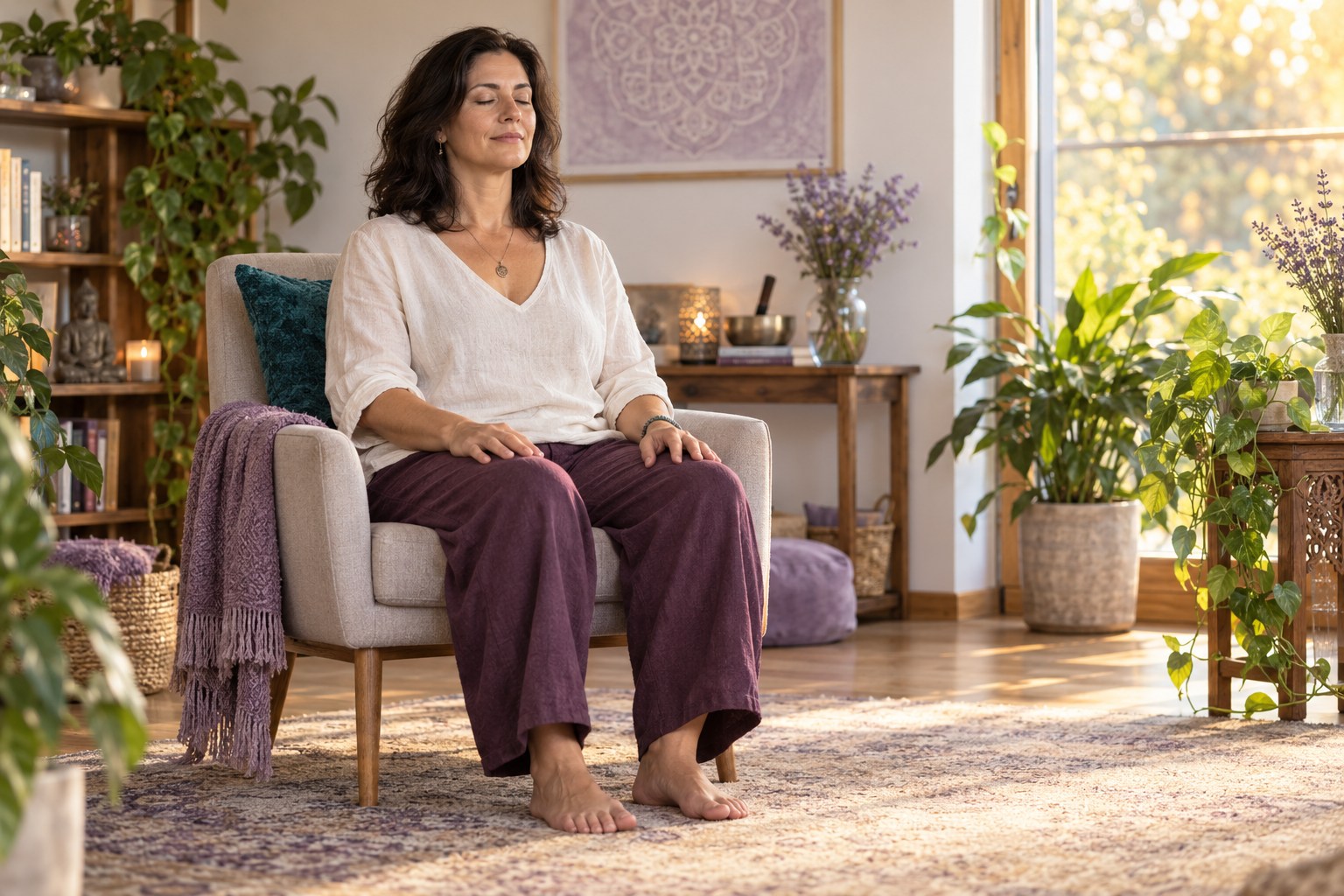
Choose one theme that felt useful. Sit comfortably, notice the support beneath you and take a few ordinary breaths. You can keep your eyes open. Then write one sentence about what you want to explore and one small action you can take.
For example: “The communication theme resonated. Tomorrow I will ask for the time I need to finish a project.” This turns a broad interpretation into something practical. You do not need to visualise lights, feel unusual sensations or purchase special objects.
If you prefer a non-symbolic starting point, try noticing your senses mindfully. Stop any exercise that feels uncomfortable, and choose a different approach.
Leave with perspective, not a verdict about yourself
An aura or chakra reading can be a meaningful spiritual conversation when it respects your choices. Keep the themes that invite useful reflection, leave the ones that do not fit and take practical concerns to the people qualified to help with them.
You are more than a colour, a chart or a reader’s impression. The best next step is one you understand and freely choose.
The historical context provided about chakras and their origins in ancient texts is quite informative. It’s interesting how spirituality has evolved over the years, but I wish there was more scientific research to support these ideas.
‘Can you see my aura?’ sounds like a pickup line straight out of a sci-fi novel! If only all dating could be this colorful and energetic! 😂 Who knew spirituality could be so entertaining?
I find it hard to believe that something as vague as color interpretation can truly influence our emotional states. Why should we rely on psychics when psychology offers proven methods for understanding ourselves? Let’s focus on real science instead.
@AuraAdmirer While I respect differing beliefs, we must prioritize evidence-based practices over subjective experiences. Personal connections are valid, but they don’t replace scientific understanding.
@DebateDude But isn’t it possible that energy fields could have an impact that science hasn’t yet explained? The human experience is vast, and not everything can be measured in a lab!
This article is a fantastic introduction to understanding auras and chakras! I’ve always been curious about energy fields, and learning how they affect our well-being is fascinating. Can’t wait to explore this further! 🌈
“Energy fields? Auras? Sounds like something out of a superhero comic! Maybe if I visualize my chakra while eating pizza, it’ll taste better. Who’s with me on this chakra pizza party? 🍕✨”
“Seven layers of the aura? Sounds like an onion, but instead of tears, we get insight into our souls! Just remember not to peel too deep or you might cry from all the hidden traumas! 🧅😆”
“The idea that our past lives might influence our current energies is intriguing! It’s like carrying emotional baggage without even knowing it. Time to book an aura reading for some cosmic decluttering!”
While the concept of auras sounds intriguing, I can’t help but question the lack of scientific backing for these claims. Can we really trust interpretations based on colors? It feels more like pseudoscience than reality.