

CHAKRAS & EVERYDAY SPIRITUAL PRACTICE
Opening up the sacral chakra can be a lovely way to reconnect with feeling, creativity and the small pleasures that make life feel like your own. You do not have to become endlessly cheerful, fearless or outgoing. A meaningful practice leaves room for your real emotions, including the ones that are difficult to name.
If you are drawn to chakra work, approach this center with curiosity rather than a checklist of things that are wrong with you. A quiet afternoon of painting, a gentle movement break or an honest conversation may be a more helpful beginning than trying to force a dramatic spiritual breakthrough.
What does the sacral chakra represent?
In a commonly used seven-chakra model, the sacral chakra is the second center, associated with the lower abdomen or pelvic area. You may see its name written as Svadhisthana or Svadhishthana. Many contemporary chakra practices connect it with orange, water, creativity, emotion, pleasure and intimacy. Teachings differ between traditions, so these associations are a spiritual framework rather than a universal rule.
Think of water as a useful image: it can move, pause and change direction without having to be the same every day. In that spirit, “opening” this chakra can mean making space to notice what you feel, express something honestly and enjoy something without abandoning your boundaries.
This does not mean that cheerful people have a balanced chakra or that sensitive people have a blocked one. Someone can appear upbeat while struggling privately. Equally, grief, tiredness or a need for solitude does not make you spiritually deficient.
Explore your relationship with feeling and pleasure
Instead of diagnosing a blockage, notice which part of your everyday life wants a little more attention. These questions can help you choose a practice that fits:
- Emotion: Can I name what I feel, or do I rush to explain it away?
- Creativity: Is there something I would enjoy making even if nobody saw it?
- Pleasure: What feels nourishing rather than pressured or performative?
- Connection: Where do I want more closeness, and where do I need more space?
- Choice: Am I saying yes because I want to, or because I am afraid to disappoint someone?
Your answers are starting points, not a spiritual score. Low mood, anxiety, pain, sexual concerns or relationship stress can have many causes. Kidney problems, pelvic symptoms, addiction and depression should not be attributed to a chakra. Seek appropriate professional care for symptoms or distress; spiritual practice can accompany that care, not replace it.
Four gentle ways to work with the sacral chakra
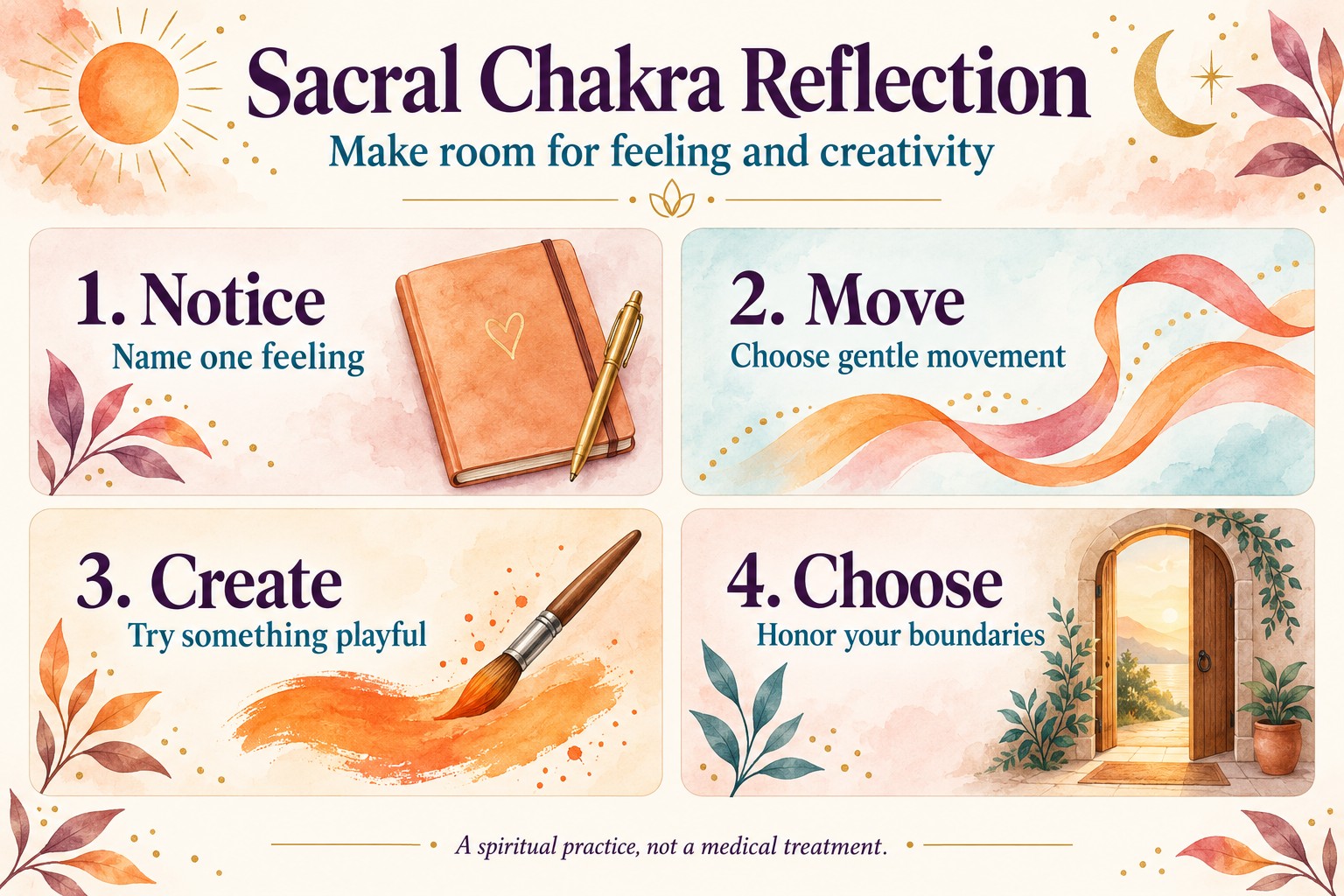
1. Notice a feeling without judging it
Take a comfortable seat, with your eyes open or closed as you prefer. Let your breath stay natural. Ask, “What is here today?” You might notice excitement, disappointment, tenderness, restlessness or simply uncertainty. You do not have to find a hidden explanation.
Try writing one sentence: “I feel disappointed because I wanted more time together.” Then add a caring response: “I can acknowledge that wish without blaming myself for having it.” Naming a feeling is different from acting on every impulse it brings.
If orange imagery appeals to you, imagine a soft orange light as a symbol of welcome. Nothing needs to glow, tingle or happen physically. Stop if the exercise feels uncomfortable, and return to noticing ordinary things in the room.
2. Move in a way that feels kind
Dancing and enjoying music can make this practice feel lighter. Choose a familiar song and move only as much as is comfortable. This might mean swaying while standing, moving your hands while seated or simply tapping a rhythm. The goal is enjoyment, not flexibility or an impressive pose.
If you choose yoga, start with a beginner or gentle class and ask for adaptations that suit you. Triangle Pose and Crow Pose are not requirements for chakra work; Crow is an arm balance and need not be part of a beginner practice. There is no need to force a hip opening or push through pain to release an emotion.
The National Center for Complementary and Integrative Health’s yoga guidance recommends a qualified instructor to reduce injury risk. Ask your healthcare professional about suitable movement if you have an injury, a health condition or are pregnant. You can also skip movement entirely and choose music or journaling.
3. Give your playful side something to make
“Letting your inner child out” can simply mean allowing curiosity without demanding a polished result. Draw an imaginary flower, arrange colors on a page, hum a tune, cook something familiar or write a few lines of a story. Choose one small activity rather than collecting supplies for a whole new hobby.
Set a short, manageable window and let the result be imperfect. Ask, “What would I try if I did not have to be good at it?” If inner-child language does not resonate with you, call this a creative break. You do not have to revisit childhood memories or uncover trauma to participate.
Keep the activity affordable and accessible. A pencil and scrap paper are enough. The value is in giving yourself permission to explore, not in buying an object claimed to open a chakra.
4. Make space for emotion and a clear boundary
Letting go is not the same as pretending you are fine or forgiving before you are ready. You can express anger through writing, acknowledge sadness or choose a quieter evening without turning those feelings into a personal failure. Sometimes the next step is a conversation; sometimes it is rest or support.
Try a simple boundary: “I would like to talk, but I need a break first,” or “That does not feel right for me.” Pleasure and intimacy should include your willing participation. You do not owe anyone touch, sexual activity, emotional disclosure or a cheerful response to prove your chakra is open.
Our guide to unconditional love and boundaries explores how warmth and self-respect can exist together. When a relationship feels unsafe, prioritize practical support rather than interpreting the situation as an energy lesson you must endure.
A four-line sacral-chakra journal
For example: “I feel flat after a busy week. I would enjoy drawing while listening to music. I do not want to answer messages for that short break. I will put my phone aside and sketch one page.” This is a modest, useful practice even if you experience no special sensation.
Afterward, notice whether the activity suited you. Perhaps the music was too stimulating, or you preferred writing to drawing. Adapt the next attempt instead of deciding that you failed. Balance is not a permanent state you must achieve once and protect perfectly.
Keep the practice supportive, not demanding
You can combine a short creative practice with rest-focused chakra reflection, while remembering that ordinary sleep and recovery matter too. If you would like a broader routine, our guide to caring for your energy offers grounding, renewal and boundary ideas.
A spiritual adviser may help you explore symbols and intentions, but should not diagnose illness, pressure you into intimacy or insist that expensive repeated sessions are needed to remove a dangerous blockage. You are allowed to pause, ask questions and decline.
Opening up the sacral chakra does not have to be a grand transformation. It can begin with an honest feeling, a little movement, an imperfect creation and a choice that respects your needs. Let the practice make more room for you, not more rules for you to meet.
I find the idea of ‘letting go’ to be particularly challenging but important. Emotional release is easier said than done.
The link between unbalanced sacral chakra and physical ailments like kidney issues and lower back pain is quite enlightening.
Balancing chakras may seem esoteric to some, but the practical advice given here about yoga and creativity is helpful for anyone.
Practices like art and writing for emotional expression resonate with me. They can be powerful tools for maintaining mental health.
The article does a good job explaining how unbalanced sacral chakra can manifest as physical and emotional issues.
This holistic approach to health might offer solutions beyond conventional treatments.
Agreed. It’s fascinating how interconnected our mind and body are when it comes to energy centers like chakras.
The concept of balancing the sacral chakra is intriguing. It seems to emphasize the importance of emotional well-being.
Releasing one’s inner child as a form of therapy is an interesting notion. It might help people reconnect with their sense of joy.
I appreciate the mention of yoga as a method to balance the sacral chakra. Physical activity often has profound effects on mental health.
Yes, yoga can be incredibly beneficial. The specific poses mentioned here are also great for opening up the pelvis and releasing tension.