

In astrology, the twelve zodiac signs are divided into three modalities: cardinal, fixed and mutable. Each group contains four signs, which is why you may also hear the word quadruplicities. Signs within a group share a symbolic approach to movement and change, while keeping their individual differences.
A simple way to remember the three is initiate, sustain and adapt. Think of beginning a garden, tending it regularly and adjusting your care when conditions change. All three approaches have a place. No modality is better than another, and a Sun sign does not determine everything about a person.
The three modalities at a glance
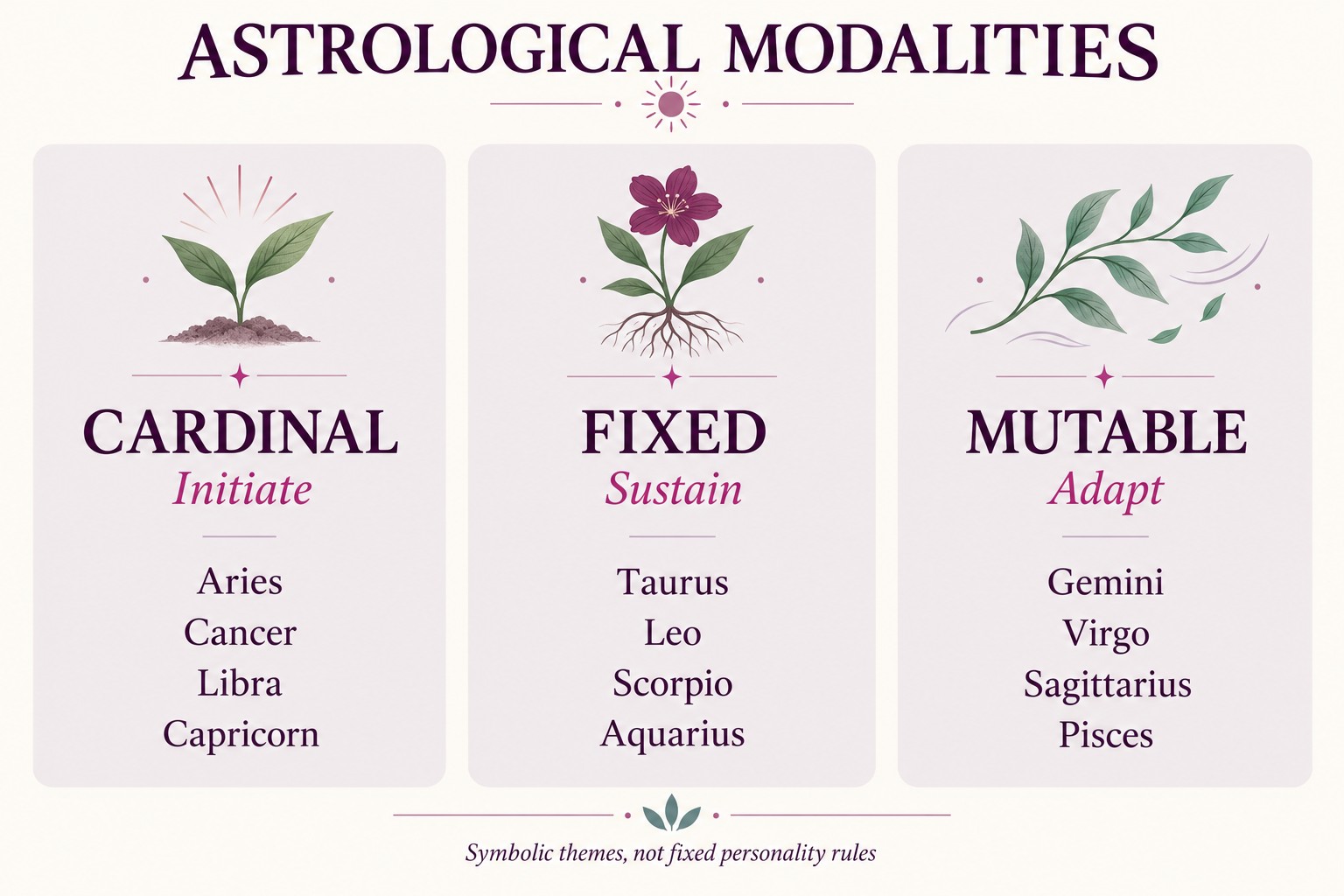
The comparison graphic above is a quick reference. Its information is repeated here as readable text:
- Cardinal — initiate: Aries, Cancer, Libra and Capricorn.
- Fixed — sustain: Taurus, Leo, Scorpio and Aquarius.
- Mutable — adapt: Gemini, Virgo, Sagittarius and Pisces.
This grouping is part of the framework described in Astrology.com’s introduction to modalities. Treat the descriptions as astrological symbolism, not fixed rules for judging intelligence, character or another person’s intentions.
Cardinal: the courage to begin
Aries, Cancer, Libra and Capricorn belong to the cardinal group. Its central theme is initiation: the first invitation, the opening conversation or the decision to turn an idea into a project.
The familiar qualities of enterprise, creativity and decisiveness can be useful prompts. Ask where you would like to take a first step, rather than assuming you must always lead. Beginning something thoughtfully may include listening, gathering information or asking permission.
Imagine a group planning a community garden. The initiating action might be asking whether neighbors are interested and arranging a meeting. That creates an opening, but it does not guarantee that the project will happen or that one person should control it.
Reflection: What deserves a beginning, and what is a realistic first step? If you tend to start many things, choose one commitment you can support before adding another. If starting is difficult, make the opening smaller.
Fixed: the value of steady attention
Taurus, Leo, Scorpio and Aquarius belong to the fixed group. Its central theme is sustaining: giving an existing intention enough attention to develop.
Stability, reliability and determination are the useful themes here. They do not mean a person is automatically dependable, stubborn or unwilling to learn. Steadiness becomes valuable when it supports a worthwhile commitment, not when it requires continuing at any cost.
In the garden example, sustaining might mean agreeing on watering duties, keeping shared tools organized and noticing which routines are manageable. Regular attention matters, but the group can still revise a routine that no longer works.
Reflection: What is worth maintaining, and what needs a review? You can honor a promise while discussing a change in circumstances. Persistence is not a reason to ignore exhaustion, new information or someone else’s boundary.
Mutable: flexibility with a clear direction
Gemini, Virgo, Sagittarius and Pisces belong to the mutable group. Its central theme is adaptation: responding when an approach needs to change.
Flexibility, communication and considering different perspectives are helpful themes to explore. They do not establish that someone can handle every crisis, always sees every side or should agree with everyone. Adaptability can include saying no to a change that would undermine an important need.
In the garden example, adapting might mean choosing different plants after learning about the soil or changing the schedule when volunteers become unavailable. The aim can remain meaningful even when the method changes.
Reflection: What can change, and what needs to stay clear? If you are considering many options, name the purpose they should serve. A revised plan is easier to understand when everyone knows why it is changing.
Why are modalities connected with seasons?
The common seasonal explanation places cardinal signs at beginnings, fixed signs in the middle and mutable signs toward endings and transitions. The familiar sequence uses Northern Hemisphere seasonal imagery: Aries with spring, Cancer with summer, Libra with autumn and Capricorn with winter.
Remember that this imagery is not a universal description of the weather where you live. As the National Weather Service’s explanation of seasons notes, seasons are reversed between the Northern and Southern Hemispheres. The same time of year can mean summer in one and winter in the other. Local climates also need not feel like a four-season illustration.
For a beginner, the most useful takeaway is the rhythm of beginning, maintaining and changing. You do not need to force your own surroundings or life experience into a seasonal metaphor.
Modality is not the same as element
Modalities describe three symbolic ways of approaching change. Elements are a different grouping: fire, earth, air and water. Keeping the two ideas separate makes astrology’s vocabulary easier to follow.
A modality label is not an elemental cleansing practice, a personality diagnosis or a complete chart reading. If the elements interest you as spiritual symbols, our four-element reflection guide offers gentle practices. Here, the focus stays on the three modality groups and the questions they can inspire.
Use all three approaches in one real situation
You do not have to restrict yourself to the modality of your Sun sign. In ordinary life, anyone may need to begin, follow through and adjust. Try these three questions with a plan you already care about:
- Initiate: What is the first manageable action, and whose agreement do I need?
- Sustain: What routine or resource will support that action?
- Adapt: When will I review the plan, and what information would justify a change?
For example, you might arrange a conversation about a shared household task, agree on a workable routine and check later whether it is fair. This is an illustrative exercise, not a prediction about how a particular sign will behave.
In relationships, ask people what helps them make decisions instead of assigning roles by birthday. One person may want to discuss possibilities immediately while another needs time. Our healthy-boundaries guide can help you make those needs clear without turning difference into a fault.
If you enjoy exploring a fuller reading, take your questions and limits with you. Our guide to preparing for a psychic reading explains how to keep the conversation optional and useful. You remain free to disagree with an interpretation.
Let the modalities be a language for possibilities: a beginning worth making, a commitment worth supporting and a change worth considering. Your choices, circumstances and relationships deserve more attention than a label alone.
Grouping zodiac signs based on quadruplicities adds a new dimension to understanding their shared and unique qualities.
The classification of zodiac signs based on their modalities is quite intriguing. It provides a structured perspective on their characteristics.
The stability and resistance to change in fixed signs align well with their placement in the middle of seasons.
It is fascinating how cardinal signs’ placement at equinoxes and solstices translates into their initiating characteristics.
The mutable signs’ communicative nature and adaptability are well-portrayed through their ability to transition between seasons smoothly.
The adaptive nature of mutable signs makes sense given their transitional roles between seasons.
Indeed, the flexibility of mutable signs appears to parallel the shifting of seasons.
Their ability to handle crises might stem from their inherent adaptability.
The correlation between cardinal signs and the start of seasons gives a logical explanation for their traits of initiation and assertiveness.
Fixed signs being goal-oriented and determined fits well with their seasonal positioning.