

Updated
A recurring theme becomes easier to examine when you compare the original notes instead of relying on a general impression. “I often dream about travel” is a starting point. It does not tell you whether the same scene repeats, which details change or how often you remember something entirely different.
The record below is a personal reflection tool. It cannot measure psychic ability, prove a prediction or determine what a dream must mean.
A repeated image can feel like an invitation to pay attention. You may hold it as a spiritual symbol, a creative idea or an ordinary reminder of something on your mind. Comparing your notes gives that curiosity a little structure while leaving room for more than one meaning.
You do not need a perfect journal or a dream every night. A few words about the scene and its feeling are enough to begin. This guide focuses on comparing entries over time; for a closer look at one animal symbol, our horse-dream guide shows how behavior, setting and personal associations can change a reflection.
Define the theme before collecting examples
Pick a narrow description, such as “trying to reach a destination,” rather than “anything connected with change.” Write down what you will count as an example. If you later broaden the description, keep a note of that change.
Include mornings when you remember no dream and notes that do not fit the theme. Otherwise a collection of handpicked matches can make the pattern appear more consistent than your actual record.
Compare the details in a small table
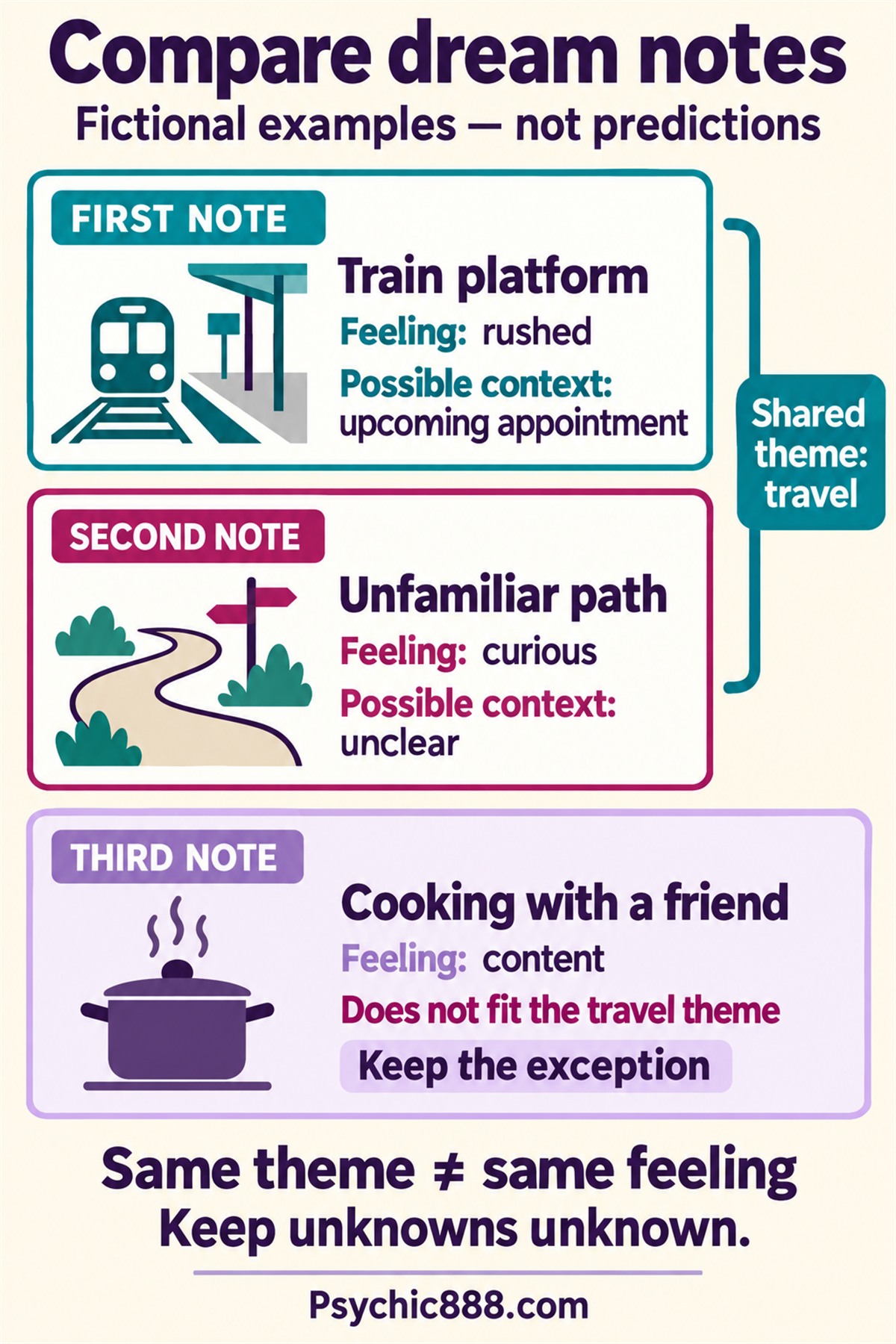
| Entry | Remembered scene | Feeling | Possible context |
|---|---|---|---|
| First note | Looking for a train platform | Rushed | An upcoming appointment |
| Second note | Walking an unfamiliar path | Curious | No clear connection |
| Third note | Cooking with a friend | Content | Does not fit the travel theme |
The two travel scenes have different feelings. Combining them into one fixed message would erase something useful. The third entry belongs in the record even though it does not support the original theme.
When you review your own entries, work through four small checks:
- Name the shared detail. In the example, both scenes involve movement toward somewhere. “Travel” is the link, not a claim that the whole dream repeated.
- Name what changed. The train platform felt rushed; the woodland path felt curious. Keep those differences visible instead of averaging them into one emotion.
- Keep the exceptions. Cooking with a friend is part of the same record, even though it does not match. “No dream remembered” is also a valid entry—not a failure or proof that you did not dream.
- Leave unknowns unknown. If you cannot recall the destination or see a waking-life connection, write “unclear.” Do not fill the gap with a meaning you found later.
Keep the original note unchanged and date any later interpretation separately. That way you can notice when an idea developed without accidentally remembering it as part of the dream itself.
Write a question instead of a verdict
Try “Where do I currently feel rushed?” or “What am I curious about?” Your answer may come from a waking concern you already know about. You are not obliged to find a connection, and a possible connection is not proof of what caused the dream.
Keep any decision proportionate to the information available. Checking an appointment time is a modest action. Accusing someone, cancelling essential care or making a major purchase requires evidence beyond a dream pattern.
Choose a small response that helps either way
Imagine the rushed train-platform scene reminds you of an appointment you have been worrying about. You could check the travel time and prepare what you need the evening before. That is useful whether the dream relates to the appointment or not; you do not have to prove the interpretation to benefit from the preparation.
The curious woodland scene might inspire an outdoor break or a drawing. You could also decide it was simply an interesting image. A meaningful dream does not have to become an instruction, and a repeated symbol does not create an obligation to act.
At your next review, ask whether the notes helped you express a feeling, see a difference or choose a manageable step. “I still do not know” is an honest outcome. The point is a clearer relationship with your own experience, not winning certainty.
Keep different reflection methods in separate records
If you also use the I Ching, record its question and result independently. Our I Ching guide and reading-record example distinguishes the source text from a personal association. That same distinction helps when comparing a dream note with a later symbolic reading.
Two interpretations that resemble each other are still interpretations. Avoid editing the original dream description to make the connection neater.
Set a useful stopping point
Choose a small review period that fits your interest, then decide whether keeping the notes was worthwhile. There is no required number of nights or special number of repeated symbols. You may keep a theme as an artistic idea, discuss an ordinary concern or stop recording.
Repeated frightening dreams that disrupt daily life deserve attention beyond symbolism. The NHS recommends a GP appointment when regular nightmares affect sleep and everyday activities.
Make room for spiritual meaning without pressure
If dreams belong in your spiritual practice, you might close a review with a quiet prayer, a few minutes of reflection or a question such as, “What quality would I like to bring into my day?” Courage, patience or curiosity can be meaningful choices without claiming that a symbol predicts an event.
You may share a note with a trusted person or spiritual advisor, but keep your own associations in the conversation. You do not need to accept a frightening interpretation, pay to prevent a supposed dream-related danger or agree that only one person can explain the image.
Your notes are personal. Use initials or omit identifying details if you share them, and leave out anything you are not comfortable discussing. Let the record support curiosity and care; if keeping it becomes a burden, you can pause without losing your spiritual connection.
The potential of lucid dreaming to positively affect one’s mood throughout the day is a fascinating concept. I wonder how much practice it takes to achieve it.
The idea that dreams can help us understand ourselves more deeply is intriguing. It makes sense that our subconscious mind would have messages to convey.
The notion that dreams can have multiple levels of meaning is compelling. It suggests that there is much to learn from even a single dream.
While dream dictionaries and interpreters may offer guidance, it’s clear that personal associations play a significant role in understanding dream symbolism.
Recording dreams immediately upon waking seems like a practical approach to decoding their meanings. Consistency must be key for accurate interpretation.
I agree that dreams might reveal our true feelings about important issues in life. This could be a valuable tool for self-reflection and personal growth.
Creating a personal dream journal and dictionary seems like a useful exercise. It could help track recurring themes and symbols over time.
Indeed, it seems like a practical method to engage more actively with one’s subconscious mind.
A dream journal could also provide insight into patterns or changes in one’s subconscious thoughts, which might be missed otherwise.
Understanding the messages from the subconscious could indeed enhance overall well-being. This article provides a thought-provoking perspective on the value of dreams.