

Updated
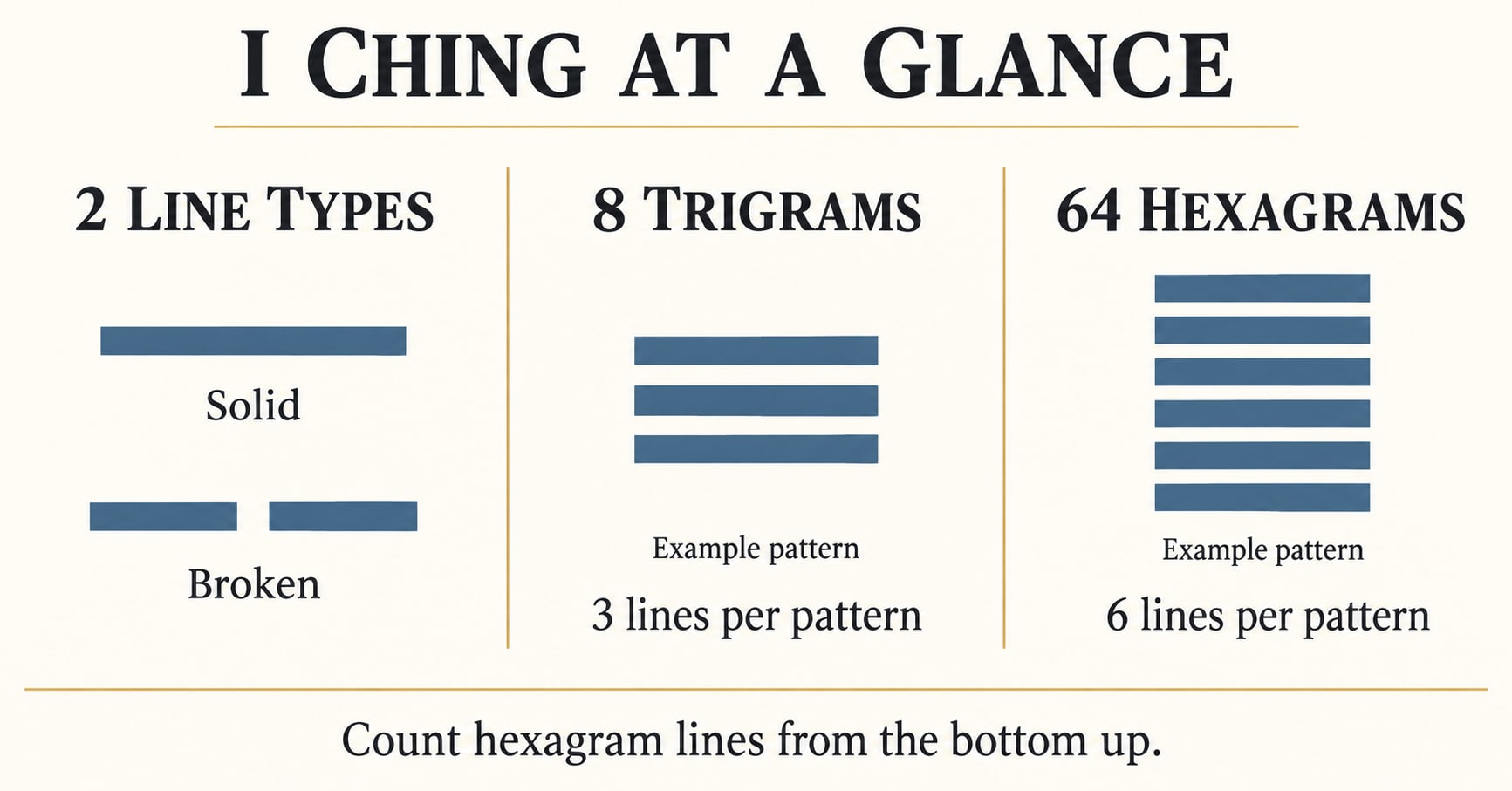
The I Ching, or Book of Changes, uses six-line figures called hexagrams. Two possible line types produce eight three-line trigrams and 64 six-line hexagrams. Those numbers describe the structure of the system; they are not an accuracy rating.
A beginner can understand the layout before trying to interpret a personal question. The cover diagram gives the basic pattern counts, and the steps below show how to keep a result readable.
The I Ching can offer a quiet way to explore change, timing and your own choices. You may approach it as a spiritual practice or as a symbolic text that invites reflection. Start with curiosity rather than a demand for certainty: a reading can help you consider a question without taking responsibility for the answer away from you.
Where the system’s history begins
The book comes from the Chinese tradition and is also called the Yijing. Stories about its origins connect Fu Xi with the figures and King Wen and the Duke of Zhou with the text. Legge’s introduction describes competing traditional accounts, rather than a single simple origin story.
Read those accounts as part of the book’s reception history. They do not establish that one person created every layer of the edition you hold today. A translated passage, an old commentary and a modern author’s advice are different parts of that edition.
Why there are eight trigrams and 64 hexagrams
Each line position has two possibilities: solid or broken. For three positions, the count is 2 × 2 × 2 = 8. For six positions, it is 2 × 2 × 2 × 2 × 2 × 2 = 64. Combining one of eight lower trigrams with one of eight upper trigrams gives the same 8 × 8 = 64 total.
A trigram and a hexagram are therefore different sizes of figure, not competing names for the same thing. The diagram shows an example pattern in each column; it does not display all eight trigrams or all 64 hexagrams.
Read the lines from the bottom upward
Line 1 is at the bottom; line 6 is at the top. The lower trigram occupies positions 1–3, and the upper trigram occupies positions 4–6. A solid line is commonly called yang and a broken line yin.
For a simple example, the first hexagram in Legge’s translation has six solid lines. Its individual line passages are arranged from the lowest to the highest position. Looking only at the picture’s top line and calling it “line 1” would send you to the wrong passage.
Keep the idea of a line separate from the number of visible strokes: a broken line still occupies one line position, even though it is drawn with two segments.
Ask about your choices, not someone else’s hidden thoughts
A useful beginner question gives you something to reflect on. It need not make the text promise a date, uncover another person’s feelings or decide a major issue on your behalf. Try these three reframes:
- Instead of “Will this project succeed?” ask, “What should I consider before committing to this project?”
- Instead of “What does my partner secretly want?” ask, “What do I need to communicate clearly about this relationship?”
- Instead of “When will everything change?” ask, “What is one change I am ready to approach thoughtfully?”
Write the exact question before beginning. If a different concern emerges while you read, note it as a later thought rather than silently changing what you originally asked.
Make a record before looking for a meaning
Use this original note format with the instructions in your chosen edition. It is a record sheet, not a substitute for learning that edition’s method.
Date and question: What am I considering?
Edition and method: Which instructions did I follow?
Lines 1 to 6: Record the result from bottom to top, marking any changing lines.
Hexagram and passages: Note the number, name and pages used.
My response: Separate the text’s wording from my own association.
Later review: What happened, including anything that did not fit?
Before you close the book, check your record in this order:
- Confirm the question. Keep the wording you began with.
- Check the six positions. Read your drawing upward from line 1, not downward from the top.
- Identify the figure. Use the lookup instructions in your edition rather than guessing from its appearance.
- Follow that edition’s line guidance. Mark any changing lines and the passages its method tells you to consult; keep the method consistent for this practice.
- Separate passage and response. Label a short quotation as a quotation, and put your own association on another line.
- Choose a modest next step. Gathering information, making space to think or having a respectful conversation may be enough.
If you notice a copying error, correct it openly in the note. If you simply dislike the result, that is different from a recording mistake. You can disagree with an interpretation or leave it unresolved without replacing the record.
A worked example of keeping interpretation separate
Suppose your ordinary question is, “What should I consider before taking on another project?” You read a passage and associate it with doing too much. Your note might say, “This made me notice that I have no spare evenings.” That is your reflection, not a quotation or a claim that the book measured your schedule.
A practical follow-up is to list your actual commitments before accepting. The example does not assign one fixed project-management meaning to a particular hexagram.
Use a first reading to learn the process
Avoid redrawing immediately to obtain a more welcome result. Record the first result and leave time to consider it. A meaningful coincidence later does not, on its own, demonstrate predictive accuracy.
If you plan to pay someone to interpret a result, first review questions to consider before a reading. For comparing services, start with the practical questions in our psychic website comparison guide, and check current terms directly.
Keep the practice gentle and in proportion
You might settle into a comfortable space, read slowly and finish with a short reflection on what deserves your attention. No elaborate purchase or dramatic experience is needed to begin learning. An unclear reading does not mean you lack intuition or have failed spiritually.
If you enjoy several practices, our beginner divination-tools guide helps you compare approaches. Keep each practice’s record separate rather than repeating the same question across tools until you receive a preferred answer.
Use ordinary evidence and appropriate professional support for health, safety, legal and financial decisions. A symbolic result cannot diagnose an illness, establish someone’s consent or guarantee a return on money. If an interpretation feels frightening or a reader pressures you to pay to avert danger, step back.
The aim of a first reading is not to master the whole book. It is to understand the structure, keep an honest note and discover whether this way of reflecting feels useful to you. Let the tradition invite thoughtfulness while leaving your choices in your own hands.
Confucius’ dedication to the I Ching as a moral guide rather than just a divination tool adds an ethical dimension to its study. It’s quite revealing about his philosophical priorities.
The historical context provided in this article is quite illuminating. It’s fascinating to see how ancient divination systems intertwine with the broader cultural and political events of the time.
The myths surrounding Fu Hsi and the origin of the trigrams add a mythical layer to our understanding of the I Ching. It’s a compelling blend of history and legend.
The information about the earliest composition of the I Ching being attributed to King Wen and later enhanced by Confucius adds a scholarly depth to its study.
It also makes one wonder how the interpretive texts might have evolved if other notable scholars had engaged deeply with the I Ching.
Absolutely, it’s interesting to see how different historical figures contributed to the evolution of the I Ching over centuries.
The article does a great job of detailing the various interpretive layers of the I Ching. It’s clear that this ancient book has a rich and multifaceted history.
The mention of archaeological evidence validating the Shang Dynasty is noteworthy. It underscores the importance of combining myth with empirical research to get a fuller picture of history.
Understanding the I Ching as a product of yin and yang dynamics provides a profound insight into its foundational principles. The duality seems to be a universal concept in various cultures.
The connection between the trigrams and Feng Shui is particularly intriguing. It shows how deeply embedded these philosophical concepts are in various aspects of Chinese culture.