

ELEMENTAL REFLECTION / AIR, FIRE, EARTH & WATER
After a tense conversation or a long day, you may want a way to set down what is lingering and feel at home in yourself again. For people who connect with spiritual energy, the four elements can offer a beautiful language for that renewal: air for a pause, fire for intention, earth for steadiness and water for a fresh beginning.
You can work with these ideas without building a fire, swimming in the sea or owning special tools. The practices below turn the original four-element approach into simple reflections you can adapt to your surroundings, mobility and comfort.
What can an elemental cleansing practice offer?
In a personal spiritual practice, “cleansing negativity” may mean releasing an argument, loosening your attention from worry or choosing how to respond next. You might visualize your aura becoming clearer as a way to express that intention. You do not have to experience a visible aura or a dramatic sensation for the pause to matter.
The elements are symbols in this guide, not a promise of permanent protection. A difficult feeling returning does not mean your ritual failed. Feelings change, relationships require care and everyday pressures do not disappear because you completed a visualization.
Begin with a useful question: What am I ready to set down, and what is still mine to address? You may be ready to stop replaying a harsh remark while still needing to make a boundary clear. You can seek spiritual renewal and take that practical step together.
Our aura-cleansing guide explores other gentle approaches. Here, let the four elements help you choose a practice that fits this particular moment.
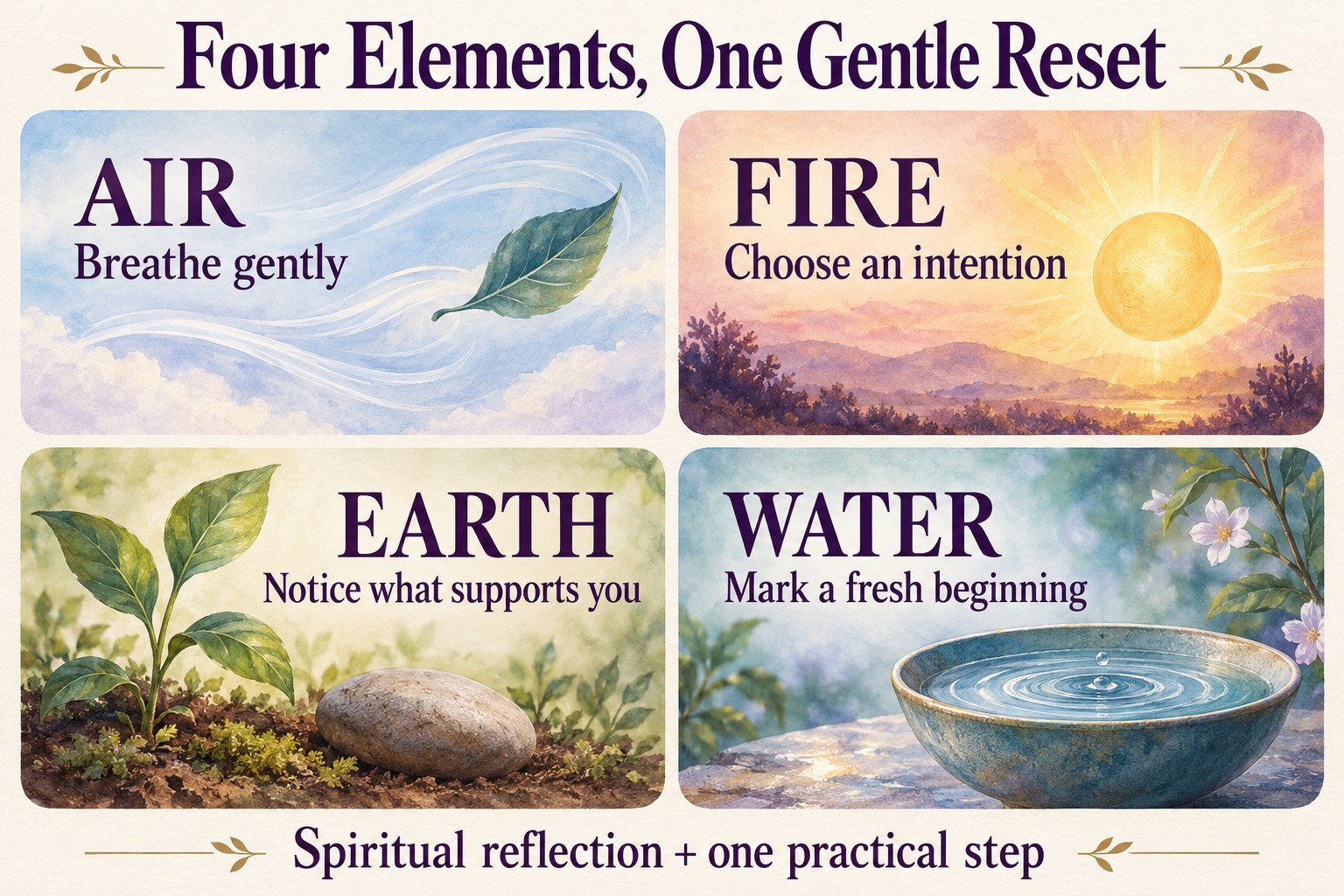
Air: breathe gently and make room for a new thought
Air can symbolize space, communication and the freedom to reconsider. Instead of trying to force unwanted energy out of your body, use the breath as an invitation to pause before your next response.
Sit with comfortable support, stand if you prefer or remain in a position that suits you. Allow a gentle, easy rhythm. The NHS breathing exercise for stress advises breathing comfortably without forcing the breath; an easy count can be used if helpful. You do not need to hold your breath, push your stomach outward or meet a demanding count.
- Notice: What thought has been repeating? Name it in one short sentence.
- Pause: Let a few comfortable breaths come and go. Leave counting out if it distracts you.
- Choose: Ask what you want your next words or action to express.
For example: “I keep replaying that message. I want my reply to be clear, not rushed.” Your next step might be drafting a response and reading it later rather than sending it immediately.
Air intention: “I make room for a thoughtful response.” If focusing on breathing feels uncomfortable or makes you dizzy, stop and let your breathing return to normal. You can instead notice the shapes and colors of three nearby objects. No particular breathing technique is required to connect with the air symbol.
Fire: choose what you want to carry forward
Fire can represent courage, transformation and purpose. That symbolism does not require an actual flame. A battery-operated candle, a picture of warm light or a visualization can give you a focus without smoke or embers.
The original violet-flame idea can be used as imagination: picture a gentle violet light, then let it remind you of the quality you want to practice. You need not imagine yourself inside a real fire or expect the visualization to physically strengthen your aura.
- Name the quality: Choose patience, honesty, courage or another value that fits.
- Picture it: Imagine a soft light representing that quality, or look at a flameless candle.
- Make it concrete: Write one action you can take today to express it.
For example: “I want courage. I will ask for clarification instead of agreeing to a task I cannot manage.” You are not burning away the responsibility; you are choosing a clearer relationship with it.
Fire intention: “I give my attention to what I want to grow.” Do not burn written worries or start a firepit solely for this exercise. If you use a real candle separately, follow the U.S. Fire Administration’s candle precautions: stable holders, separation from anything that can burn, and extinguishing before leaving or sleeping. Its guidance recommends flameless candles and advises against lit candles in bedrooms, bathrooms and sleeping areas.
Earth: notice the support already around you
Earth can symbolize steadiness, belonging and a foundation you can return to. You may feel a spiritual connection through a garden, a tree or an ordinary stone. You can also practice from a chair by noticing the support beneath you.
Grounding here means bringing attention to the present surroundings. It is not a claim that the earth electrically removes harmful energy or prevents you from absorbing others’ emotions. Shoes do not stop you from enjoying nature, and barefoot contact is not a requirement.
- Find a steady point: Notice your chair, the floor beneath your feet or a familiar view.
- Notice detail: Look at a leaf’s veins, a stone’s texture or the pattern of light on the ground.
- Name your support: Identify one person, routine or resource you can rely on.
- Use it: Take a small action, such as eating a meal, checking your schedule or asking a trusted person for help.
For example: “I feel pulled in several directions. My calendar can help me see what is actually possible.” The earth practice becomes a reminder to make your plans manageable.
Earth intention: “I return to what supports me.” Choose safe weather and surroundings if you go outdoors. Leave plants undamaged and respect the place you visit. A window view or indoor plant is a valid alternative; you do not need to hug a tree, walk barefoot or travel somewhere special.
Water: mark a fresh beginning without washing away your feelings
Water can symbolize movement, renewal and the ability to soften around an experience. Washing your hands, taking a comfortable shower or watching ripples in a bowl can mark a transition. Picture setting down the day as the water moves, while allowing your feelings to be heard rather than treating them as impurities.
- Name the transition: “Work is finished,” or “I am ready to begin my evening.”
- Choose a simple moment: Use ordinary handwashing or watch a small bowl of water without touching it.
- Notice what remains: Ask whether you need rest, a conversation or a different plan.
- Close: Dry your hands or set the bowl aside, then begin the next part of your day.
Water intention: “I welcome a fresh beginning and keep what I have learned.” Plain water is enough. Drinking water can be ordinary hydration, but it is not evidence that an aura has been purified; follow any fluid guidance you have been given.
If a bath is meaningful to you, our energy-bath guide includes a fuller ritual and accessible alternatives. Keep bathing comfortable and floors nonslip. You do not need herbs, oils or salt for this reflection.
Enjoying a coastal view does not require entering the water. There is no need to attribute spiritual cleansing to ocean ions. If you do swim recreationally, check conditions and use a lifeguarded beach; the National Weather Service’s rip-current guidance warns that sunny weather does not necessarily mean safe swimming. A symbolic practice is never a reason to ignore water hazards.
Choose one element, or combine them gently
You do not have to complete all four practices. Use the guide below to select a starting point, then let the experience be enough.
- Air — breathe gently: Helpful as a prompt when you want a pause before speaking or acting.
- Fire — choose an intention: A reminder to turn a desired quality into one action.
- Earth — notice what supports you: A way to reconnect with your surroundings and practical resources.
- Water — mark a fresh beginning: A symbol for ending one part of the day and entering another.
These are invitations, not personality types or prescriptions. If one image brings up an unpleasant association, choose another. You can use words alone instead of visualizing, and you can stay seated throughout.
To combine the elements, try this short sequence:
- Name the experience you want to set down.
- Pause with comfortable breathing or sensory attention: air.
- Choose a value for your next action: fire.
- Notice one source of support: earth.
- Mark the transition with ordinary handwashing or a water image: water.
- Write and take one manageable next step.
After an argument, that step might be: “I will ask to talk tomorrow when we have time to listen.” After a tiring workday, it might be: “I will eat, rest and leave nonurgent messages until morning.” A calmer moment does not require pretending the original issue never happened.
Let renewal support your life, not become a test
Notice whether the practice helps you pause, choose a kinder response or make a useful change. There is no universal cleansing schedule, special sensation you must achieve or obligation to keep repeating until you feel completely positive.
If sensitivity to other people is part of your spiritual experience, our guide to empath care and boundaries offers practical scripts. You can care about someone without becoming responsible for everything they feel.
Persistent distress or physical symptoms deserve appropriate support, not an assumption that your aura is weak. If a reader says you must urgently buy protection to avoid disaster, you can decline and take time to decide.
Let the four elements remind you of possibilities: room to think, a clear intention, steady support and a fresh start. Pair that symbolism with an everyday self-care routine, and let your next small act of care be part of the renewal.
This approach to energy cleansing aligns with many ancient philosophies and modern mindfulness practices.
Using the elements as described seems to offer a very natural and grounding way to manage one’s energy.
The concept of using natural elements for aura cleansing is quite interesting. It reminds me of traditional practices in various cultures.
The article provides practical steps but lacks empirical evidence to support its claims about aura and energy cleansing.
While the methods described are intriguing, I wonder about the scientific basis for these practices.
There might be a placebo effect at play which can still have positive outcomes.
True, but it’s also important to consider the psychological and emotional benefits of such practices.
Connecting with nature and the elements can have therapeutic effects, even if the science behind aura cleansing is debated.
Agreed, the mental and emotional aspects shouldn’t be underestimated.
I appreciate the detailed explanation of using each element for cleansing. It provides a holistic approach to maintaining personal energy.
The practical advice on utilizing air, fire, earth, and water for cleansing is useful for those looking to explore holistic methods.