

SAGE & SPACE / A THOUGHTFUL NEW BEGINNING
Some rooms hold a strong association: the kitchen after an argument, a desk after a difficult project, or a bedroom that no longer feels restful. If you believe in spiritual energy, cleansing your space with sage may feel like a meaningful way to acknowledge that atmosphere and welcome a fresh beginning.
You do not need to fill your home with smoke to make that intention real. An unlit herb, a quiet room walkthrough and one practical change can become a personal renewal ritual. This guide helps you choose your approach, understand the cultural context and close the practice with care.
What does cleansing with sage mean?
For some people, sage represents clarity, release or protection. The ritual gives those intentions a visible form: you pause, recognize what you want to leave behind and decide how you want to inhabit your space now. You may understand that as spiritual cleansing without treating it as a guaranteed removal of unseen forces.
A room feeling heavy does not prove that something harmful is present. Unfinished tasks, a painful memory, clutter or an unresolved conversation may also influence your experience. A ritual can sit beside ordinary cleaning, communication and rest rather than replace them.
Burning sage is not a household air-cleaning treatment. The EPA’s guidance on indoor particulate matter explains that burning materials produces particles and can introduce other combustion pollutants. Claims about a plant’s properties should not be turned into promises that its smoke improves sleep, thinking or health.
Respect the tradition, and know what you are buying
“Smudging” can refer to culturally specific Indigenous ceremonial practices. There is no single universal Native American ceremony, and a commercial bundle does not give someone authority to teach one. Traditions, medicines and permissions differ between communities.
The First Nations Health Authority’s account of ceremony at Lu’ma shows smudging within Indigenous-led care, guided by cultural knowledge and relationships. That context matters more than copying a list of accessories from a shop.
If you are learning an Indigenous practice, seek guidance from people authorized within that tradition and respect what is not offered for public use. For your own household reflection, you can describe what you do as a personal intention or space-renewal ritual rather than claim ceremonial authenticity. You do not need a feather, shell, borrowed prayer or imitation of sacred objects.
Sage products may contain different plants, including garden sage or white sage, and sometimes added fragrance or other herbs. A common name is not enough to identify what you have. Before buying, ask:
- What is the plant? Look for a clear botanical identification and a complete ingredient list.
- Where did it come from? Ask whether it was cultivated or harvested and how the seller knows its source.
- What does the seller actually claim? Prefer transparent information over promises that a purchase will fix illness, remove a curse or guarantee good fortune.
- Does it suit your home? Consider scent sensitivity, shared spaces and whether you want an unlit object instead.
Do not assume that rosemary, cedar, juniper and sage are interchangeable ceremonial medicines or equally suitable to burn. Nor is a product automatically responsibly sourced because its packaging uses spiritual language. You may also choose not to buy anything; your attention is the heart of this personal practice.
Five checks before you begin
Prepare the room and choose a version that everyone sharing it can comfortably accept.
- Ask about consent. A shared home or workplace is not yours alone to scent or smoke. Check with housemates and follow property rules.
- Consider air and scent. Choose a smoke-free, fragrance-free version when smoke or scent could bother anyone. “Sage spray” still needs an ingredient check; it is not automatically suitable for skin, pets or furnishings.
- Clear a small surface. Put away loose papers and obvious clutter. Keep doors and walking routes usable.
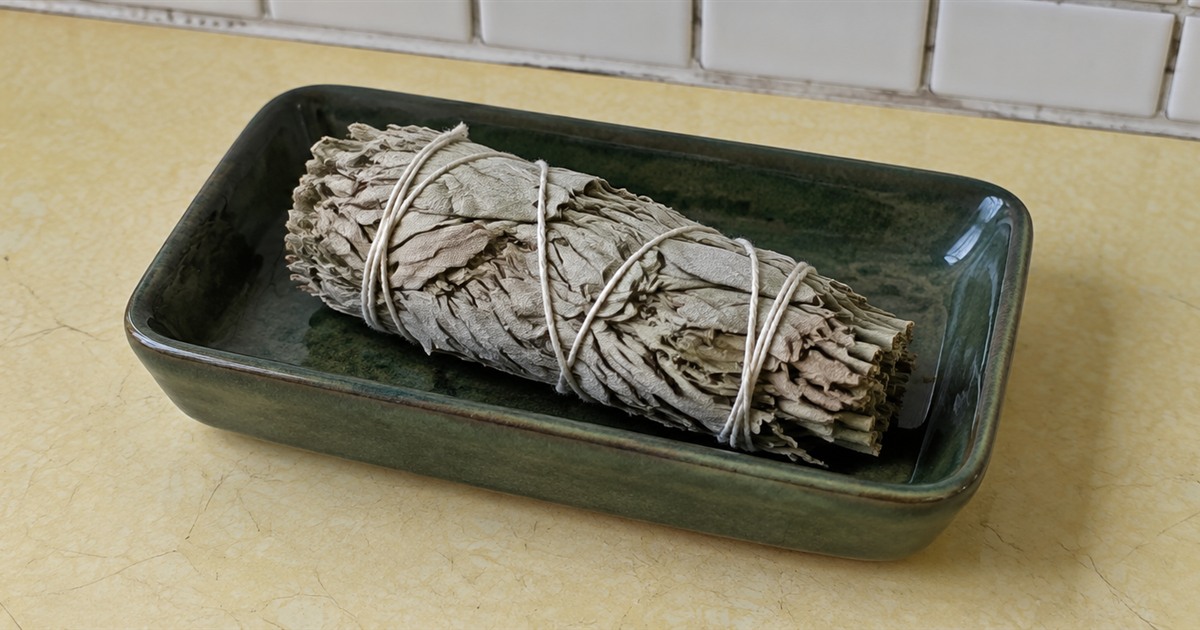
- Choose a simple object. An unlit bundle in a dish, a notebook or an ordinary stone can represent the intention. You do not need a complete ceremonial kit.
- Decide what follows. Pick one action—washing bedding, clearing your desk or making a respectful request—that supports the feeling you want.
A fresh start need not become a complete home makeover. Our guide to using feng shui thoughtfully at home offers more ideas for connecting an intention with a manageable change in your surroundings.
A seven-step smoke-free sage ritual
This is a personal household reflection, not instructions for an Indigenous ceremony. You can use an unlit sage bundle as a symbol, or leave the herb out entirely.
1. Name the transition
Say what you are marking: “That conversation is finished,” “I am beginning a new project,” or “This room can support rest again.” Keep the statement specific enough to guide you without blaming someone else for contaminating your space.
2. Set one intention
Choose a quality you want to practice: patience, focus, welcome or gentleness. A simple phrase might be, “May this space support clear thinking and kind words.” Use your own language rather than copying a prayer whose context you do not understand.
3. Place your symbol
Rest the unlit sage in a stable dish where it will not spill or be disturbed. If you have children or animals, keep herbs and small objects out of reach. A written intention can replace any physical plant.
4. Walk or look through the room
Move slowly if comfortable, or remain seated and turn your attention to each area. Notice what welcomes you and what asks for care. A corner may need tidying; a mirror may need cleaning. Neither needs smoke to make the room usable.
5. Pair the intention with an action
Make one small change. Clear a bedside surface, put tomorrow’s notebook on the desk or move an obstacle out of a walkway. If the room reminds you of conflict, the next action may be arranging a calmer conversation—not moving furniture.
6. Pause and check in
Notice your response without demanding a dramatic energy shift. Ask, “What feels different? What still needs attention?” If nothing changes, you have not performed the ritual incorrectly. Some situations need time or a different kind of support.
7. Close and put things away
Thank yourself for the care you gave your home. Store the unlit sage appropriately and write one sentence about your next step. Closing makes the ritual a bounded practice rather than something you must repeat until everything feels perfect.
If you choose to burn sage
Smoke-free practice is the simplest option here. If burning is part of a tradition you follow, seek appropriate guidance and follow applicable safety instructions. This article does not provide a lighting or ember-carrying tutorial.
Opening a window does not make smoke harmless. Do not deliberately fill rooms, closets or cabinets with smoke, or sweep a burning bundle around your body, clothes, electronics or curtains. Avoid burning where it is prohibited, near medical oxygen or where smoke could affect others. Never disable a smoke alarm for a ritual.
Keep any burning material in an appropriate stable, heat-resistant container on a suitable surface, and remain present. Do not leave it while stepping into another room, going to sleep or answering a distraction. If you also use a candle, follow the U.S. Fire Administration’s candle precautions; a flameless candle is another option.
At the end, make sure burning material is completely extinguished and cooled before storage or disposal. Preserving a bundle for reuse must never take priority over putting it out safely. Do not rely on “no visible flame” as proof that hidden embers are gone.
For more context and an alternative reset, see our smudging and space-renewal guide. You can honor your spiritual intention while choosing not to produce smoke.
Give each room an intention that fits its purpose
You do not have to cleanse every room in the same way. Let the place suggest a useful question:
- Bedroom: “What would help me wind down?” Put away work materials or make the bed comfortable.
- Living room: “How do I want people to feel welcome?” Clear a seat and make room for an unhurried conversation.
- Work area: “What deserves my attention next?” Remove one distraction and name a realistic task.
- Entryway: “What can I set down when I arrive?” Create a place for keys or pause before opening messages.
If crystals already have meaning for you, our crystals-at-home guide can help you choose a symbolic placement without promising that a stone controls the room. More objects are not necessarily more helpful.
When should you repeat the practice?
You might mark a move, the end of a demanding week or a change in how a room is used. Let repetition be a choice, not an emergency response to every uncomfortable feeling. There is no required cleansing schedule and no need to purchase repeated services because someone says your space is spiritually unsafe.
Keep a short note: your intention, the action you took and what you noticed later. That helps you see whether the practice serves you. If a ritual makes you increasingly afraid or unable to relax without repeating it, step back and seek supportive help.
A welcoming home grows through ordinary care as well as meaningful moments. Pair your room ritual with a manageable self-care routine, and allow the fresh beginning to be gentle. You can believe in spiritual renewal without needing to prove that every trace of negativity has disappeared.
The explanation of sage’s antibacterial and antimicrobial properties adds a scientific dimension to the practice, which is quite interesting.
Indeed, it’s fascinating to see the blending of traditional practices with modern scientific insights.
The guidance on proper disposal of sage embers is practical advice that ensures safe practices.
Agreed. Proper disposal methods prevent potential accidents and ensure readiness for future use.
Using dirt or sand to extinguish the embers is a great tip that I hadn’t considered before.
The point about respecting cultural origins while practicing smudging is well-taken. Cultural sensitivity is essential.
I found the segment on saging oneself to be particularly intriguing. Personal cleansing rituals could have meaningful psychological benefits.
I appreciate the detailed instructions on how to perform smudging safely. The emphasis on intention and respect for cultural traditions is important.
The article provides a thorough overview of sage burning and its cultural significance. The step-by-step guide is particularly helpful.
The safety tips mentioned, such as avoiding unattended sage burning and not inhaling the smoke, are crucial for anyone new to this practice.
It’s good to know alternatives like rosemary, cedar, or juniper can also be used for smudging. This opens up more options for those who may not have access to sage.