

Reading formats · Find your conversational fit
Jump to a section
Picking a psychic reading format is a question of how you like to communicate. Do you think clearly when you talk, or would you rather just type a sentence at a time or even write out a careful question and read it later? Your answer can matter more than a website’s claim that one format creates a stronger connection than another.
Phone, live chat and email can each offer a welcoming setting for a spiritual reading. If you believe in intuitive guidance, choose the format that helps you feel present, heard and able to ask meaningful questions. None of these formats establish how accurate a psychic is. The best comparison is how each one handles space, clarification, and privacy.
If you’re thinking about getting a phone reading, chat, or email reading, start with your own communication needs. You don’t have to pick the fastest option or one where a reader says it is more powerful. A format needs to help you to participate comfortably and stay in control of what you decide to share.
Asking Questions
A question that has many details might work best with immediate clarification. A question that’s reflective and you’ve already thought it through might work better in writing. An emotionally sensitive topic might need more time no matter what format you choose.
If you were asking about a job and saying that you felt pulled between a secure job and a creative interest, on the phone you could clarify things that were unfamiliar, and in live chat you could read the answer before you respond to it. An email reading would allow you to get a complete interpretation and consider it at your own time.
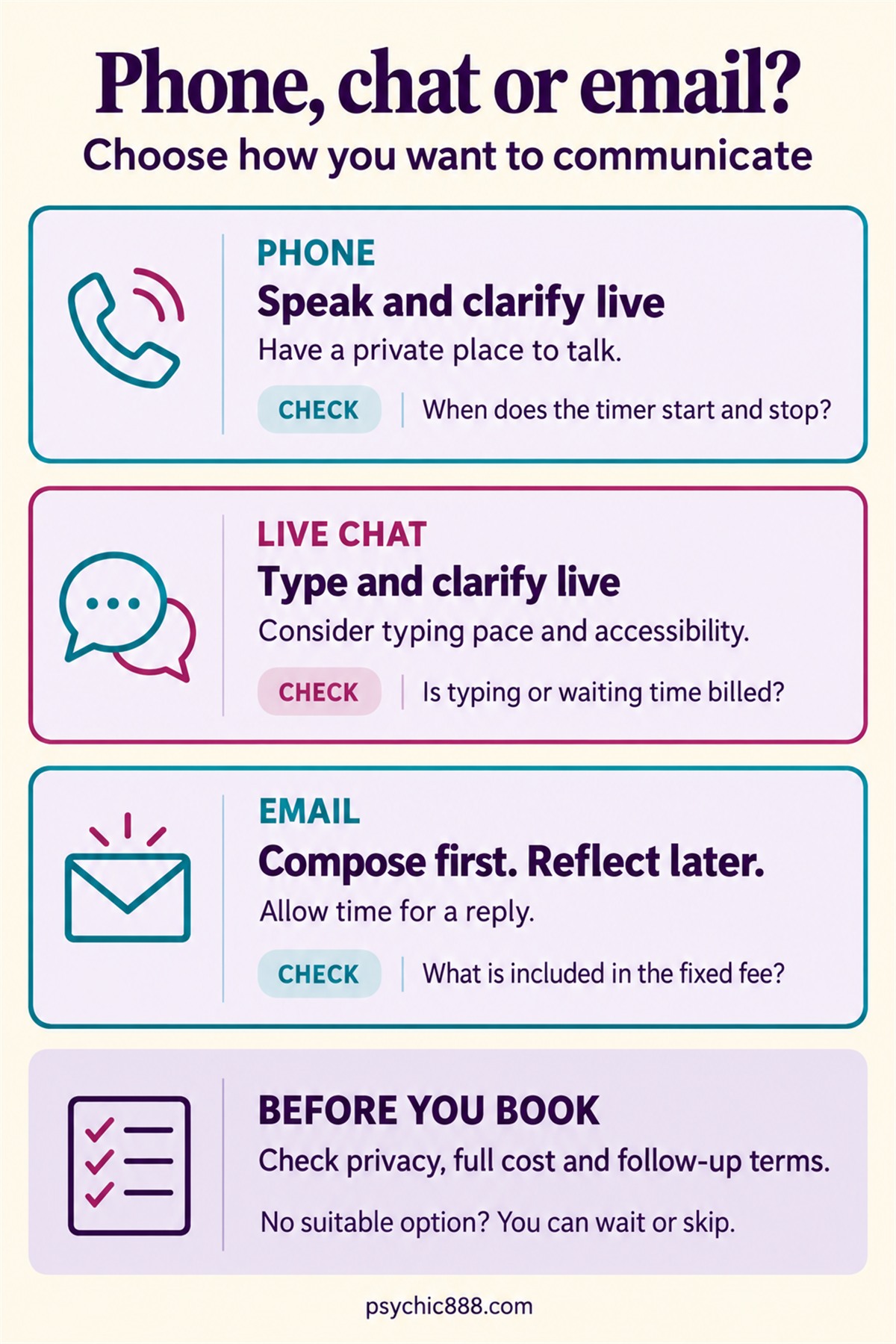
The difference is how you interact, not which format is spiritually stronger. A live conversation lets you clarify immediately; email gives you time between composing a question and receiving a response.
| Compare | Phone | Live chat | |
|---|---|---|---|
| How you respond | Speak and clarify immediately | Type and clarify live | Compose first; wait for a response |
| Main practical constraint | A private place to speak | Typing pace and screen accessibility | Turnaround and follow-up terms |
| Billing check | When the timer starts and stops | Whether typing/waiting time is billed | Exactly what the fixed fee includes |
| Privacy check | Recording and who can overhear | Transcript storage and notifications | Inbox access and forwarding |
If none fits your needs or budget, postpone or skip the purchase.
If your real need is urgent or you need medical or legal help, changing the reading format won’t help you to address the need. Get the right help from a qualified professional. A psychic reading can stay an optional spiritual activity instead of carrying a responsibility that cannot be met.
For help narrowing your topic, our first-reading preparation guide includes question examples and an overview of reading styles.
What a Phone Reading Can Offer
One benefit of a phone reading is that you can have a back-and-forth conversation with the reader. If something doesn’t make sense, you can ask them to explain it, slow down, or go back to your original question. Some people also find it easier to talk about what’s going on instead of trying to explain everything in writing.
Hearing someone’s voice can make a reading feel more personal as well. You can hear their tone, pauses, and reactions as the conversation goes along. Just remember that a reader sounding warm or confident doesn’t automatically mean every interpretation will connect with you. Pay attention to what they’re actually telling you as well as how they’re saying it.
Think about where you’ll be during the reading too. If you live with other people, have thin walls at work, or are somewhere public, you might not feel comfortable talking openly about personal things. Headphones can keep other people from hearing the reader, but they can still hear your side of the conversation.
If you’re worried that you’ll forget parts of the reading, ask if you’re allowed to take notes or if a recording is available. If recordings are offered, find out how they work and who has access to them. If you don’t want your reading recorded, ask about that before the call begins so you know what to expect.
When a Phone Reading Might Not Be the Best Fit
Some people find it harder to stop and think during a live conversation. You might agree with something in the moment and realize later that you weren’t completely sure about it. If you tend to do that, give yourself permission to pause. You can simply say, “Give me a second to think about that.” You don’t have to fill every quiet moment by giving the reader more information.
Paying by the minute can also make a phone reading feel rushed. Before the call, find out when you start being charged, how the website counts minutes, and how you end the reading when you’re ready. Setting an alarm can help you keep track of your own time, and some platforms might also let you set a spending limit before the reading begins.
Phone readings aren’t going to be the most comfortable option for everyone. You might have trouble hearing the reader, need more time to process what someone is saying, feel anxious talking on the phone, or simply communicate better in writing. In that case, chat or email readings might be a better fit. The best format is the one that makes it easiest for you to communicate and understand your reading.
It’s also a good idea to know what happens if the call drops. Will the reader call you back? Does the timer keep running? How do you contact customer support if something goes wrong? Finding those things out beforehand means you won’t have to worry about figuring them out in the middle of your reading.
Live Chats and Immediate Exchange
Live chat gives you an immediate exchange that comes in written form. You can reread a statement and keep the conversation going, and you can say an exact phrase you want to explain. For people who prefer written communication, this can make the exchange easier to follow.
Typing also makes it easier to keep the initial questions exact. You can draft your question before the reading and remove details you don’t need. This can reduce the temptation to explain your entire history during a paid conversation.
But live chat is still a timed interaction on many platforms. Waiting for a longer answer, correcting a misunderstanding, or typing slowly can affect the cost. Confirm if the clock runs while either person is writing a message and if the service has a fixed-price alternative.
It’s important to remember that text can lose its tone. A brief answer might sound harsh even if it isn’t intended that way. Always ask for clarification instead of assuming a short sentence has a hidden meaning or judgement against you.
Transcripts and Chat
A chat transcript can be helpful if you want to remember what was said. It can also become something you repeatedly reread when you need to have certainty. Consider if having a record that you can read over and over again helps you to reflect or encourages you to look at every word for another meaning.
Ask if the transcript is automatically saved, how long it stays available, and if it can be deleted. Find out if the reader, platform, staff, or an outside service has access to the transcript. A private conversation does not automatically carry the confidentiality protections of a regulated professional service.
Avoid copying someone’s private message into a chat unless there is a clear reason and permission to do so. You can describe an issue without including names, contact information, photos, or a conversation history.
Also check notification settings because a discreet chat can become visible on a shared screen or device through a message preview.
What an Email Reading Can Offer
An email reading gives you more time to think about what you want to ask without feeling like you have to explain everything on the spot. You can write your question, come back to it later, and decide if there’s anything you want to add or take out before sending it. You can also read the response when you have enough time and privacy to really take it in.
This can be a good option if you want to focus on one main topic and would rather have time to think about the response instead of having a live conversation. Email readings can also be easier if your schedule doesn’t match the reader’s or you live in different time zones. One downside is that if your question isn’t clear, the reader might misunderstand what you’re asking, and you won’t be there to explain it right away.
Before ordering, check how many questions are included, how long it usually takes to receive your reading, and if you’re allowed to ask for clarification afterward. An “email reading” can mean different things depending on the reader or website. It’s also helpful to know what happens if the reader misunderstands something important in your original question.
A longer response doesn’t automatically mean a better reading. Pay more attention to whether the reader actually answers your question and explains things in a way you can understand. A few thoughtful paragraphs that stay focused on what you asked can sometimes be more helpful than several pages that never really get to the point.
Privacy Needs to Be Checked
An email might stay in inboxes or sent folders. It can be forwarded and can be seen through a screenshot. Consider if you would be okay if the details in the message were accessible later.
Even special features have their limits. Google explains that Gmail Confidential Mode does not prevent recipients from taking screenshots or photos of a message. A privacy feature should therefore support careful sharing rather than replace it.
Use the subject line that gives as little information as necessary. You might use the subject, “Questions for my reading,” instead of writing an intimate title. Check to make sure you’re sending it to the right place before you click send.
A separate email address can help you to organize your bookings from your private email but doesn’t guarantee that you’ll be anonymous. Your payment, account details, and message content might still identify who you are. Ask the provider what information is required and don’t send documents to make the reading feel more complete.
Comparing Costs
Don’t compare a five-minute introductory offer with a detailed written service like they’re the same. Decide what you want to cover and then calculate the total costs. Include fees for clarification, transcripts, and if they require a subscription.
The FTC’s online shopping guidance is relevant here: examine the seller and the terms and keep records of the purchase. For a reading, a saved description of the scope can be as useful as the payment receipt.
A fixed email fee can give cost certainty but limits the follow-up questions. A phone call might allow for more clarity but create different charges. A live chat might add immediate interaction with a record but still charge for time you spend typing. The best value depends on how you communicate.
If you can’t explain how the final price is calculated, ask before you book a reading. You should not discover important billing rules only after the reading. Clear payment terms are important no matter what format you choose.
For broader provider checks, see our guide to comparing psychic websites. A suitable format is only one part of assessing a service.
For a simple comparison, suppose a phone or chat service charges $3 per minute: twelve billed minutes would be $36. A $25 email reading would cost less only if its included scope meets your needs and no follow-up fee is required. These are hypothetical figures, not current provider offers. Compare the total for your question, not just the headline rate.
Use our reading-service comparison worksheet to record the timer rules, included questions and support terms side by side.
Format and Situation
Consider three hypothetical clients. Mike speaks comfortably but does not like rereading messages, so he might prefer a short, fixed-price phone reading. If Julie needs time to process the language and wants a clear email response, email readings might be best for her. If Tom needs to ask follow-up questions without talking out loud, a live chat might be best.
These hypothetical examples illustrate communication preferences, not fixed personality types. The same person might pick differently if they get another reading. A call that works today might be inconvenient if they are traveling.
Check the accessibility with the provider. Ask about screen reader compatibility or captions if you need them. Don’t just think that every chat service is accessible just because it uses text or that every phone service accommodates the same needs.
You can also decide that none of the formats fit what you need. Waiting until you have privacy, money, or a better question is a choice you can make on your own. A service needs to adapt to your needs instead of ignoring them.
Communication Styles
You can learn something about the format you pick without purchasing multiple readings. Write down a short question, read it out loud, and then think about explaining an unfamiliar part. Pay attention to which step feels easier and where you need more time. This is good practice and not a psychic test.
If the spoken version is longer than the written one, a call might need an outline. If the written question loses its importance, then live clarification might be needed. If you’re comfortable with both, look at the cost and scheduling to decide.
Plan a fallback if the format doesn’t work for you. You might stop a poorly connected call and contact customer support or ask if an inaccessible chat can be refunded under the site’s policy. Agreeing to a format doesn’t mean you need to continue a reading when there is a problem that stops you from using what you paid for.
After a written or spoken session, a short journal entry can help: record the exact words, your own response and one practical next step. Our guide to listening to intuition offers a grounded way to reflect on impressions without treating them as instructions.
Final Thoughts: You’re In Control of Your Information
Share only the context needed to explain your question. For the reflective discussion, a brief description is often enough; full identifying details about you or other people are usually unnecessary. Keep any legitimate booking or billing requirements separate from the reading itself. Never give up payment verification codes, passwords, or access to someone else’s account as part of a reading.
The FTC recommends strong passwords and two-factor authentication to help protect personal information. Apply those habits to psychic platforms as you would to other online services. A reassuring conversation does not remove technical risks.
Before you start, pick a boundary you want to keep, such as a time limit, spending limit or a topic you don’t want to talk about. State it clearly if you need to and then pay attention to how the reader responds when you ask them for clarification on something or decline more services.
After the reading, separate what was said from what you wondered and what you can verify. The format can change how the reading feels, but the role is the same. You decide the meaning and what actions make sense in your situation.