

SELF-ALLEVIATION / REFLECTION WITHOUT SELF-BLAME
The manner in which we deal with physical or emotional pain matters. When you are struggling, it can be tempting to demand a complete explanation: Why am I feeling this way? What have I done wrong? How do I make it stop?
Self-alleviation can begin with a gentler question: “What would help me carry this moment with a little more care?” Here, the phrase means making room for an experience, considering your response and choosing suitable support. It does not mean curing illness through thought or proving that you have released every difficult feeling.
You can acknowledge yourself rather than try to be someone you are not. That includes admitting sadness, frustration or uncertainty. You do not have to turn those feelings into a verdict about your worth.
Start by noticing, not accusing
If something is not working, describe it as specifically as you can. “I feel overwhelmed after these conversations” gives you more to explore than “Everything is wrong with me.” Notice the situation, the feeling and what you need, without assuming you already know the cause.
A feeling is not a moral failure. Anger may sit beside a wish to be treated fairly; fear may sit beside a need for more information or protection. You can take a feeling seriously without treating every conclusion that comes with it as a fact.
If spiritual language helps, you might describe a heavy mood as “dense energy.” Keep that as a personal metaphor, not a diagnosis. You do not need to decide that something invisible is damaged before asking for rest, company or professional help.
A short pause can be enough. Name the feeling in ordinary words, notice something around you and ask what is needed next. If looking inward increases distress, turn to a simple outward task or seek support instead of forcing a breakthrough.
Separate responsibility from blame
Taking responsibility can be useful when it means addressing a choice you can influence. Perhaps you interrupted a friend, agreed to more than you could manage or avoided a conversation that now needs attention. A specific action can be considered, changed or repaired.
That is different from believing you caused every painful event. Illness, mistreatment, loss and other people’s decisions are not evidence that you “sowed negativity.” Pain does not establish guilt, and continuing symptoms do not prove a failure to forgive.
Try separating three things:
- What happened: the event or behavior you can describe.
- What you felt or assumed: your response, including what remains uncertain.
- What is yours to address: a choice, request, limit or act of repair within your role.
For example, if a friend cancels plans, you may feel disappointed and assume you do not matter. The cancellation is known; the assumption may not be. Your next step could be asking what happened and expressing what you need, rather than accusing them or condemning yourself.
Not every problem calls for greater openness. If someone is harming or threatening you, prioritize appropriate safety support. You are not responsible for making another person stop being abusive through a better attitude.
A three-question guide for a gentler response
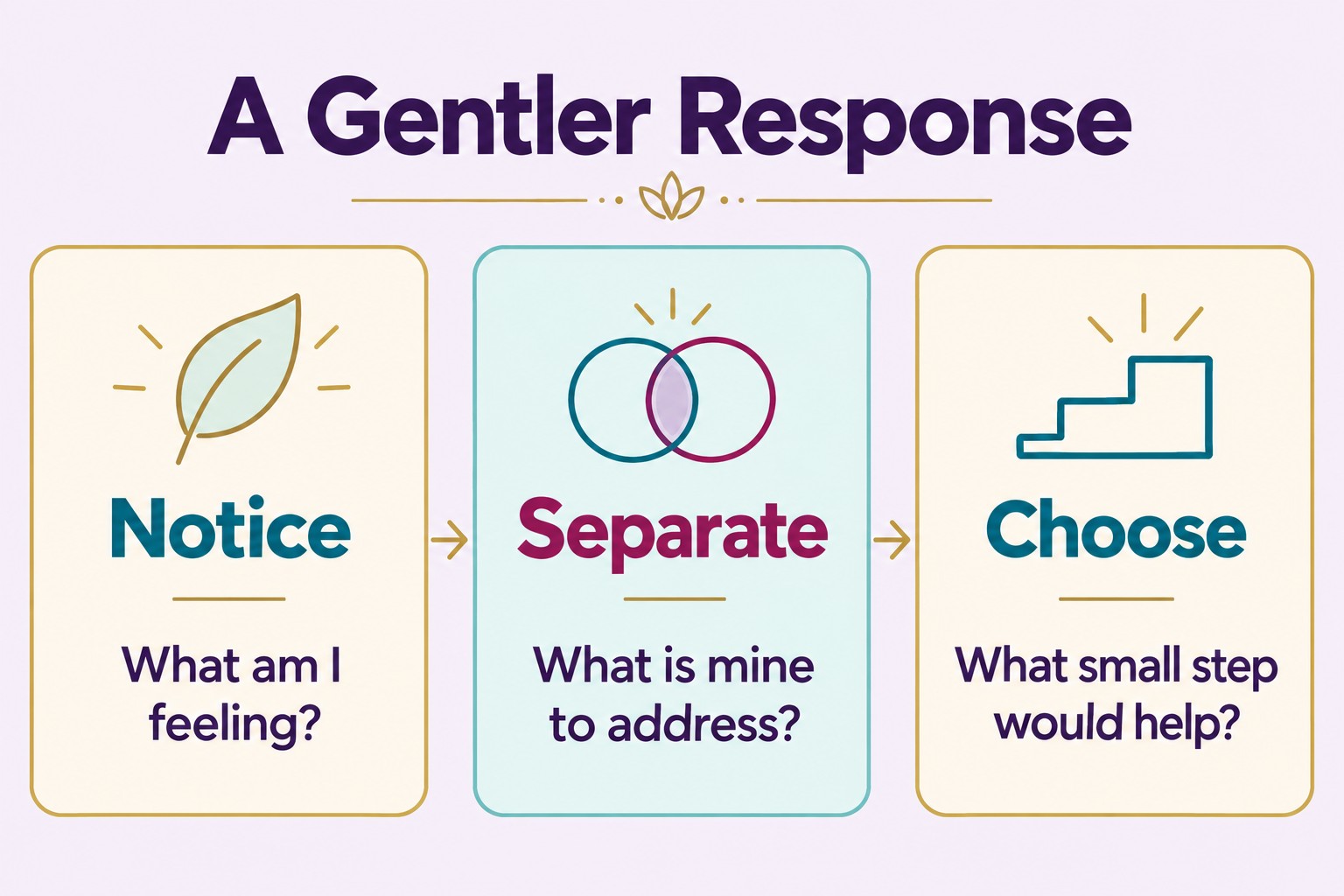
The cover’s three prompts can be used separately or together. They are a reflection aid, not a treatment or a required sequence:
- Notice: What am I feeling? Use a plain word or sentence: “I am disappointed,” “I feel tense,” or “I do not know yet.”
- Separate: What is mine to address? Look for a specific choice, while leaving other people’s choices with them.
- Choose: What small step would help? Consider a pause, a request, a boundary or appropriate support.
If you miss a chance to respond differently, return to the questions later. A reflection exercise should not become another reason to criticize yourself. Our heart-centered practice guide explores compassionate choices and boundaries in more detail.
Let forgiveness remain a choice
Forgiveness doesn’t mean you excuse anyone for their wrongdoings. It also does not require forgetting, restoring trust or renewing contact. You may find it meaningful, you may be unsure about it, or it may not be the word you want to use.
You can choose a smaller aim without settling the question of forgiveness: “I want to spend less of today rehearsing this argument,” or “I want support in deciding what boundary I need.” These intentions leave room for the seriousness of what happened.
Self-forgiveness can mean learning from something without defining your whole identity by it. Where a repair is appropriate, keep it specific. An apology for a hurtful comment is more useful than a promise to never have another difficult emotion.
A prayer or symbolic letting-go practice is optional. It cannot certify that a physical condition will improve or that another person has changed. Nor must you contact someone to complete a private spiritual reflection.
Our self-love and reflective-reading guide offers another way to consider your needs while keeping your own judgment and limits.
Support the body without promising self-healing
Ordinary care belongs beside reflection: regular meals where possible, rest, suitable activity and supportive contact. Adapt choices to your health, access needs, resources and professional advice rather than trying to meet a perfect wellness standard.
The NIMH’s self-care guidance includes manageable priorities and supportive connections. If distress is persistent, severe or interfering with everyday activities, speak with a qualified health professional. You can ask for help sooner whenever you need it.
Physical pain deserves appropriate assessment, not an explanation that you are holding too much negativity. NCCIH’s chronic-pain guidance describes multiple possible causes and notes that complementary approaches are not risk-free for everyone. Discuss suitable options with your clinician; do not change treatment on the basis of a spiritual exercise.
If you use an “energy balance” framework, our guide to energy reflection and everyday support keeps that symbolism separate from medical care. A psychic reading or affirmation cannot diagnose symptoms or replace treatment.
In an immediate crisis or danger, seek urgent local help rather than continuing this exercise.
Look for a useful next step, not a perfect inner state
After reflecting, ask what changed in your understanding. Did you name a need? Find a question to ask? Recognize that a responsibility is not yours? You may find something useful even if your mood has not changed.
If the same difficulty keeps returning, explore what support, information or practical change might be missing. Repetition is not proof that the universe is punishing you or that you have failed a spiritual lesson.
Self-alleviation can be modest: a clearer request, a kinder response to yourself, an appointment or permission to stop an unhelpful exercise. Let your spiritual life offer meaning without making you responsible for controlling every outcome. You can care for yourself while still being human.
The article raises an interesting question about the recurrent nature of negative experiences and our role in them. It’s worth exploring further.
The perspective that physical and emotional well-being are interlinked is gaining traction in modern psychology. This piece aligns well with that understanding.
The article presents a compelling argument for the importance of self-awareness and forgiveness in healing. It brings attention to the necessity of personal accountability.
The notion that our thoughts and behaviors can manifest in our physical well-being is a significant point made here. It does make one think about the holistic approach to health.
True, this idea has been supported by various studies in psychosomatic medicine.
While it’s interesting, I wonder how much of it is scientifically validated.
The text does seem to overemphasize the individual’s role in their own suffering. It might overlook systemic and external factors that also contribute.
I find the discussion on ‘True forgiveness’ particularly enlightening. The distinction between excusing and forgiving is crucial.
The article’s ideas on negativity and its impact on life outcomes are thought-provoking.
Yes, yet it’s important to approach these claims with a critical mind and seek empirical evidence where possible.
Indeed, recognizing and managing negativity can be challenging but is essential for personal growth.
I appreciate the call for personal accountability but would have liked to see more strategies on how to practically achieve the suggested mindset changes.