

Remote viewing • Hidden-picture practice • Curious reflection
Remote viewing is the proposed ability to describe a distant or hidden target without ordinary access to it. People interested in intuition sometimes explore it through picture exercises, sketches and short written impressions. The appeal is understandable: it invites curiosity about what we notice and how we interpret a feeling or image.
You can try a simple exercise without assuming that remote viewing is established, that everyone can learn it or that a successful-looking match proves a psychic gift. This beginner guide keeps the activity low-pressure, consensual and separate from important real-world decisions.
What remote viewing means in this guide
The target is something you have not seen, such as a picture placed in an opaque envelope by a willing helper. You write or sketch impressions before it is revealed, then compare your original note with the picture. This is different from deliberately visualizing a scene you already know.
Remote viewing is also distinct from astral-travel beliefs. The exercise does not require imagining that you leave your body. Nor does it give you permission to seek private information about a person, monitor a partner or claim to know what someone is doing elsewhere.
If you are more interested in imagination than a hidden target, our gentle clairvoyance-related exercises offer that separate starting point. Neither practice needs a dramatic experience to be worthwhile as reflection.
A brief historical perspective
Remote viewing attracted U.S. intelligence research, but investigating a claim is different from establishing a dependable ability. The CIA’s historical account says its own psychic research began in 1972, ended in 1977 and passed to the Defense Intelligence Agency. After a 1995 independent evaluation, the CIA did not restore the program.
That account describes intriguing results alongside unreliability and inconsistency for intelligence use. It is not a guarantee that a beginner, course or paid reader can obtain hidden information. For more archive context, see our guide to the CIA psychic-research records.
You do not need a claim of ancient origins or “government-proven” powers to enjoy a thoughtful exercise. Leave the history interesting without turning it into a promise of personal results.
Five steps for a simple hidden-picture exercise
You will need a willing helper, paper, a pen and a small selection of ordinary pictures. Use neutral subjects such as a landscape, a building or a household object—not distressing scenes or someone else’s private photographs.
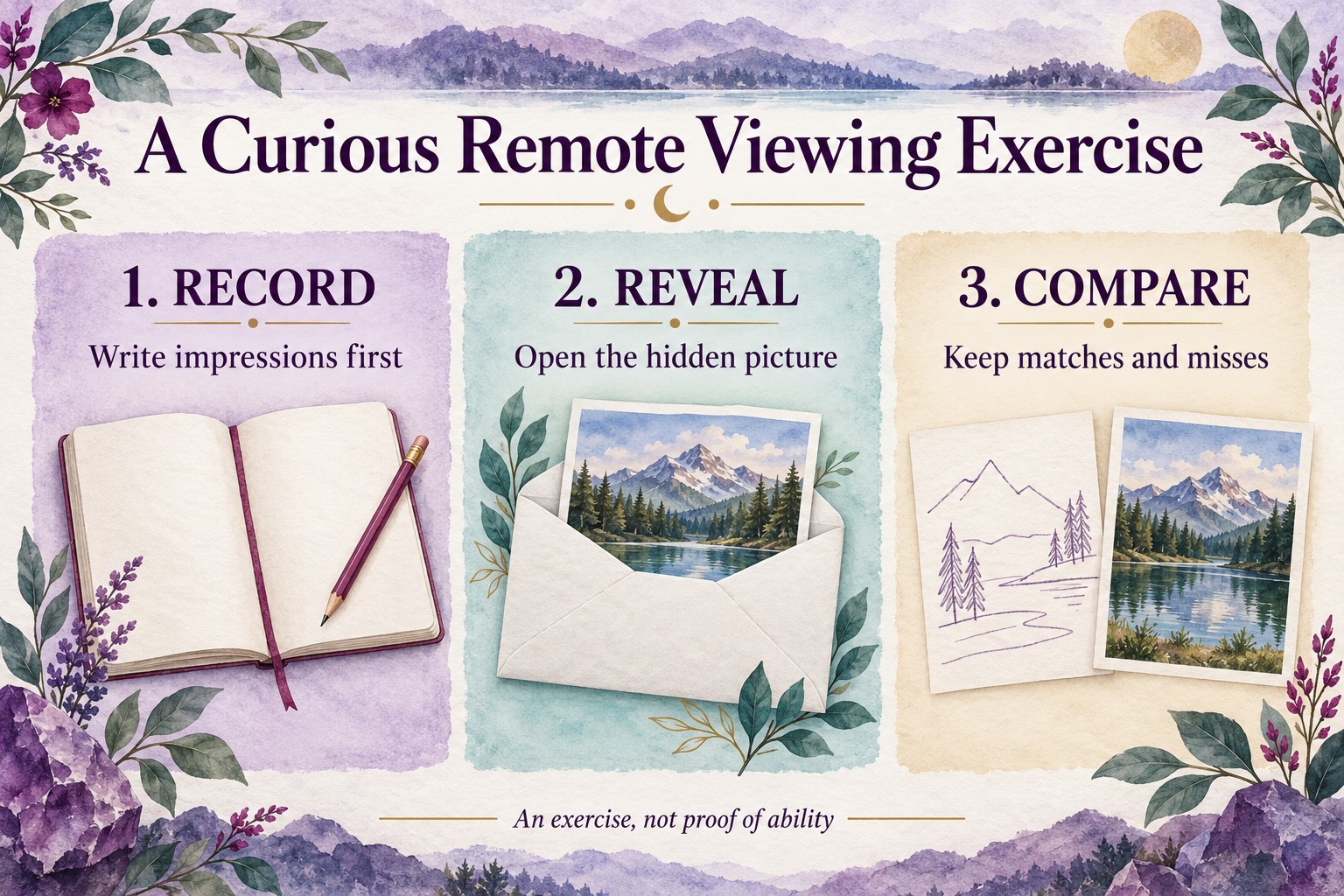
The cover summarizes the essential sequence: Record—write impressions first. Reveal—open the hidden picture. Compare—keep matches and misses. An exercise, not proof of ability. The five steps below explain how to keep that sequence clear.
1. Start simple and agree on boundaries
Choose one short attempt rather than a marathon. Agree that either person can stop, no outcome is required and no result will be used to make a consequential decision. A few minutes is a suggested practical limit, not an established training formula.
Use a picture instead of sending a friend out to act somewhere unknown. A willing helper can prepare a harmless target while staying safe. Do not turn the exercise into following someone, locating a missing person or guessing private behavior.
Decide beforehand what counts as a specific observation. “A red bicycle beside a wall” is more specific than “something outside.” Broad words can fit many pictures, so they deserve a different kind of comparison.
2. Choose a target without providing clues
Ask your helper to put each picture in the same kind of opaque envelope and mix them before selecting one. You should not inspect the pictures or see identifying marks. Keep the selected envelope out of view until the reveal.
For this informal exercise, your helper should not hint through conversation, facial reactions, filenames or a description of their favorite picture. If you know their selection habits, note that as possible context rather than pretending no ordinary clues could exist.
Real pictures and drawn images can both be used for curiosity. There is no need to claim that cartoons prevent results or that particular subjects have stronger psychic properties. Choose an agreed set and keep it consistent for the attempt.
3. Settle comfortably and record first
Sit in a familiar place, breathe normally and keep your eyes open or closed as you prefer. There is no requirement to surrender your judgment, block every memory or enter an unusual state.
Write short descriptions of whatever comes to mind: a shape, color, texture or spatial arrangement. You can make a simple sketch. Separate the impression from your guess about the object: “round, metallic” is different from “I think it is a saucepan.”
Include what you deliberately imagined and what remains unclear. “Nothing particular” is a valid entry. Add the time, finish the note and leave its original wording unchanged before your helper reveals the target.
If you feel discomfort, strain or worry, stop. Avoid breath-holding, sleep deprivation or staring at bright lights. A relaxed moment may be pleasant, but relaxation does not establish that you are accessing hidden information.
4. Keep uncertainty instead of forcing confidence
The original advice to “not doubt” can put too much pressure on a beginner. You can stay open to a possibility while admitting uncertainty. Feeling certain, excited or moved is not a way to determine whether an impression is accurate.
Writing is useful because it preserves what you said before the reveal—not because it sends an image through your nervous system or makes a correct answer resonate throughout your body. A bodily feeling may be part of your experience, but it is not a scoring method.
End when you planned to end. Do not keep adding descriptions until one must fit. If you record many alternatives, retain all of them during comparison rather than selecting only the successful-looking phrases later.
5. Reveal, compare and close the exercise
Open the target after the note is finished. Read each original phrase beside the picture. Identify specific matches, broad similarities, clear differences and statements you cannot evaluate. Keep the misses on the same page as the matches.
Do not expand the target after seeing it. If your picture shows a bridge, that does not confirm an imagined room beyond the edge of the photograph. The surroundings you guessed are still unknown unless they were part of the agreed target.
Thank your helper and stop. If you repeat on another day, use a fresh target and retain every attempt. You can explore without treating a series of informal games as proof of a skill.
An example of an honest comparison
This is a fictional example showing how to compare a note, not a report of a successful session. The same care applies to an apparent exact match: it can be interesting without settling the cause. Chance, ordinary clues, familiarity and flexible interpretation still need consideration.
For spiritual reflection, you might ask why a scene appealed to you or how the exercise affected your mood. That personal meaning is separate from a claim that you perceived a hidden location.
What the exercise should not become
Do not use impressions as evidence that a partner is unfaithful, that someone is in danger or that a medical problem exists. Check concerns through appropriate real-world conversations and qualified services. A sketch cannot replace emergency assistance, an investigation or professional advice.
Respect other people’s privacy even when you believe your intuition is strong. They do not owe you personal information to confirm a guess. Avoid sharing names, accusations or claims about their actions based on an exercise.
Pause if practice becomes compulsive, frightening or difficult to set aside. You do not need to chase a result to protect your spiritual identity. Seek suitable support for troubling experiences rather than assuming that they mean your abilities are developing.
Let learning mean clarity, not certainty
A useful outcome may be noticing how quickly you name an object, how often you change a memory after feedback or how much you enjoy sketching. Those observations can make the activity worthwhile without a claim of paranormal success.
Our guide to understanding intuitive experiences thoughtfully offers more help separating an observation, an interpretation and a decision. Here, the aim is simple: keep the target consensual, record before the reveal and preserve the whole comparison.
You may remain a believer, a curious beginner or undecided. A respectful practice leaves room for all three. Explore gently, welcome correction and keep your everyday judgment alongside your sense of wonder.
The concept of remote viewing is quite fascinating. It’s intriguing to see how an ancient practice can be adapted into a skill that people can learn and develop today.
The practice of starting simple and gradually increasing complexity is a practical approach. It likely helps in building confidence and skill progressively.
The emphasis on mental focus and eliminating doubt is key. It appears that confidence and clarity of mind are crucial for successful remote viewing.
The method of focusing and eliminating distractions to achieve remote viewing is reminiscent of techniques used in meditation and mindfulness.
The step-by-step guide for practicing remote viewing is well laid out. It makes the concept approachable, even for those who may be skeptical.
Including practical exercises such as having a friend hide an object adds a tangible element to learning remote viewing, making it more engaging and practical.
While remote viewing sounds similar to other psychic abilities, the explanation differentiates it well, particularly in how it does not require leaving one’s body.
I appreciate the historical context provided. It shows how remote viewing evolved from ancient practices to a more structured modern technique.