

Clairvoyance • Imagination • Gentle observation
Clairvoyance is often described in spiritual practice as “clear seeing”: intuitive images or visual impressions that a person finds meaningful. If you are curious about it, you can explore imagination and observation without demanding visions, treating every image as a message or deciding that you must have a gift.
The three exercises below adapt this article’s original themes: creating a scene, noticing spontaneous impressions and becoming aware of your surroundings. Think of them as opportunities to learn how you pay attention—not a promise that practice will produce psychic abilities.
Before you begin: images are not automatic information
Imagining a garden, remembering a dream and seeing something in the room are different experiences. Give each its own description. A vivid mental picture does not establish that you are seeing another person’s life, predicting an event or receiving a spirit message.
You may still enjoy a symbol spiritually. A doorway might remind you to consider a new opportunity; that is different from knowing an opportunity will arrive. A meaningful image can open a question without becoming a fact you must act on.
The University of Exeter’s aphantasia research overview describes inability to visualize in the mind, alongside particularly vivid imagery at the other end of the spectrum. Not forming mental pictures is not a spiritual failure. You can work with words, ideas, sounds or an object you can actually see instead.
Prepare a comfortable, ordinary setting
Choose a familiar place where you can sit comfortably and stop easily. Keep lighting comfortable, breathe normally and use a short time limit. One or two minutes for a first attempt is a suggested boundary, not a scientifically established training dose.
Do not practice while driving, operating equipment or doing anything that needs your full attention. Avoid staring at bright lights, pressing on your eyes, holding your breath or using sleep deprivation to seek experiences. Keep your eyes open whenever that feels better.
If quiet reflection increases distress, end the exercise and return to an ordinary activity. The NCCIH meditation safety guidance notes that unwanted experiences can occur and advises against replacing or postponing conventional care. You do not need to push through discomfort to progress spiritually.
Three exercises: imagine, notice, observe
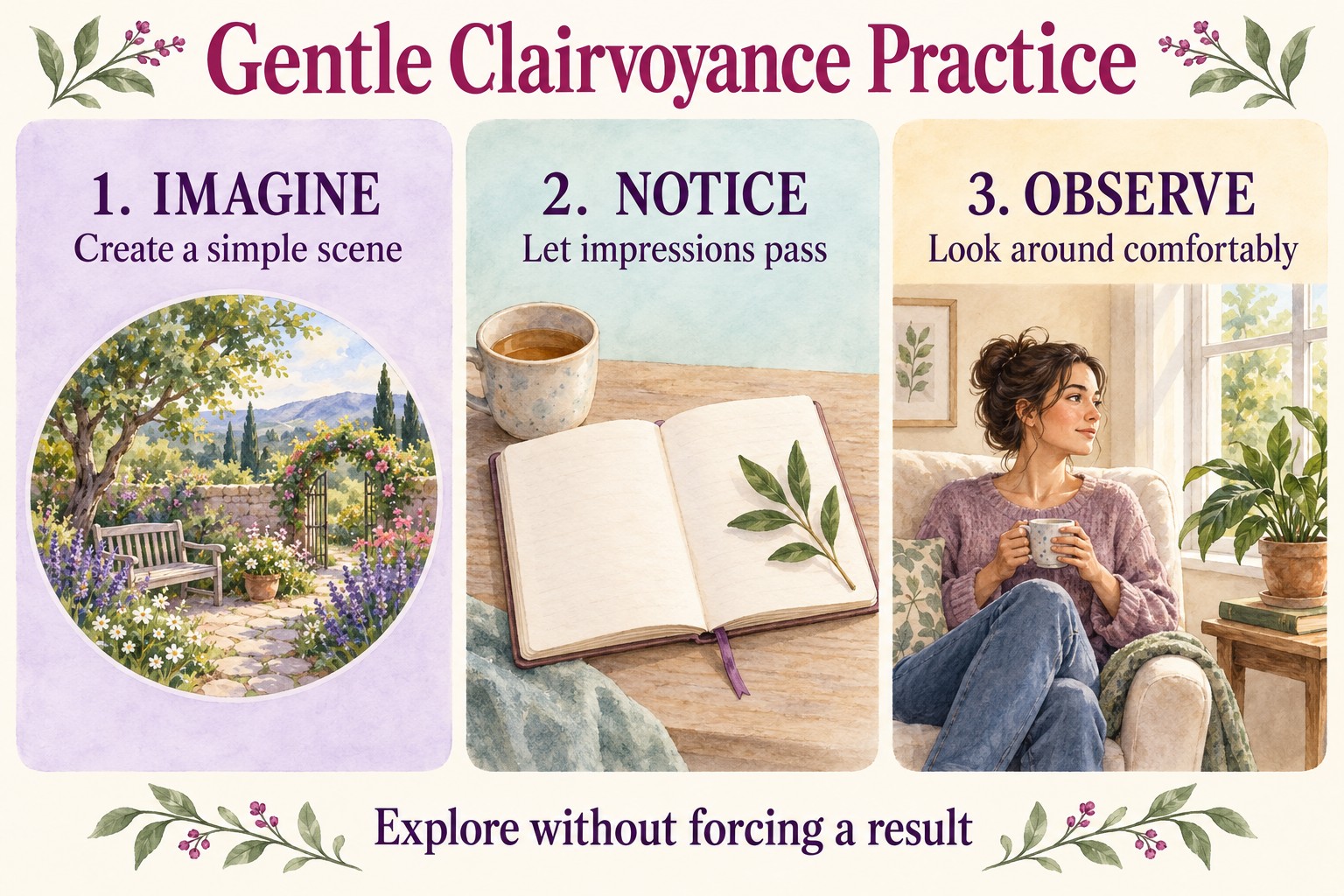
The cover summarizes the choices: Imagine—create a simple scene. Notice—let impressions pass. Observe—look around comfortably. Explore without forcing a result. Choose one rather than treating all three as a compulsory routine.
1. Imagine: create and leave a simple scene
This exercise is about deliberately chosen imagery. Pick a neutral scene, such as a garden bench, a bookshelf or a quiet path. Avoid a frightening memory or a scene you feel you must “solve.”
- Sit comfortably and notice the real room around you.
- With eyes open or closed, think of your chosen scene. Picture one feature if that comes easily: a color, shape or object.
- Add one small action, such as a leaf moving. If you prefer, describe the scene in words rather than seeing it.
- End deliberately. Look around the room, move your hands and name an ordinary object near you.
- Write one sentence about what was easy and one about what you chose to add.
If you imagined a blue bench because you selected it, record it as created imagery. Do not later describe the color as a message that arrived independently. That distinction lets you enjoy imagination while remaining clear about the experience.
A nonvisual version could be “The bench is smooth, the garden is quiet, and I would like to sit there.” You do not need to force a picture. The practice is complete when you choose to end it.
2. Notice: let a passing impression remain a possibility
Here the aim is to notice what is already present without building a scene on purpose. You might notice an image, a word, an ordinary thought or nothing particular. All are acceptable.
- Set a brief limit and choose a comfortable posture.
- Let attention settle without demanding a message. Notice ordinary thoughts as well as anything you consider intuitive.
- If an image appears, describe it simply: “a window,” “a red shape” or “a remembered beach.” Avoid adding a story to make it important.
- If guide or angel language is meaningful to you, you may include a short personal intention for kindness or clarity. An intention does not confirm the source of a thought.
- Finish at your chosen limit, return attention to the room and make a short note.
Rather than asking “Who sent this?” immediately, try “What did I notice, and what might have brought it to mind?” A recent conversation, a book or a hope may be relevant. You can leave the source uncertain.
If you enjoy spiritual reflection, our spirit-guide connection guide offers a separate approach. You never have to accept a frightening instruction, keep a troubling experience secret or continue an exercise to prove openness.
3. Observe: widen awareness without straining your eyes
This adapts the original peripheral-vision exercise into ordinary observation. It is not a way to train yourself to see ghosts, auras or hidden messages.
- Sit in comfortable light and look at an ordinary object, such as a book or plant.
- Without forcing a fixed stare, notice the general shapes and colors elsewhere in the room. Blink and move your eyes naturally.
- Turn your head normally to check a detail that catches your attention. Do not try to interpret an unclear shadow without looking directly.
- Stop if you feel eye strain, dizziness, worry or discomfort.
- Record what you could actually identify, and leave uncertain details uncertain.
A curtain moving near a window is an observation. “A spirit moved it” is an interpretation, not something the exercise establishes. Checking a draft or another ordinary cause does not prevent you from having a spiritual life.
Prefer an even simpler version? Look around normally and name three real colors in the room. No staring, altered state or peripheral movement is needed.
Keep a useful practice note
A short record is more manageable than monitoring yourself all day. Try four lines:
- Practice: which exercise you chose and your approximate time limit.
- Experience: what you noticed, including no image or an unclear impression.
- Context: what you deliberately imagined, already knew or recently encountered.
- Reflection: a possible meaning and a small response that remains sensible if the interpretation is wrong.
For example: “I chose the garden exercise for two minutes. I imagined an open gate. I had been thinking about joining a class. The gate reminds me of curiosity; I will read the class description and check the cost.” This is an illustrative note, not a report of a psychic result.
You would not need to conclude that the gate guarantees success or that someone is sending you a message. If you revisit a note later, preserve the original wording and record nonmatches as well as apparent connections. Do not change a vague image to fit a later event.
Our guide to understanding experiences without rushing to a psychic label explores observation, interpretation and decisions in more depth. This exercise guide focuses on trying a bounded practice, not collecting signs.
Dreams, visual changes and knowing when to stop
Vivid dreams, recurring symbols and strong intuition may interest you spiritually, but they do not establish clairvoyance. An unfamiliar visual experience in waking life deserves attention on its own terms, rather than being treated as a reason to intensify practice.
The NHS guidance on floaters and flashes recommends urgent assessment for first-time or sudden flashes or floaters, a sudden increase, a dark curtain or shadow across vision, or accompanying blurred vision or eye pain. Use an appropriate urgent eye-care or medical service where you live; do not wait for a spiritual explanation.
If unexplained sights or other sensory experiences concern you, seek suitable professional advice. These exercises cannot determine their cause. Do not stop prescribed treatment because someone describes symptoms as a psychic awakening.
You can also pause simply because the practice is not enjoyable. Rest, ordinary responsibilities and time with other people do not interfere with your spiritual worth. There is no requirement to practice repeatedly throughout the day.
Let curiosity be enough
After a few comfortable attempts, ask whether you can describe your experience more clearly, stop when you choose and hold an interpretation lightly. Those are useful aims; a dramatic vision is not required.
If you enjoy meditation separately, our gentle meditation guide discusses building a routine with realistic limits. Choose practices that fit your life rather than a timetable for developing a gift.
You may identify as intuitive, spiritually curious or clairvoyant. Whatever language you choose, let imagination remain imagination when you created it, let uncertainty remain uncertainty, and keep your choices your own.
This article provides intriguing insights into clairvoyance. The exercises seem practical and straightforward for beginners.
The signs of being clairvoyant listed are quite common. It would be helpful to differentiate more clearly what delineates a clairvoyant experience from regular intuition or imagination.
Interesting read. It would be beneficial to have more scientific perspectives on the topic.
A critical analysis from both angles could provide a more comprehensive understanding of clairvoyance.
I agree. A balanced approach with both scientific and experiential evidence would be enlightening.
The methods outlined seem doable for someone willing to invest time and effort. Consistency appears to be key.
The notion of connecting with guides and angels is a fascinating aspect. Has anyone had personal experiences they’d like to share?
I’ve tried similar exercises and found them helpful in enhancing my intuition. The journaling aspect was particularly beneficial for me.
Connecting with guides can indeed provide profound insights. However, it’s important to stay grounded and critical of the experiences.
I wonder how these exercises might intersect with other cognitive or psychological practices. Any thoughts?
The idea of keeping a detailed journal to track experiences is something that could be beneficial in various aspects of personal growth and not just clairvoyance.
The concept of internal and external visualization as described reminds me of various meditative practices found in different cultures.