

Spiritual balance · gentle energy practices · everyday care
Some days you feel scattered, emotionally full or disconnected from the quiet part of yourself. If energy work is meaningful to you, a small daily ritual can offer a way to pause, set an intention and return to what matters. You do not need to be a Reiki practitioner or have a dramatic spiritual experience to make room for that moment.
The word “energy” can mean several things: physical stamina, emotional capacity or a spiritual sense of connection. Keeping those meanings separate helps you choose the support you actually need. Feeling tired is not proof that your aura is damaged, and spiritual balance is not a measure of your health or worth.
The grounding, aura and shielding practices below use imagery as personal spiritual symbols. You can welcome their meaning while caring for your body in ordinary ways and seeking appropriate help for symptoms.
Begin by asking what feels out of balance
Before trying to change your energy, name the experience. “I have not slept well,” “I feel overloaded after a difficult conversation,” and “I miss my spiritual routine” point toward different needs.
- Physical tiredness: notice rest, daily demands and any symptoms that deserve medical attention.
- Emotional overload: consider a supportive conversation, a quieter activity or a boundary.
- Spiritual disconnection: make room for prayer, reflection or a familiar practice if you want to.
You may need more than one kind of support. A visualization does not have to replace a meal, sleep, practical help or healthcare. It can sit alongside them.
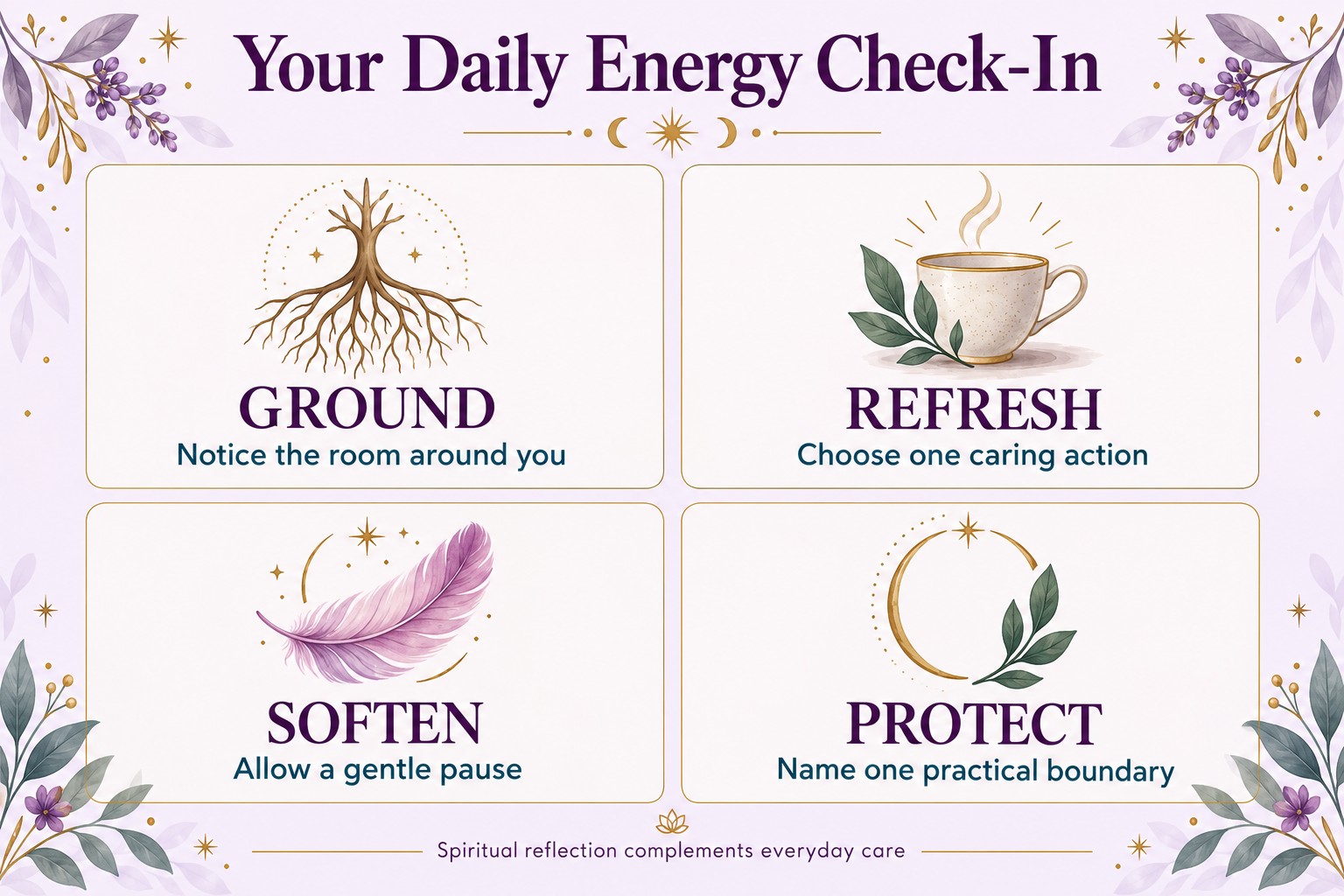
1. Ground: use earth imagery to reconnect with the present
If a connection to universal energy is part of your beliefs, let that idea remind you of belonging rather than a force you must make enter your body. Choose a comfortable position and allow your breath to remain natural.
- Notice a surface supporting you and an object in the room.
- Picture roots or a simple cord extending toward the earth, if that image feels reassuring.
- Imagine steadiness moving through the scene, like a gentle stream returning to its source.
- Let the image fade, look around and choose your next ordinary action.
The cord and returning stream are optional symbols. You do not need to visualize every part of your body, breathe deeply or keep going until something changes. If inward attention feels uncomfortable, stay with an external object or skip the exercise.
For more ideas about spiritual belonging, see connecting with your energy source. A brief practice can be meaningful without promising that universal energy will keep you healthy.
2. Refresh: let aura imagery mark a caring reset
An aura is described in spiritual traditions as an energy field surrounding a person. You can use its colors as imaginative language for how you would like to meet the day. There is no required “right” color, and a darker image does not show illness, negativity or failure.
Instead of trying to repair a faulty rainbow, choose one quality: patience, warmth, clarity or openness. Picture a color that represents it to you. If you enjoy hand gestures, make a small comfortable movement in front of you or above your head; keeping your hands at rest is equally fine.
Then connect the intention to something concrete. Clarity might mean tidying a work surface. Warmth might mean calling a friend. Rest might mean declining an optional task.
You do not need to touch particular energy centers or hold your fingers in a special shape. These gestures are not a method for energizing organs, muscles or blood flow. Our gentle aura-cleansing guide offers further reflective approaches without turning colors into a health diagnosis.
3. Soften: take a pause without demanding pain relief
If you are uncomfortable, a kind pause may be more useful than another instruction to “fix your vibration.” Find a supported position, keep your breathing easy and direct attention toward something neutral or pleasant nearby.
White-light imagery can be a symbol of kindness if you enjoy it. You might imagine soft light in the room rather than concentrating intensely on a painful area. You can also use a phrase such as, “I do not have to solve everything in this minute.”
Do not force repeated deep breathing until pain disappears. Stop if you feel dizzy, distressed or more uncomfortable. A sensation changing during a ritual does not establish what caused it or whether a health problem has resolved.
Spiritual reflection should not delay care for new, severe, persistent or concerning symptoms. Do not use an aura impression or a reading to decide whether pain needs attention. Seek appropriate medical advice, and urgent help for a medical emergency.
If you want a routine centered on ordinary attention rather than elaborate imagery, starting a manageable meditation practice explains ways to adapt the experience.
4. Protect: pair a symbolic shield with a real boundary
After a demanding conversation or busy day, you may enjoy imagining a gentle circle of light around you. Choose a color you find reassuring. Let the circle represent permission to pause—not a barrier that guarantees protection from harm or proves other people have negative energy.
Ask what the symbol calls you to do in everyday life. For example:
- Time: “I can talk for ten minutes, then I need to rest.”
- Attention: mute nonessential notifications during a chosen quiet period.
- Emotional capacity: “I care, but I cannot take this on today.”
- Space: step away from a conversation when it is safe and appropriate.
People can be stressed, upset or different from you without being spiritually harmful. Focus on behavior, your capacity and respectful choices rather than labeling someone by their aura. If a situation is unsafe, practical support matters more than visualization.
Boundary ideas for sensitive people can help you turn a protective intention into a workable action.
Create a routine you do not have to perform perfectly
Choose one practice, not all four, when you are short on time. You might ground before a busy task, refresh after tidying, soften during a quiet break or reflect on a boundary before responding to a request.
A short journal entry can help you notice what is useful:
- What I noticed: a feeling, a demand or an ordinary need.
- What I tried: the practice or caring action.
- What I will do next: one practical choice, or permission to leave the ritual alone.
You are not measuring an invisible energy score. If a practice helps you feel more connected, enjoy that. If nothing changes, you have not failed. Try another approach or stop, especially if you feel compelled to repeat a ritual until it seems “right.”
When low physical energy needs another kind of support
Persistent tiredness deserves attention beyond spiritual interpretation. The NHS guide to tiredness and fatigue advises seeking medical advice when unexplained tiredness lasts a few weeks or affects daily life. A clinician can help assess the cause; do not diagnose it from chakra or aura beliefs.
Likewise, a paid healing service should be clear about the limits of its claims. NCCIH’s Reiki information explains that Reiki has not been clearly shown effective for health-related purposes. Reiki is a particular complementary approach, not another name for every grounding or visualization exercise described here.
You can value spiritual practice without expecting it to do a healthcare professional’s work. Balance may begin with a quiet intention, a kinder boundary, appropriate care or simply a little more room to rest. Choose what supports your life today, rather than what promises a perfect energetic state.
The techniques outlined for grounding and aura cleansing are interesting. I wonder if there are scientific studies that corroborate these practices.
The idea of using energy shielding to protect from negative influences is quite unconventional. I would like to see empirical evidence supporting this technique.
The concept of universal energy is intriguing. It would be beneficial to explore how different cultures around the world perceive and utilize such energies.
The article touches on aura cleansing in a unique way. I am curious about how this practice is viewed in traditional and modern contexts.
Using visualization for pain management seems like a practical approach. It would be interesting to see if combining this with other pain relief methods could enhance its effectiveness.
Overall, the techniques mentioned appear to be a blend of mindfulness and visualization methods. It would be interesting to see long-term studies on their efficacy.
The step-by-step processes provided for energy healing are clear and detailed. It might be useful to include any potential risks or contraindications involved.
Breathing exercises for pain relief are a well-documented method in various wellness practices. It’s good to see them incorporated into this energy healing approach.