

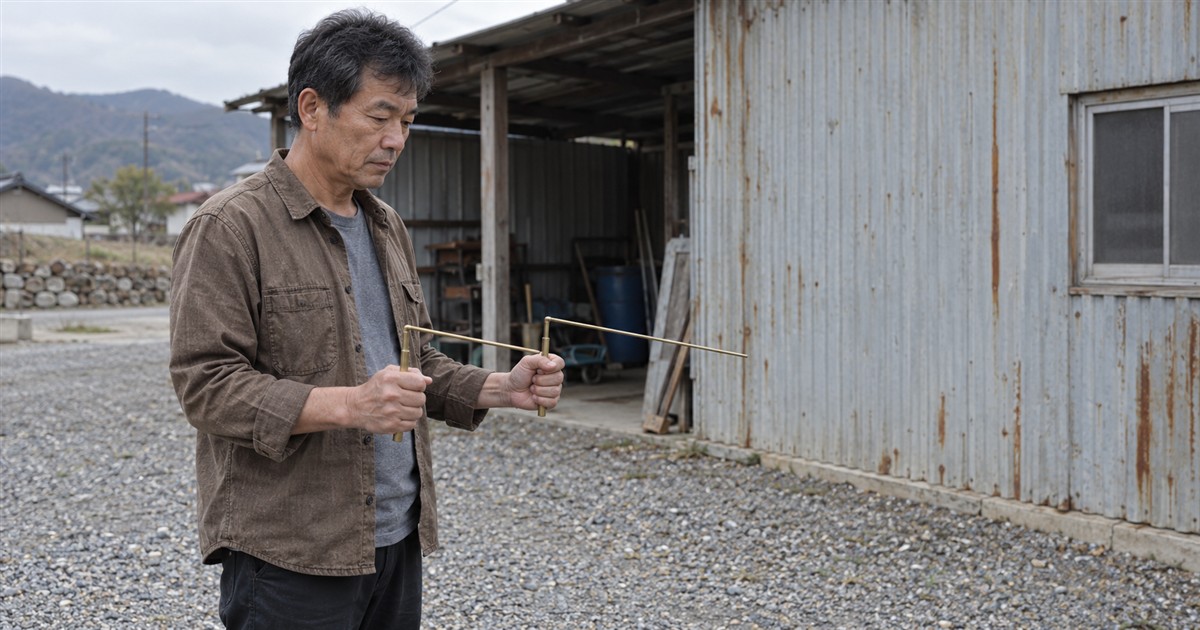
Dowsing • A gentle beginner practice
Dowsing rods invite you to slow down and notice small movements. For people drawn to intuitive and spiritual practices, that simple ritual can be a meaningful way to explore a question or become more attentive to a place. You do not need an elaborate ceremony, expensive equipment or an immediate dramatic response to begin.
This guide focuses on two L-shaped rods: how to hold them comfortably, try a short practice and keep a useful record. Treat what happens as something to reflect on, rather than an instruction you must obey. Curiosity and discernment can belong in the same session.
What are dowsing rods?
L-shaped dowsing rods have a short handle and a longer arm that can swing as you hold it. Some have a sleeve around the handle to help the rod rotate freely. Other traditional dowsing tools include a forked branch or a pendulum. If you prefer a single suspended tool, our beginner pendulum guide explains a separate practice.
In spiritual traditions, people use rods to explore intuitive responses, a room’s atmosphere or a symbolic yes-or-no question. Historically, dowsing has also been associated with searching for water. These uses are not interchangeable: a personally meaningful spiritual experience does not establish that a tool can reliably locate water, measure an aura or identify a spirit.
Choose a simple, comfortable pair
Look for smooth handles, rounded or protected ends and rods that turn without scraping or catching. Brass and copper are common materials, but a costly metal or decorative design is not a promise of better results. Comfort, manageable weight and ease of movement are more useful starting points.
Keep long rods away from eyes, children and pets, and allow room around you. Do not walk with the arms pointed at someone. A quiet indoor room or level garden path makes a better first practice than uneven ground, wind or a crowded space.
How to hold dowsing rods: six beginner steps
- Settle your stance. Stand comfortably with your feet stable and shoulders relaxed. Take a few easy breaths. Sitting is also an option if standing is uncomfortable.
- Hold one handle in each hand. The short sections sit roughly upright; the longer arms extend forward. Leave enough distance between your hands that the rods can move without immediately colliding.
- Loosen your grip. Hold securely enough not to drop the rods, but do not clamp the rotating parts. If there are handle sleeves, grip those rather than pinching the exposed arms.
- Find a resting position. Begin with the long arms approximately parallel and level. Notice whether a small wrist tilt makes them swing. This helps you understand the equipment before assigning meaning.
- Try one low-stakes prompt. You might say, “I am taking this moment to listen to my own response.” Observe for a brief period without repeatedly changing the question.
- Record and finish. Lower the rods safely, write down what you actually saw and end the practice. A few minutes is enough for a first attempt.
If the rods remain still, you have not failed. There is no requirement to produce a movement. If they swing rapidly, pause and check your grip, wrist angle and surroundings before deciding that the motion carries a message.
What do crossed or open rods mean?
There is no universal spiritual dictionary for rod movements. Some practitioners choose crossed rods for one response and open rods for another; others use different conventions. Agreeing on a convention can make your journal easier to read, but it does not turn a movement into proof.
| What you observe | A useful next step |
|---|---|
| The rods cross | Describe the movement first. Check whether your hands tilted inward before applying your chosen symbolic meaning. |
| The rods swing apart | Notice grip, posture and any breeze. Record the response without treating it as a command. |
| One rod moves more | Check whether one handle catches or one hand holds more tightly. You do not have to force a symmetrical response. |
| The rods remain parallel | Allow “no clear response.” Put the tool down rather than asking the same question until it changes. |
| Movement changes between attempts | Keep both observations. Consider how wording, expectation and physical position changed. |
A helpful distinction is observation versus interpretation. “Both arms turned inward” is an observation. “This place feels welcoming to me” is your interpretation. Recording them separately leaves room for spiritual meaning without losing track of what happened.
A ten-minute practice for noticing a space
Choose a familiar room where you feel comfortable. First spend two minutes without the rods: notice light, temperature, sound and how your body feels. Our guide to using your senses mindfully offers another way to begin.
Next, stand still in two or three safe locations, holding the rods in the same relaxed position. Give each location a short observation period. You might ask, “What do I notice about being here?” Keep this exploratory rather than asking the rods to declare a room safe, haunted or harmful.
Use the final few minutes to compare your notes. Was one spot brighter? Could you hear traffic near a window? Did you already expect a response in a particular corner? Ordinary details do not have to spoil a spiritual practice; they give it context.
A simple journal entry
Prompt: What do I notice in my reading corner?
Observation: The rods moved inward after I shifted my weight.
Personal impression: I felt settled near the window.
Practical context: The room was warmer there, and my wrists tilted slightly.
Next step: Spend a few quiet minutes there without the rods tomorrow.
That kind of note is more useful than “The rods proved this corner has good energy.” It gives you something to revisit while preserving the personal value of the experience.
Other ways people use rods—and sensible boundaries
Exploring personal questions
Keep questions gentle and within your own choices: “Would I enjoy spending time journaling today?” or “What feelings come up when I imagine this change?” For a major decision, use the practice to uncover feelings and follow with conversation, information and practical planning. Do not use a rod response to decide medication, investments, legal action or another person’s hidden intentions.
Reflecting on spiritual presence
Some practitioners include rods in rituals of remembrance or spirit communication. If this fits your beliefs, choose a comforting intention and leave room for uncertainty. Movement cannot establish who is present, their identity or an exact location. An unexpected swing is not a reason to fear a negative entity or pay someone to remove one.
Looking for a misplaced object
A short ritual may help you pause and recall where you last used an item. Combine it with an ordinary search: retrace your steps, check likely surfaces and ask anyone who may have moved it. Never let an ambiguous response become an accusation against someone.
Searching for water or underground services
Do not rely on dowsing before digging or drilling. The U.S. Geological Survey’s explanation of water dowsing describes why apparent successes can occur where groundwater is common and why determining its depth, quantity and quality requires appropriate scientific investigation. Rods are not a substitute for utility-location services, professional site assessment or water testing.
Troubleshooting without chasing an answer
If the rods keep crossing: check whether your wrists tip inward, the arms are balanced or the handles rotate freely. Reset once, then stop if you become frustrated.
If you feel you are steering them: set the rods down and notice your expectations. Small changes in posture or hand position can move the arms, even without a deliberate push. A calmer question may be more useful than trying harder.
If the result worries you: return to what you know outside the session. A movement is not a diagnosis, prediction of danger or obligation. You can end a practice at any point and choose a different form of reflection.
If you enjoy the ritual: keep it brief and occasional, and look for insights you can put into ordinary life. Our guide to listening to intuition can help you explore the feelings that arise. You can also compare rods with the other approaches in six divination tools for beginners.
Begin with curiosity, finish with your own choice
The most rewarding first session may be a quiet one: a comfortable grip, a few observations and a new question to think about. You do not need to prove a special ability or make every movement mean something. Let dowsing be an invitation to reflect, while your judgment, boundaries and practical knowledge remain part of the conversation.
Dowsing rods for measuring auras sounds compelling. I have yet to come across solid evidence supporting this, though.
Copper being used in dowsing rods for its strength and durability is interesting. I wonder if other materials can be as effective.
Copper’s conductivity might play a role in its effectiveness. Other metals may not yield the same results.
There could be multiple factors influencing this, including the user’s belief and skill in using the rods.
Dowsing rods seem to offer a variety of uses from measuring auras to finding lost items. It’s essential to approach such topics with both curiosity and critical thinking.
Absolutely. Balancing an open mind with a demand for evidence is crucial when exploring such practices.
I’ve read about dowsing rods being used in various cultures, but this article provides a detailed explanation on how to use them. Interesting.
The concept of using dowsing rods to find lost items is intriguing. I wonder about the scientific backing behind these practices.
The ability to find lost things using dowsing rods sounds very practical. I’d be interested in trying this myself.
The process of using dowsing rods for yes or no questions seems straightforward. It’s fascinating to think about how this method has persisted over time.
Yes, it’s important to keep an open mind while also seeking evidence.
True. It’s always good to question and understand the principles behind such practices.
Finding spirits using dowsing rods raises many questions about the nature of these tools.
Indeed. The spiritual aspect of dowsing rods makes one ponder about the intersection of science and mysticism.