

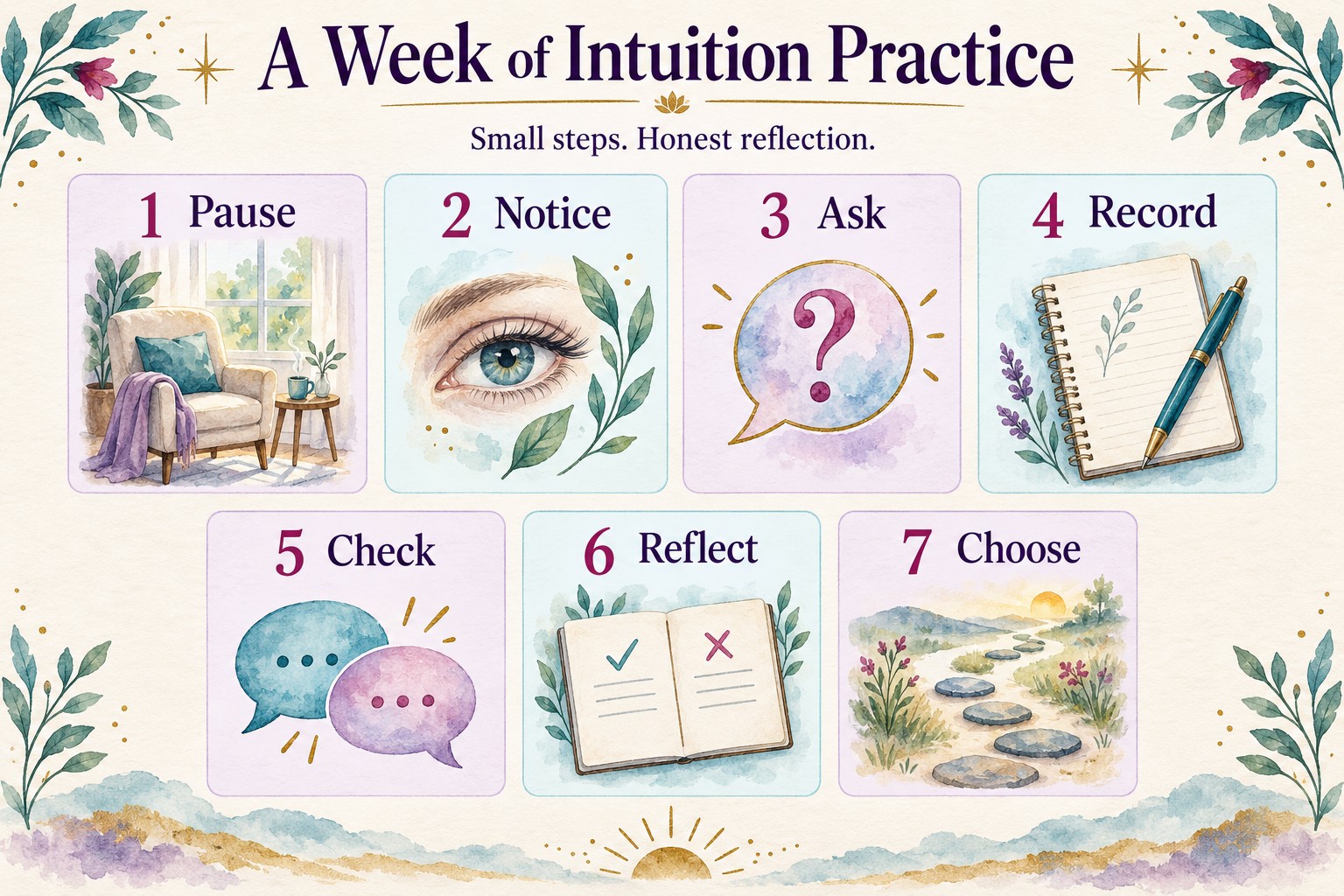
A GENTLE WEEK OF INTUITION PRACTICE
Getting your intuition stronger does not have to mean making bigger predictions or following every hunch. It can begin with something quieter: noticing an impression, giving it words and learning what happens when you respond thoughtfully. You can honor an inner nudge without asking it to carry every decision in your life.
Perhaps you have felt drawn toward a project before you could explain why, or sensed that you needed a little space after a conversation. If you understand these moments as spiritual guidance, there is room for that belief here. The practices below help you explore your experience with curiosity, patience and a useful record of what you actually noticed.
What does stronger intuition mean?
Intuition is often described as a gut feeling, a quick impression or a sense of knowing that arrives before a full explanation. Some people interpret it as a connection with their soul or spiritual guides. Others recognize it as a response shaped by experience and subtle details they have noticed. You do not need to settle that question before beginning a reflective practice.
A useful kind of strength is discernment: being able to notice an impression without automatically treating it as a fact. In their paper on conditions for intuitive expertise, Daniel Kahneman and Gary Klein explain that the quality of intuitive judgment depends on the setting and opportunities to learn; a strong feeling alone does not establish accuracy.
That research concerns judgment and expertise, not proof of spiritual gifts. For everyday practice, its useful reminder is simple: stay open to feedback. Our article on using intuition as a gift offers a broader look at intuition, self-trust and responsibility.
A seven-day practice for getting your intuition stronger
Choose small, reversible situations. You might decide which creative task to begin, which familiar walking route to take or when you would enjoy a quiet break. Keep safety, accessibility, dietary needs and other practical limits in place. Missing a day is not a failure; simply continue when you have time.
Day 1: Pause before looking for an answer
Settle somewhere comfortable for two or three minutes. You can keep your eyes open and notice a nearby object, the sounds around you or your natural breathing. You do not need to empty your mind, breathe in a special way or wait for a message.
If prayer is part of your life, you might ask for clarity and patience. Then write one sentence about how you feel before making a choice. This gives you a starting point rather than an expectation that something remarkable must happen. If quiet sitting feels uncomfortable, try a gentle walk instead.
Day 2: Notice how an impression arrives
Does a hunch appear as a word, a picture, a body sensation or a preference you cannot immediately explain? Describe one example without judging it. “My shoulders tightened when I opened the invitation” is more specific than “The energy was wrong.”
A sensation can have several explanations, including tiredness or anticipation. Noticing it is worthwhile; deciding what it means can wait. If dreams are meaningful to you, record an image on waking, but keep its possible symbolism separate from claims about future events.
Day 3: Ask one manageable question
Instead of “What will happen to my whole life?” try “Which of these two hobbies would I like to spend ten minutes on today?” Write your first response, then consider the practical details. If both options are safe and available, you can try one and observe how it feels.
A menu choice can be another light exercise: notice what appeals to you, while still checking ingredients and your needs. Enjoying the meal tells you something about your preference, not that you have proved a prediction ability.
Day 4: Record the impression before the outcome
Use a notebook, a voice note or a short private entry on your phone. Write what you noticed before you learn what happened. Include your uncertainty. A dated note is more useful than remembering only the moments that seemed especially striking.
Try this entry: “I feel drawn to work on the painting first. I expect it will help me start creatively, but I may simply be avoiding the email task.” Later, record whether painting helped and whether the email still needed attention. Both parts belong in the story.
Day 5: Check gently instead of assuming
If an impression concerns another person, ask a respectful question rather than announcing what they must be feeling. “You seemed quieter today; would you like to talk?” leaves room for an answer. “I know you are upset with me” turns an impression into a conclusion.
You may discover that you noticed something useful, or that you misunderstood it. Either result can teach you. Consent matters: people do not owe you private information so that you can test a hunch.
Day 6: Reflect on matches, misses and unknowns
Read your notes without rewriting the original impressions. Which outcomes matched? Which did not? Which remain unclear? An unanswered message is an unknown, not evidence that your interpretation was correct.
You can also revisit a past decision, as long as you do it kindly. Include times when a hunch helped and times when following it did not. Do not blame yourself for harm because you think you “should have known.” Reflection is for learning, not punishment.
Day 7: Choose a small next step
Look for one useful pattern in the week. Perhaps you make calmer choices after a break, or your creative preferences become clearer when you write them down. Pick something you can repeat: a brief pause before replying, a weekly journal review or an honest check-in with someone you trust.
If nothing stands out yet, keep the routine simple. The goal is a more thoughtful relationship with yourself, not a dramatic spiritual experience. For help translating a hunch into a decision, explore how to listen to your intuition.
A journal entry you can reuse
Copy these prompts into your own notebook. Five brief lines are enough; you do not need a long explanation for every feeling.
- Situation: What choice or moment am I responding to?
- Impression: What did I notice before knowing the outcome?
- Other explanations: What might I be hoping, fearing or remembering?
- Action: What small, respectful step can I take?
- Outcome: What happened, and what remains unknown?
For example, you might feel drawn to ask a friend for a walk rather than a busy evening out. Your practical reason is that you both have early mornings. If the walk feels comfortable, record that outcome without claiming to know how every other plan would have turned out.
Keep guessing games playful
Guessing who is calling or what a friend might wear can be a light activity if you enjoy it. Write a guess before checking, count misses as well as matches and stop if it becomes tense or compulsive. Familiar routines and chance can influence the result, so a correct guess is not proof of psychic ability.
Do not turn games into gambling, spending decisions or judgments about someone’s honesty. You can appreciate a coincidence as a personal moment of wonder without making it a rule you must obey.
Quiet is helpful; pressure is not
Rest, creativity and a little space from notifications may make reflection more pleasant. Meditation is optional, not a requirement for being intuitive. NCCIH’s meditation guidance notes that negative experiences can occur and advises against replacing conventional care with meditation. Shorten, change or stop a practice that leaves you distressed.
If you would like a gentle introduction, our guide to building a meditation practice offers alternatives and practical considerations. And if emotional sensitivity is part of your experience, empath values and boundaries can help you include your own needs in your spiritual life.
For major health, legal, financial or safety decisions, use reliable information and qualified support; a hunch can prompt a question, but it should not replace those checks. You do not have to take bigger risks to prove that you trust yourself.
Let your intuition become a conversation rather than a command. Notice what arrives, stay curious about its meaning and choose an action that respects your values and the facts. That is a hopeful practice you can keep developing, one ordinary day at a time.
The suggestion to relax and quiet the mind as a means to enhance intuition is sensible. Meditation often aids in achieving mental clarity.
I agree. Meditation can indeed help in centering oneself and being more attuned to one’s inner voice.
The idea of documenting intuitive moments to build trust in one’s own intuition seems like a practical approach to understanding oneself better.
I appreciate the practical tips on developing intuition. Journaling and playing games could definitely be engaging ways to enhance this innate ability.
Interesting read on the power of intuition. The idea that it can aid in taking calculated risks is particularly noteworthy.
Taking risks based on intuition could be beneficial, but it’s also important to balance this with rational thought.
Developing a method to validate intuitive decisions with logical analysis could be a prudent approach.
It’s fascinating how intuition can manifest in different forms, from gut feelings to dreams. The uniqueness of this experience for each individual is worth exploring further.
Dreams as a form of intuition indicates that our subconscious mind continues to work even when we are not consciously aware.
True, recognizing how our intuition communicates with us personally can enhance our ability to rely on it.
The article provides a comprehensive overview of intuition and its role in decision-making. It is intriguing how our subconscious mind can influence our choices.
The mention of intuition as a condition where the conscious mind operates in a unique manner is fascinating. It would be interesting to see more scientific research on this topic.
The concept of intuition providing answers before questions are asked is compelling. It suggests a deeper connection between our conscious and subconscious minds.
Yes, understanding this connection might help us tap into our intuition more effectively and improve decision-making.
Indeed, this could imply that our brains process a vast amount of information subconsciously, which then manifests as intuition.