

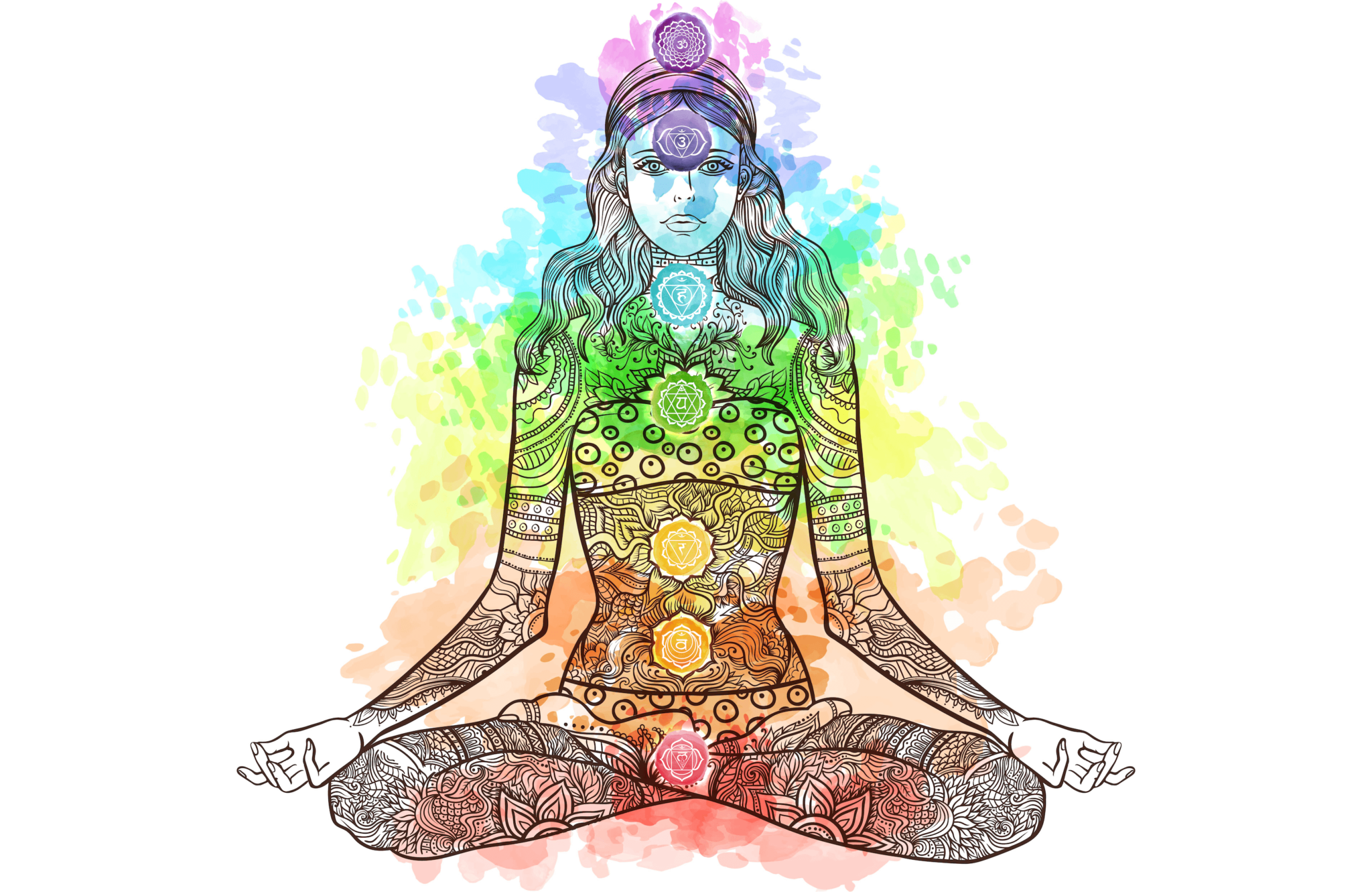
SEVEN CHAKRAS • MEANING, SYMBOLISM & REFLECTION
Understanding the seven chakras can give your spiritual practice a welcoming structure. Instead of trying to change everything at once, you can explore one theme at a time: stability, creativity, confidence, compassion, expression, intuition and connection. Each offers a different way to ask, “What needs my attention today?”
In chakra teachings, these centers belong to the subtle or energetic body. Many people use them in meditation, visualization, prayer and personal reflection. This guide introduces the familiar seven-chakra model, explains common associations and offers a small practice for each center. You do not need special equipment or a dramatic experience to begin.
What are chakras?
The Sanskrit word chakra is commonly translated as “wheel” or “circle.” Yogic teachings describe chakras as centers of subtle energy, with prana referring to vital energy and nadis to its subtle channels. These are terms within a spiritual tradition, not interchangeable names for nerves, blood vessels or glands.
Yoga teacher Sandra Anderson’s introduction to chakras explains the distinction between subtle centers and physical structures. The familiar map places centers from the base of the spine toward the crown of the head, but teachers and traditions may describe their locations and symbolism differently.
Lotus imagery, colors, elements and sounds help people focus attention on a center’s meaning. Treat them as a vocabulary for spiritual exploration rather than a list you must memorize perfectly. A different color association in another book does not mean that your practice is wrong.
The seven chakras at a glance
This quick reference uses common contemporary associations. Locations are areas of symbolic focus, not anatomical diagnoses. The detailed practices below explain how to turn each theme into an ordinary, caring action.
| Chakra | Focus area | Common color |
|---|---|---|
| 1. Root Muladhara |
Base of the spine | Red |
| 2. Sacral Svadhisthana |
Pelvis / lower abdomen | Orange |
| 3. Solar plexus Manipura |
Navel / upper abdomen | Yellow |
| 4. Heart Anahata |
Center of the chest | Green or pink |
| 5. Throat Vishuddha |
Throat | Blue |
| 6. Third eye Ajna |
Between the eyebrows | Indigo |
| 7. Crown Sahasrara |
Crown or above the head | Violet or white |
Explore each chakra through a useful question
The following associations are spiritual themes, not promises that a center controls an organ or guarantees an emotion. Choose whichever question feels relevant. You can write, speak, draw or simply reflect on your answer.
1. Root chakra: stability and belonging
The root chakra, Muladhara, is often connected with grounding and the earth element. Its imagery invites you to think about a foundation: what helps you feel supported, present and able to meet the day?
Ask: “What would make today a little more manageable?” Your answer might be an organized corner of your home, asking for help with a task or arranging a meal. These practical needs deserve attention; feeling uncertain is not a spiritual failure.
Try: Sit in a supported chair and notice the surface beneath you. If visualization appeals to you, imagine roots reaching gently into the earth. If it does not, name three things you can see. Then choose one small step that supports your everyday stability.
2. Sacral chakra: creativity and feeling
Svadhisthana is commonly associated with water, creative expression, pleasure and emotional movement. Water can be a useful image for allowing a feeling to change without forcing it away.
Ask: “What would I enjoy creating or exploring without needing to be good at it?” You might make a small sketch, cook something familiar or listen to music you love. Pleasure does not have to be productive.
Try: Give yourself ten unhurried minutes for a creative activity. Notice what you enjoyed rather than judging the result. Our guide to exploring the sacral chakra develops this theme further. Neither creativity nor sexual interest is a test of whether this chakra is “open.”
3. Solar plexus chakra: confidence and choice
Manipura is also called the navel chakra. Its fire symbolism is often used to explore initiative, personal power and purposeful action. Confidence here need not mean being fearless or having control over everything.
Ask: “Which decision is actually mine to make?” Separating your choice from another person’s reaction can make the next step clearer. Perhaps you can decide when to send an application, but you cannot determine the employer’s answer.
Try: Write down one task within your control and break it into a first step small enough to do today. If you enjoy color visualization, picture a warm yellow glow as a reminder of that intention. The action matters more than making the image vivid.
4. Heart chakra: compassion with boundaries
Anahata is associated with love, connection and the air element. In everyday reflection, it can invite kindness toward others and toward yourself. An open-hearted life still has room for disagreement, grief and limits.
Ask: “What would care look like if I included myself?” Maybe you can listen to a friend for a while without cancelling the rest you need. Forgiveness, if meaningful to you, is your choice; it does not require renewed contact with someone who has harmed you.
Try: Name one quality you appreciate in yourself, then choose one manageable act of kindness. If you like using stones as reminders, our guide to heart chakra crystals explains a gentle symbolic approach. Buying a crystal is optional.
5. Throat chakra: honest expression and listening
Vishuddha is commonly connected with communication and the element of space or ether. The theme includes listening as well as speaking. You do not need a loud voice or comfort with public speaking to express yourself honestly.
Ask: “What do I want to say, and how can I say it respectfully?” A useful starting sentence is, “I would prefer…” or, “I need some time to think.” Your truth can be clear without becoming an accusation.
Try: Write one sentence you have been struggling to say. Read it quietly if that feels comfortable, or keep it as a written message. Avoid straining your voice or forcing a sound. Difficulty speaking in a situation may deserve practical support, not a judgment about your spiritual balance.
6. Third-eye chakra: insight and discernment
Ajna is associated with inner awareness and intuition. For believers, it can be a meaningful focus for spiritual reflection. You do not have to see visions, predict events or picture anything at all to explore its themes.
Ask: “What am I noticing, and what am I assuming?” A feeling that someone seems distant may invite a gentle question; it does not reveal their private thoughts. Intuition and checking facts can work alongside each other.
Try: Record one impression before responding, then note what you later learned. Include uncertainty and alternative explanations. The seven-day intuition practice offers a structured way to develop this kind of reflection without pressure to be right.
7. Crown chakra: meaning and spiritual connection
Sahasrara is associated with the crown and is often represented by a thousand-petaled lotus. It invites reflection on the divine, a higher self or a sense of belonging to something larger than your immediate concerns.
Ask: “What gives my life meaning, even when I do not have all the answers?” Your response might involve prayer, nature, community, service or your own faith tradition. You can feel connected without being constantly serene.
Try: Spend a short moment with a phrase of gratitude, a familiar prayer or quiet attention to the world around you. Our guide to connecting with your higher being offers optional practices. Do not use a crown-chakra description to explain away depression or a need for professional support.
Colors, mantras and crystals: optional supports
A red cloth, a blue journal or a green plant can be enough to remind you of the theme you chose. No object is necessary, and a more expensive tool does not establish a stronger connection. If you use crystals, keep them as objects for reflection rather than remedies to swallow or add to drinking water.
Some teachers use seed sounds such as LAM, VAM, RAM, YAM and HAM, with OM often associated with the upper centers. Pronunciation and associations vary by teaching. You can learn within a tradition that interests you, hum comfortably or practice in silence. You are not required to chant a particular sound to receive value from reflection.
For a yoga-teaching overview of names and symbolism, Yoga International’s seven-chakra guide provides further context. Its spiritual descriptions should not be treated as medical explanations of how organs function.
What does “balancing” a chakra mean?
In everyday spiritual language, balancing can mean returning attention to a theme that feels neglected. If you have been putting everyone else’s needs first, a heart-chakra reflection might help you consider reciprocity. If you feel creatively stuck, a sacral-chakra practice might give you permission to play.
Those are invitations, not diagnoses. Anxiety does not prove a blocked root chakra, digestive trouble does not establish a solar-plexus imbalance, and difficulty trusting does not mean that you are spiritually defective. Medical and mental-health symptoms need appropriate attention regardless of the symbolism you find meaningful.
Reiki is sometimes offered alongside chakra work, but the two are not identical. NCCIH’s Reiki information explains that Reiki has not been clearly shown effective for health-related purposes and that scientific evidence does not support the proposed energy field. If you choose a session for personal spiritual reasons, keep expectations realistic and continue ordinary care.
A simple chakra check-in
Try this brief practice with just one center rather than feeling you must work through all seven. You can repeat it on another day with a different theme.
- Choose: Pick a theme, such as communication or stability.
- Notice: Describe what is happening in your life without calling it a blockage.
- Reflect: Use the question from that chakra’s section.
- Act: Take one small, realistic step based on your answer.
- Return: Later, consider whether the step helped and what you still need.
For example, a throat-chakra check-in might begin with, “I have been agreeing to plans I do not want.” Your reflection could lead to, “Thank you for inviting me, but I cannot come this time.” That ordinary sentence gives the spiritual theme a useful place in your day.
Choose gentle, comfortable practices; you do not need intense breathwork, difficult postures or a forced Kundalini experience. If meditation leaves you distressed, stop or change the activity. Understanding the chakras can be an enriching way to explore your values, but the most important result is not a perfect energy map. It is making room for a more attentive, compassionate life.
The concept of chakras and their impact on physical and mental well-being is fascinating. It’s intriguing how ancient practices like Reiki integrate with modern wellness strategies.
The symbolic representation of chakras through elements, colors, and sounds adds a rich layer of meaning to the practice. It resonates with the idea of a holistic and interconnected universe.
True, but it’s equally important to discern between metaphorical representations and literal interpretations in these contexts.
Symbolism often helps in understanding complex concepts, and it seems to be a vital part of many ancient traditions.
The article provides a comprehensive overview of chakras. It would be beneficial to cross-reference these insights with scientific literature on energy medicine to gain a well-rounded perspective.
It is stated that unbalanced chakras can lead to diseases. While this is an interesting viewpoint, further empirical evidence might be needed to fully validate these claims.
Utilizing stones and crystals for chakra balancing is a practice seen in various cultures. The synergy between natural elements and human energy fields is a compelling concept.
The connection between chakras and physical symptoms like joint pain or lack of energy is an intriguing area for further study. It would be interesting to see more scientific investigations in this field.
For those new to the concept of chakras, starting with basic practices like meditation and grounding exercises seems like a practical approach to exploring this field.
The explanation of each chakra and their corresponding aspects is thorough. Understanding the connection between energy flow and health may benefit holistic approaches to healthcare.
Indeed, it’s quite detailed. I wonder if integrating chakra balancing with conventional medicine could enhance patient outcomes.
There’s potential in combining these practices. Research in psychoneuroimmunology shows the mind-body connection is significant.