


A spiritual awakening can feel like noticing that an old way of living no longer fits. You may question your purpose, relationships or beliefs, or feel a stronger connection with nature and spiritual practice. The experience can be uplifting, uncertain or mixed with grief.
People often call these changes “stages,” but there is no single sequence you must complete. The 19 themes below are reflection prompts. Recognizing several does not diagnose an awakening, and recognizing none does not make your spiritual life less meaningful.
What does spiritual awakening mean?
In everyday spiritual writing, awakening often describes a shift in awareness, values or a sense of connection. Different traditions give spiritual realization their own meanings. Enlightenment and nirvana are not interchangeable names for every personal change.
Rather than asking whether you have reached a higher rank, ask what is changing and how you want to respond. Spiritual curiosity can sit alongside faith, practical advice and ordinary conversations. For a different angle, explore our psychological perspective on awakening experiences.
19 experiences you can explore at your own pace
Read the themes in any order. Choose the one that describes your present concern; there is no need to pursue every experience.
1. Looking for a more meaningful direction
A familiar routine may feel less satisfying. Describe what is missing before deciding that your whole life must change.
Reflection: Which part of my week deserves more attention?
2. Reassessing life after a turning point
A loss, move, relationship change or new opportunity can raise spiritual questions. Difficult events are not deserved lessons, and growth does not require suffering.
Reflection: What practical support does this change require?
3. Feeling that something important has shifted
You may sense a new perspective before you can explain it. Give the feeling language without treating certainty as evidence about the future.
Reflection: What can I actually observe?
4. Becoming curious about spiritual practice
Prayer, tarot, meditation or a thoughtful conversation may attract you. Begin with one modest practice rather than an expensive commitment.
Reflection: What would I like to explore gently?
5. Learning from more than one tradition
Curiosity can broaden understanding. Learn from a tradition’s own voices and history; its sacred terms need not mean the same thing as terms from another tradition.
Reflection: What context am I missing?
6. Reconsidering who gets to guide you
A teacher can offer ideas while leaving your judgment intact. Question demands for obedience, secrecy, isolation or repeated payments to unlock a special status.
Reflection: Am I free to disagree and leave?
7. Wanting quiet without losing connection
Solitude may help you hear your own thoughts. Keep supportive contact and responsibilities alongside private reflection.
Reflection: What balance of quiet and company supports me?
8. Feeling more connected with nature
A walk, a garden or noticing a season may feel sacred. Connection can include ordinary care for the place where you live.
Reflection: What small act of care can I offer?
9. Questioning an old identity
You might feel less defined by a role, achievement or other people’s approval. You do not have to erase your personality or neglect your needs.
Reflection: Which part of my identity still feels honest?
10. Listening more closely to intuition
An impression, dream or coincidence may suggest a useful question. Record the observation separately from the meaning you give it.
Reflection: What other explanation or information should I consider?
11. Moving through a quiet or uncertain period
A pause is not proof that you have failed. Integration may look like keeping a routine and trying one change consistently.
Reflection: What is worth continuing without a dramatic sign?
12. Noticing strong feelings or bodily sensations
Emotion and physical sensations can accompany many life changes. Ringing ears, pain, palpitations or exhaustion should not be assumed to be energy clearing or evidence of awakening.
Reflection: Does this need ordinary care or medical advice?
13. Feeling unsettled by unfamiliar experiences
Spiritual language does not replace support for distress, confusion or experiences that interfere with daily life. You can seek care while keeping your beliefs.
Reflection: Who can help me feel safe and understood?
14. Seeing relationships more clearly
A changing priority may reveal a boundary or an unresolved disagreement. Avoid assuming others are spiritually inferior or dangerous because they see things differently.
Reflection: What specific behavior needs a conversation or limit?
15. Remembering vivid dreams or meaningful coincidences
These experiences may invite reflection on memory, hope or concern. They do not establish another person’s thoughts or a prediction.
Reflection: What does this bring to mind in my own life?
16. Letting go with care
You may decide to release an expectation, habit or role. Make consequential choices with time, practical information and appropriate support.
Reflection: What can I change gradually and safely?
17. Wanting to contribute
Compassion may lead toward volunteering, listening or helping a neighbor. Service can fit your resources without becoming a duty to rescue everyone.
Reflection: What contribution is sustainable for me?
18. Allowing faith and uncertainty together
You can value spiritual meaning without having every answer. Claims about collective ascension or a move to 5D belong to spiritual frameworks, not an established timetable or physics test.
Reflection: What can remain an open question?
19. Bringing insight into an ordinary day
Clarity may show up as a kinder response, a steadier boundary or a more honest decision. You do not need to feel peaceful permanently to keep learning.
Reflection: What is one action I can practice this week?

Turn a meaningful moment into a manageable practice
Choose a short walk, a few lines of reflection, prayer or a brief meditation. Keep sleep, meals, responsibilities and supportive contact in place. You can adapt or pause a practice that leaves you distressed or overstimulated. Our meditation guide offers a manageable starting point.
If intuition is part of your exploration, keep impressions separate from facts. Our guide to using intuition develops that distinction. Compassion can also include limits; see unconditional love and boundaries.
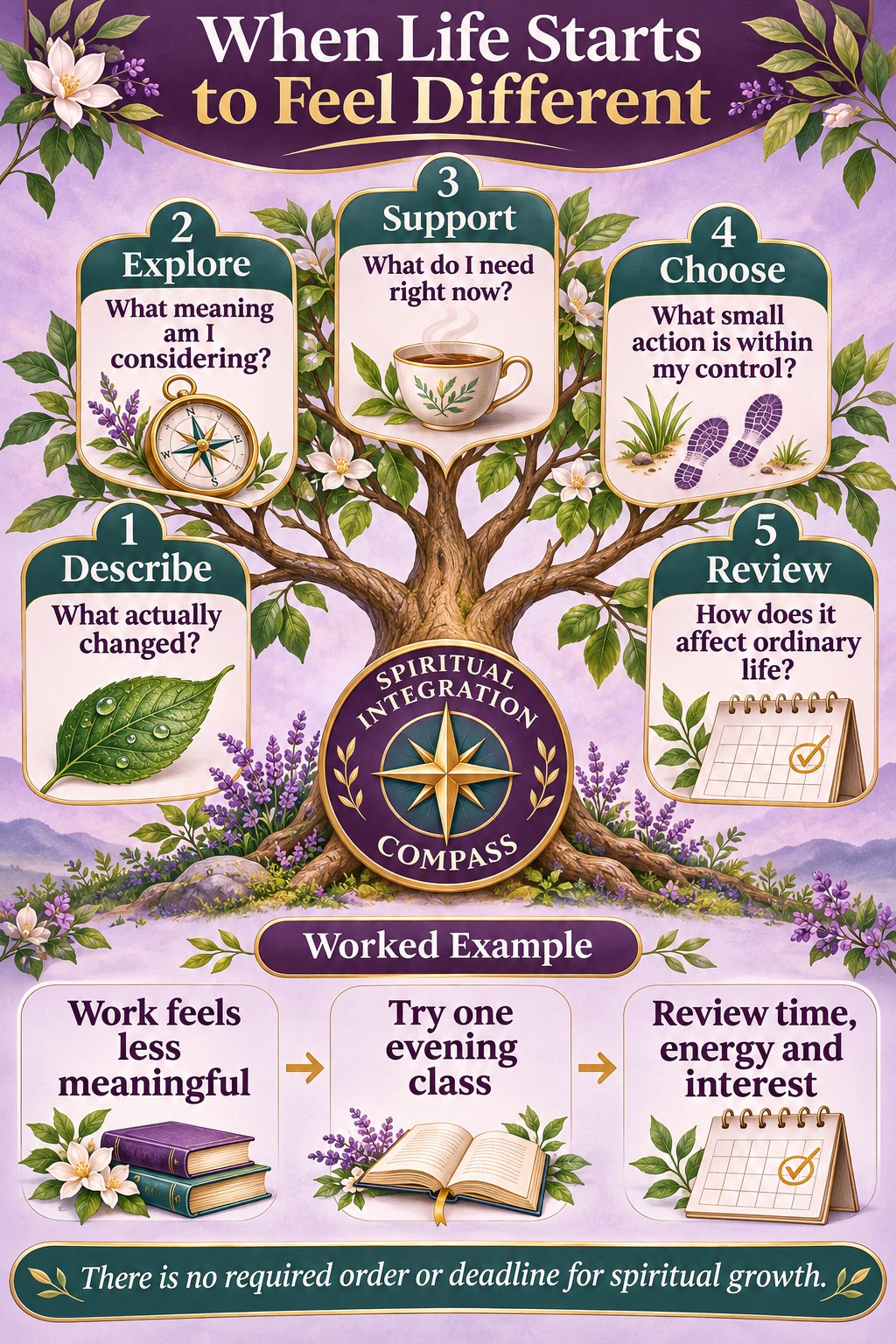
Free spiritual integration worksheet
Use these prompts in a private note on paper or your device. Return to one entry after a week.
- What changed? Describe one event, feeling or concern without interpreting it.
- What meaning am I exploring? Write a possibility, leaving room for another explanation.
- What do I need? Name a practical need, boundary or source of support.
- What is within my control? Choose one small, reversible action.
- How did it affect daily life? Notice sleep, responsibilities, relationships and whether the practice helped.
Example: “My work feels less meaningful. I may want more creativity. I need time to consider options. I will try an evening class before making a major job decision.”
When care matters more than finding a label
Hearing voices or seeing things others do not is not proof of newly awakened abilities. NHS guidance on hallucinations advises seeking medical help. If you become suddenly confused, feel in immediate danger or hear instructions to harm yourself or someone else, seek emergency help.
A helpful spiritual guide respects fees, consent and your freedom to seek other support. You do not need to cut off supportive people, ignore symptoms or make a dramatic life decision to demonstrate growth. Let an insight earn its place through the care it brings to an ordinary day.
Frequently asked questions
1. Do spiritual awakening stages happen in a fixed order?
No universal sequence establishes spiritual growth. These themes may overlap, recur or never describe your experience.
2. How long does a spiritual awakening last?
There is no dependable timetable. Focus on how you are functioning and what support or practices help rather than a deadline.
3. Can spiritual questioning begin without a crisis?
Yes. Curiosity, learning, a conversation or time in nature may prompt reflection. Suffering is not a requirement.
4. Does doubt mean I am going backward?
Doubt can be part of examining a belief carefully. It does not establish failure or a lower spiritual status.
5. Must I meditate every day?
No. Choose a practice that fits your life. Prayer, walking, creative activity or a brief reflection may suit you better.
6. Are physical symptoms proof of an awakening?
No. Pain, palpitations, exhaustion and other symptoms can have ordinary or medical causes. Seek appropriate advice rather than assuming spiritual clearing.
7. What if meditation makes me uncomfortable?
Pause or adapt the practice. Open your eyes, orient to the room and seek qualified support if distress continues.
8. Does wanting solitude mean I should leave everyone behind?
No. Quiet time can help without abandoning supportive contact or responsibilities. Consider what balance supports you.
9. Are vivid dreams spiritual messages?
Some people give dreams spiritual meaning. A dream can invite reflection without proving a message, prediction or another person’s thoughts.
10. What does 5D mean in awakening discussions?
It is used in some spiritual frameworks for a different state of awareness or connection. It is not an established scientific stage or a required milestone.
11. How can I choose a spiritual guide?
Ask about scope, cost and boundaries. Look for freedom to disagree and seek other support; avoid pressure, secrecy or promises to unlock a special rank.
12. Can I keep my religious faith while exploring these themes?
Yes. You can reflect within your own tradition and decide which practices fit your beliefs and values.
13. Should I change jobs during an awakening?
An insight may highlight a need, but a major job decision also needs practical information, time and consideration of responsibilities.
14. How do I know whether a practice helps?
Review its effect on daily life: sleep, relationships, responsibilities and your ability to make considered choices. A dramatic sensation is not the only measure.
15. Can I seek mental health support and still value spiritual meaning?
Yes. Qualified care and spiritual beliefs can coexist. You do not need to settle a spiritual explanation before asking for help.
The notion of becoming more powerful and knowing your worth during an awakening is a positive takeaway from the article.
The mention of connecting with higher powers and experiencing peace resonates with many philosophical teachings.
Seeing spiritual awakening as a journey that includes both challenges and growth opportunities is a realistic perspective.
The concept of changing one’s mindset as a sign of awakening is quite compelling and aligns with psychological theories.
The article provides a comprehensive overview of spiritual awakening, highlighting its deep-rooted cultural significance.
The article’s advice to connect with nature and practice mindfulness to hasten the awakening process is practical and encouraging.
I appreciate the detailed signs of an awakening, as it helps to identify and understand personal experiences better.
It’s interesting to see how various life events, both positive and negative, can trigger a spiritual awakening.