

Lunar rhythms · Spiritual reflection · Traditions
The moon offers a beautiful way to give spiritual practice a rhythm. Its changing appearance can become a reminder to begin, listen, adjust and rest. For someone who enjoys psychic readings, tarot or intuitive journaling, that rhythm can make a scattered practice feel more intentional.
Lunar cycles also have meanings far beyond contemporary psychic work. Communities around the world use lunar calendars and observances for different religious, cultural and practical purposes. Exploring those differences makes the subject richer than a single claim that everyone performs the same ritual beneath a full moon.
This guide brings together a clear phase reference, examples of distinct traditions and an approachable monthly practice. Use what supports your beliefs and daily life. You do not need to perform every exercise, feel a special sensation or buy anything to participate.
What changes during a lunar cycle?
The Moon reflects sunlight. As it travels around Earth, the portion of its sunlit surface that we see changes. NASA’s moon-phase guide explains the familiar eight-phase sequence and the approximately 29.5-day cycle. Ordinary phases are not caused by Earth’s shadow.
Waxing describes increasing visible illumination; waning describes decreasing illumination. These are astronomical descriptions. Associating waxing with growth or waning with release is a symbolic choice, useful for some practitioners but not a physical instruction governing your intuition.
For example, you might choose a new-moon intention because the idea of a fresh beginning speaks to you. That meaning can be sincere without requiring every new moon to produce a dramatic change. A quiet month can be just as valuable as an eventful one.
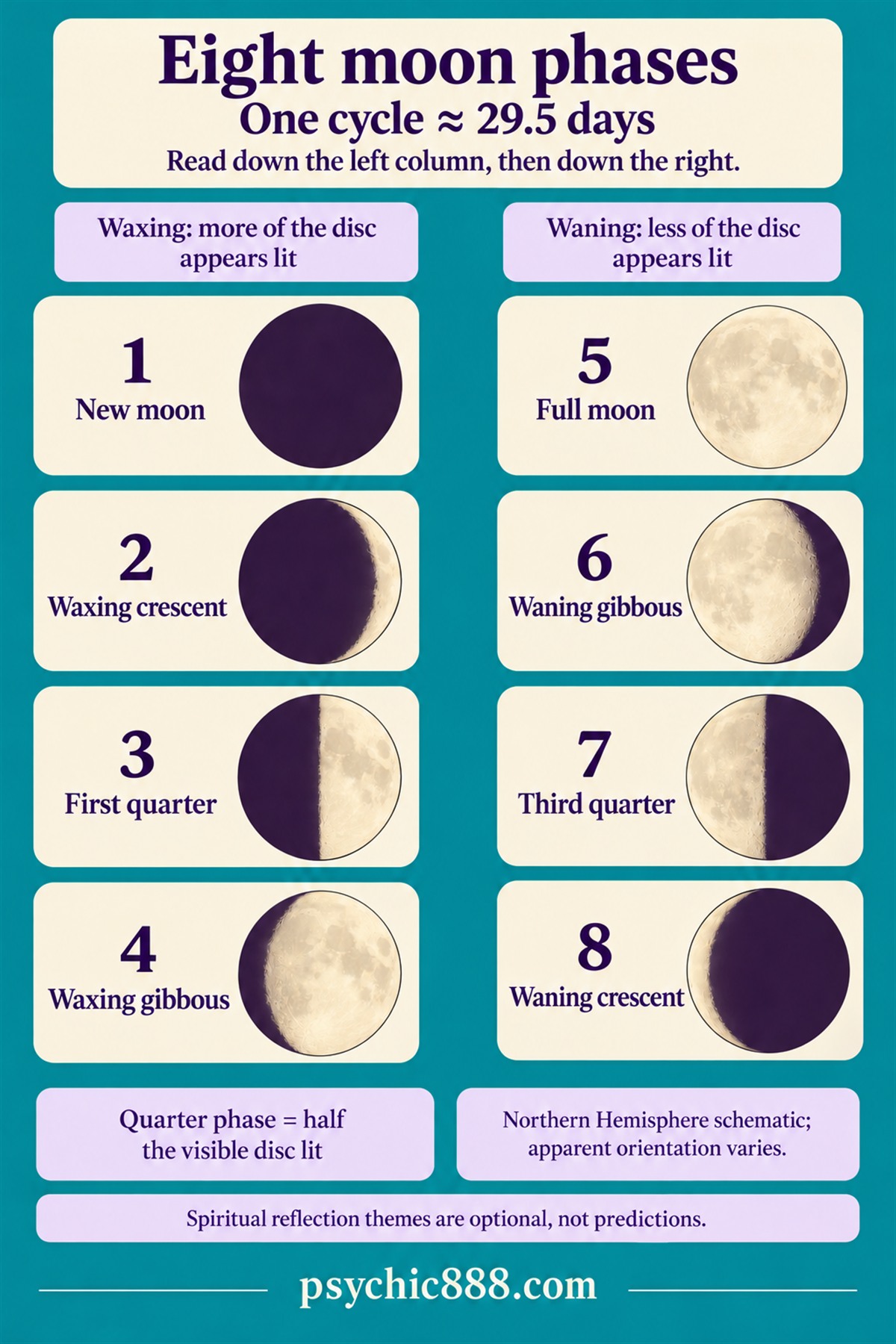
The eight moon phases: a practical reflection guide
The themes below are suggestions for a personal practice, not universal cultural teachings or predictions. A phase can give you a question to return to rather than tell you what must happen.
| Phase | Optional theme | Reflection question | A small practice |
|---|---|---|---|
| New moon | Begin | What would I like to make room for? | Write one intention and name a small first step. |
| Waxing crescent | Nurture | What support would help this beginning? | Choose a resource, conversation or manageable habit. |
| First quarter | Choose | Where do I need to make a decision? | Separate what you control from what you cannot. |
| Waxing gibbous | Refine | What needs adjustment before I continue? | Review your question and change one workable detail. |
| Full moon | Notice | What has become clearer? | Celebrate progress and record what remains uncertain. |
| Waning gibbous | Appreciate | What can I learn or share? | Write a lesson or offer sincere thanks. |
| Third quarter | Release | What commitment or assumption no longer fits? | Choose a practical boundary or simplify a task. |
| Waning crescent | Rest | What would help me feel replenished? | Leave space for quiet and prepare gently for the next cycle. |
Beginning and building: new moon to waxing gibbous
At the beginning of your chosen cycle, keep the intention specific. “Become more intuitive” is difficult to put into practice. “Spend five minutes noticing my first impression before I check my messages” is something you can actually try.
During the waxing phases, return to the same question instead of constantly replacing it. At first quarter, identify a decision or obstacle. During waxing gibbous, refine the plan. If your initial intention proves unrealistic, changing it is discernment, not failure.
A short tarot reflection can support this process: one card for what you are noticing, one for a helpful resource and one for a practical next step. Our guide to what to ask tarot cards can help you turn a broad concern into a clearer question.
Noticing and integrating: full moon to waning crescent
The full moon can be an inviting occasion to pause and acknowledge progress. Look back at what you wrote rather than asking yourself to feel especially powerful. You might discover a completed conversation, a changed assumption or a boundary that now feels easier to maintain.
As the visible moon wanes, consider what you can simplify. Release need not mean cutting someone out of your life or making a sudden irreversible decision. It might mean stopping a repetitive reading habit, declining one unnecessary task or letting a question remain unanswered for now.
The waning crescent can be a gentle reminder to rest. If quiet makes spiritual listening easier for you, enjoy it. If your clearest impressions arrive at another phase, there is no need to force yourself into this pattern. Your circumstances and comfort matter more than matching a chart.
Moon traditions around the world are not interchangeable
Lunar observances can connect people with teachers, religious devotion, seasonal knowledge and community. Calling all of these “psychic rituals” misses what makes each tradition meaningful. It is better to name a specific example, understand its purpose and let its community explain it.
Guru Purnima: gratitude for teachers
The Hindu American Foundation’s explanation of Guru Purnima describes an observance on the full moon of Ashadha dedicated to honouring the guru or teacher. Hindu, Buddhist and Jain communities observe it in their own ways. This is a specific religious occasion, not evidence that every full moon serves the same purpose.
A respectful personal takeaway is appreciation: which teacher, relative or mentor helped you grow? You can thank that person without claiming to reproduce an observance you have not learned within its tradition.
Australian Aboriginal lunar knowledge: community-specific accounts
In Eclipses in Australian Aboriginal Astronomy, researchers Duane Hamacher and Ray Norris discuss diverse accounts of the Moon and eclipses, including knowledge connecting phases with tides. The diversity matters: Australian Aboriginal peoples do not share one uniform lunar story or practice.
These accounts invite respect for knowledge embedded in particular communities and places. They are not a ready-made set of ceremonies for a general psychic reading. Learn from material communities choose to share, and keep cultural attribution attached to what you learn.
Contemporary Pagan practice: gathering and reflection
Some contemporary Pagan communities explicitly build rituals around lunar timing. Circle Sanctuary’s Circle Craft full-moon guidance, for example, includes spiritual reflection and journaling. Its Full Moon Circle also offers an example of community practice online.
This is an identifiable contemporary approach, not a claim that all Pagan groups agree or that every modern exercise has an ancient, unbroken lineage. If a gathering interests you, read its invitation and participation guidelines. Observing respectfully may be more appropriate than copying a ritual into your own practice.
Eclipses: powerful symbolism without urgent predictions
An eclipse can feel awe-inspiring. Spiritually, some people choose to reflect on change, visibility or uncertainty at that time. Those themes need not become warnings that something bad is approaching.
NASA explains that a lunar eclipse occurs at full moon when Earth’s shadow reaches the Moon; a solar eclipse occurs at new moon when the Moon passes between Earth and the Sun. Eclipses do not occur every month because the Moon’s orbit is tilted.
For a reflective reading, try “What am I ready to see more clearly?” or “What can wait until I have better information?” Avoid treating eclipse imagery as proof of hidden betrayal, unavoidable destiny or stronger contact with spirits. No celestial event obliges you to purchase an urgent cleansing or additional reading.
What research can—and cannot—tell us about lunar sensitivity
Noticing that you feel different around a full moon is an experience worth describing carefully. It does not, by itself, identify the cause. Expectations, evening light, sleep, stress and memorable events can all enter the picture.
A 2021 study of sleep under field conditions observed later and shorter sleep before the full moon in the groups studied, including Toba/Qom communities in Argentina and an urban United States setting. That finding concerns sleep timing; it does not demonstrate increased psychic ability or guarantee that you will experience the same pattern.
Likewise, a four-year emergency-department study found no significant full-moon increase in its measured patient volumes. A sweeping claim that full moons always cause chaotic behaviour is not a good foundation for spiritual guidance.
You can value lunar symbolism while keeping these distinctions clear. If sleeplessness or distress persists, seek appropriate support rather than assuming you must complete a ritual to resolve it.
A five-step moon journal you can actually keep
- Choose a manageable rhythm. Write once a week or at two phases you enjoy. Daily entries are optional. Start with a few lines rather than a long ritual checklist.
- Record ordinary context. Note the date, phase, sleep, mood and relevant events. Include calm and uneventful days so your record is not made entirely of striking coincidences.
- Separate observation from interpretation. “I dreamed of my grandmother” is an observation. “I felt comforted and associated it with her care” is your interpretation. Both can matter without becoming a verified prediction.
- Choose one grounded action. Make the phone call, take the walk or prepare the question you have been postponing. Let reflection support life rather than repeatedly delay it.
- Review several cycles gently. Look for patterns and exceptions. Ask what the practice helps you notice, not only whether a particular phase confirms what you expected.
An imagined journal entry might read: “Waxing crescent; tired after a busy week. I pulled a card and thought about asking for help. My first impression was that I need a better routine, not another prediction. Tomorrow I will set aside twenty minutes to plan the week.” The useful part is the connection between reflection and an achievable action.
If you want to explore impressions more closely, see ways to listen to your intuition. For a quieter starting point, try mindfulness through your senses.
Crystals, moon water and caring for your tools
Placing a crystal near a window or setting a closed jar beside your journal can be a meaningful symbol of dedication. You do not need to describe it as a scientifically established energy transfer for the ritual to have personal value.
Keep stones dry unless you know their material-specific care requirements. Avoid leaving valued objects where weather, pets or theft could damage them. Do not put crystals into drinking water: mineral composition and treatments vary, and appearance is not a safety test.
If you make moon water, remember that moonlight does not purify water. Keep paper tarot cards away from liquids, and do not use unknown or stored outdoor water for drinking, eyes or wounds. A decorative sealed container is enough for a symbolic practice. An empty bowl or a written intention can serve just as well.
Booking a lunar-themed psychic reading
Ask how the reader uses the phase: as a conversation theme, a tarot spread, an astrological interpretation or something else. Confirm the format, time, total cost and cancellation terms. An explanation should make the session clearer, not make you afraid of missing a narrow spiritual deadline.
Consider what you want to take away: a reflection question, a fresh perspective or a manageable next step. Our guide to preparing for a psychic reading covers practical questions to ask before booking.
The moon can be a companion to your practice rather than its supervisor. Let its changing light invite curiosity, gratitude and renewal, while keeping your choices, well-being and everyday responsibilities firmly your own.
20 questions about lunar spiritual practice
1. Do I need to follow the moon to have a meaningful psychic reading?
No. Lunar timing is an optional spiritual framework, not an admission requirement. Choose a time when you can listen comfortably, ask clear questions and afford the session without pressure.
2. Which moon phase is best for setting intentions?
Many contemporary lunar practitioners choose the new moon as a symbol of beginnings. You can also set an intention whenever a need becomes clear; a missed date does not invalidate it.
3. Does a full moon guarantee a more accurate reading?
No. Brightness and spiritual symbolism do not establish psychic accuracy. A full-moon gathering may feel meaningful, but evaluate the reader’s boundaries, clarity and terms independently of the date.
4. What is the difference between waxing and waning?
Waxing means the visible illuminated portion is increasing; waning means it is decreasing. In a personal reflection practice, you might associate these with developing an intention and reviewing or releasing it.
5. Is the first quarter a quarter-lit moon?
No. About half the visible disc is illuminated. The name describes its place roughly one-quarter of the way through the cycle, not the illuminated fraction.
6. Can I do a moon ritual indoors or under cloudy skies?
Yes. If your practice is symbolic, a journal, quiet room or calendar reminder can provide the focus. Seeing moonlight is not necessary, and bad weather need not become a test of devotion.
7. What should I ask tarot at the new moon?
Try: What deserves my attention now? What resource can support one small beginning? What action is mine to take? Keep questions focused on your choices rather than guarantees about another person.
8. What should I ask tarot at the full moon?
Ask what has become clearer, what you appreciate and what still needs honest attention. Compare the reading with your earlier notes instead of treating a dramatic card as an unavoidable event.
9. Is it wrong to rest during a waxing moon?
No. The phase guide offers themes, not rules for your body or schedule. Rest, treatment, caregiving and ordinary responsibilities take priority over a ritual calendar.
10. How can I start a moon journal without making it complicated?
Record the date and phase, one observation, your sleep and mood, a reflection question and one practical step. Review several cycles and include ordinary days, not just unusually vivid experiences.
11. What if my dreams seem stronger before a full moon?
Write them down if you wish, including changes in sleep, stress and routine. Treat their imagery as a reflection prompt rather than proof of a prediction or a message you must obey.
12. Does a lunar eclipse happen at the new moon?
No. A lunar eclipse happens at a full moon when Earth’s shadow falls on the Moon. A solar eclipse happens at a new moon when the Moon passes between Earth and the Sun.
13. Must I avoid readings during an eclipse?
There is no universal rule. Follow your own tradition if you have one, and postpone if the occasion makes you anxious or tired. An eclipse does not require an urgent paid reading.
14. Can I charge crystals in moonlight?
You may place suitable stones in a protected, dry location as a symbolic dedication. Moonlight charging is a spiritual belief, not a demonstrated change in a crystal’s healing or psychic properties.
15. Should I put crystals in moon water?
Not unless you have reliable material-specific guidance, and never use crystal-infused water for drinking. Some stones can be damaged by water or contain substances unsuitable for ingestion. Keeping stones dry is the simpler option.
16. Can I use moon water on tarot cards?
Keep liquid away from paper cards. A closed container beside a deck can serve as a symbolic ritual element without wetting or damaging it. Moonlight does not make water safe to drink.
17. Are all moon traditions forms of psychic practice?
No. Lunar observances may concern worship, teaching, calendars, land, seasons or community life. They should not all be relabelled as divination or treated as interchangeable rituals.
18. How do I learn about a tradition respectfully?
Begin with sources shared by the community itself. Learn the occasion’s name and purpose, ask whether visitors are welcome, and do not assume a public description permits you to reproduce a restricted ceremony.
19. Can I join an online full-moon gathering?
Yes, if the group welcomes participants and its approach feels comfortable. Check the time zone, cost, recording and privacy arrangements, and whether you may simply observe or leave.
20. How do I choose a reader who works with lunar cycles?
Ask how they use lunar timing, what the session includes and what it costs. Look for someone who welcomes questions and respects your decisions, without promising certainty or selling urgent protection from an eclipse.
‘The moon is a living presence’? Really? This sounds like poetic mumbo jumbo. If there are no scientific methods backing this up, why should anyone take these claims seriously? Let’s focus on facts instead of myths.
But facts are often shaped by beliefs too, Realist! Maybe it’s worth exploring these ‘myths’ as they could lead us toward new understandings of ourselves and our world.
This all sounds like a bunch of nonsense to me. The idea that a big rock in the sky can influence human behavior? Come on! Science hasn’t found enough evidence to back this up, so why should we believe it? 🤨
But Sam, science isn’t everything! Many cultures have believed in the moon’s influence for centuries, and personal experiences can’t be dismissed so easily. There’s more to life than just what can be measured!
Isn’t it funny how the same celestial body can elicit such differing responses? Whether one believes in lunar effects or not, it certainly reflects our deep connection with nature and shared humanity.
True, Penny; but do we need cosmic explanations for human behavior when psychology does just fine?
Why not appreciate both views? Psychology and spirituality can coexist beautifully if we allow them space!
“It’s like dialing a phone number while having no signal” – love that line! 😂 It perfectly captures how I feel during the waning crescent phase. Can’t wait for my next full moon gathering now!
I absolutely love this article! The way it connects ancient practices with modern psychic work is just beautiful. 🌕 It really resonates with my experiences during the full moon, and I feel more in tune with the universe. Thank you for sharing!
If I had a nickel for every time someone blamed their bad mood on the moon… I’d have enough to hire an astronomer who could finally tell me why everyone is acting weird every full moon! 😂
This article presents a fascinating perspective on lunar cycles and their impact on our psyche! It’s intriguing to see how different cultures honor the moon through rituals and traditions. 🌙 I’m eager to learn more about how I can incorporate this into my own life.
‘Psychics say’ doesn’t equal truth! It’s important to consider both sides of this debate—while many people claim to feel influenced by lunar phases, others have found no correlation. Let’s not ignore scientific skepticism! 🧐
‘Science says’ only goes so far; intuition matters too! Some folks just want deeper connections with nature and each other; can’t we let them have that without criticism?