

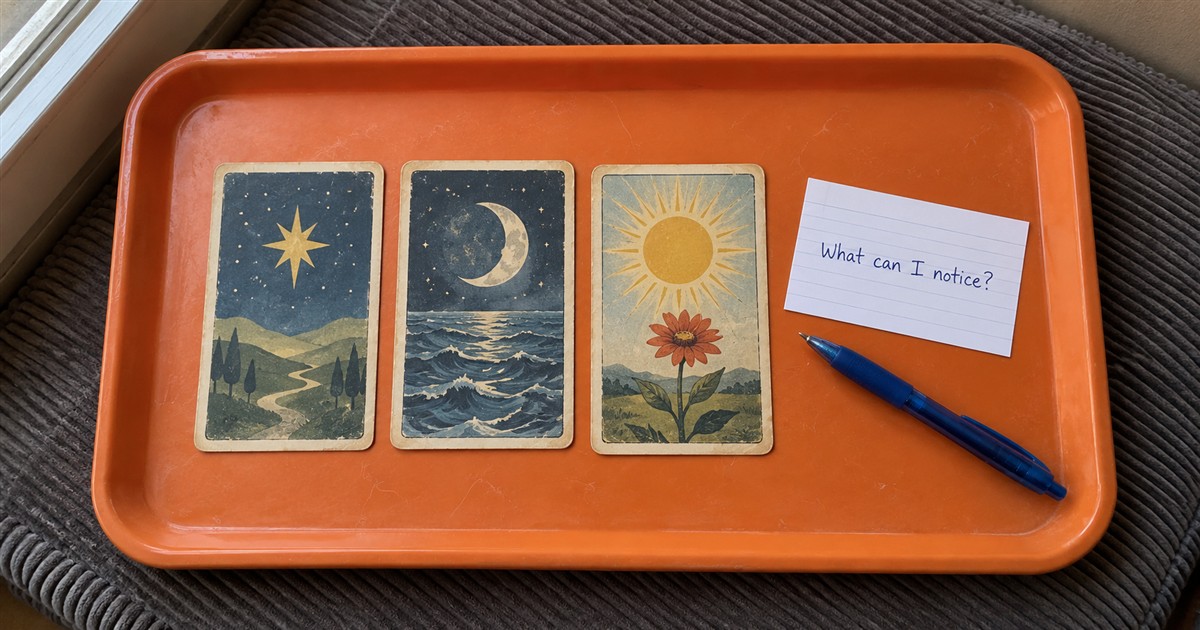
Tarot questions, meaningful reflection and personal choice
You have a deck in front of you, a question on your heart and the feeling that there is something worth exploring. But where do you begin? A useful tarot question gives the reading a focus without asking the cards to take over your life.
You do not have to hide uncertainty, sadness or longing to deserve a meaningful reading. Instead of dividing questions into “good” and “bad,” think about what kind of answer would actually help. A question about your needs, options or next step often offers more room for insight than a demand for a fixed prediction.
What makes a tarot question useful?
Good questions do not require perfect wording. Aim for a focus you can understand and an answer you can reflect on or act upon. For example, “What would help me prepare for my job interview this week?” has a clearer purpose than “Will my whole career work out?”
- Choose one topic: A relationship conversation, a creative project or a transition is easier to explore than every area of life at once.
- Keep your choices in view: Ask about what you can notice, express, prepare or change.
- Leave room for more than one interpretation: An open question can reveal a useful angle without pretending to settle the future.
- Give enough context: A short description helps a professional reader understand what you mean; you do not need to disclose private details you would rather keep to yourself.
- Use the right kind of support: Medical tests, legal advice and practical financial information answer questions that symbolic reflection cannot.
Tarot educator Brigit Esselmont discusses open-ended questions and follow-up questions as ways to deepen a reading. You can use that approach without assuming every card carries one certain answer.
A four-part way to phrase your question
- Name the situation: “I am considering a move closer to family.”
- Name the need underneath it: “I want support, but I value my independence.”
- Choose a focus: “What trade-off am I finding difficult to acknowledge?”
- Bring it back to your agency: “What conversation or information would help me explore that trade-off?”
You might end up with: “What do I need to consider about support and independence as I compare these two places to live?” That gives the reading a clear purpose while leaving the actual housing decision with you.
A time window can help define the exercise: “What could I practice this week?” It does not make a prediction more reliable. Avoid treating a month, season or card number as a guaranteed deadline.
Eleven common question topics—and more useful ways to explore them
The examples below keep the concerns people often bring to tarot, but change the reading’s job. You are not forbidden to discuss a difficult topic. You are separating meaningful reflection from claims a card cannot verify.
| Topic | Question you may bring | Reflective alternative | Practical boundary |
|---|---|---|---|
| Someone else’s commitment | Will they leave their spouse? | What boundary do I need while this relationship remains uncertain? | Their choices belong to them. Use direct conversations and actual agreements, not a reading as a promise. |
| Another person’s feelings | Do they hate me? | How can I respond to the distance between us while respecting both people? | A card cannot verify private thoughts. Difficult emotions are welcome topics; they do not make you a negative person. |
| Soulmate identity | What is my soulmate’s name? | What qualities would make a relationship feel loving and mutual to me? | Spiritual connection need not depend on a predicted name or one compulsory destiny. |
| Marriage timing | What year will I get married? | What would help me prepare for the kind of partnership I want? | A reading cannot guarantee a wedding date, and marriage need not be everyone’s goal. |
| Lottery results | Will I win the lottery? | What feeling am I hoping a sudden windfall would change? | Tarot cannot supply reliable winning numbers. Do not use cards to justify gambling or spending. |
| Moving decisions | Should I move? | What needs and trade-offs deserve attention as I compare staying and moving? | Compare actual costs, housing, support and responsibilities. The cards do not make the decision for you. |
| Court outcomes | How will court go for me? | What would help me organize my questions and cope with uncertainty? | Obtain legal guidance from a qualified attorney; do not treat a reading as legal advice or a verdict forecast. |
| Pregnancy or illness | Am I pregnant or sick? | What support would help me take the appropriate practical next step? | Use appropriate testing and health care. A tarot reading cannot diagnose pregnancy or illness. |
| A loved one’s recovery | When will my partner get better? | How can I offer care while also respecting my own limits? | Discuss prognosis and care with the health care team. Cards cannot establish recovery or survival. |
| Lifespan | How long will I live? | What deserves more of my attention in the life I am living now? | Tarot cannot establish a death date. If the topic feels frightening, pause and seek supportive conversation. |
| An unfocused request | Tell me anything about everything. | What part of my current work situation would be useful to reflect on today? | A general reading is possible; a chosen topic often makes it easier to connect the interpretation to your life. |
For pregnancy questions, use an appropriate pregnancy test and follow its instructions. The FDA’s pregnancy-test information explains why timing and correct use matter. Seek health care guidance for symptoms, uncertain results or other medical concerns rather than trying to confirm them through cards.
Relationship questions can be especially tender. Asking about your own boundaries does not mean the situation is your fault. If you love someone but feel unhappy, our guide to understanding relationship unhappiness offers space to consider your needs without pressure to stay or leave.
Sixteen tarot questions you can adapt to your life
Pick one question that fits today, not an entire list to ask in one sitting. Replace “this” with the situation you actually want to explore. These are original reflection prompts, not promises that the deck can establish facts about the future.
Love and relationships
- What do I need to express more clearly in my current relationship?
- What helps me recognize mutual respect while dating?
- What boundary would support my peace after a breakup?
- What quality can I bring to a conversation I have been avoiding?
Work, creativity and goals
- Which part of this project needs my attention before I begin?
- What strength have I been overlooking in my work?
- What assumption might be limiting how I approach this opportunity?
- What small action would help me explore this creative idea?
Personal growth and self-care
- What am I ready to make more room for in my daily life?
- Where could I be gentler with myself this week?
- What pattern would I like to understand rather than judge?
- What kind of support am I willing to ask for?
Spiritual reflection
- What quality would help me feel more connected to my spiritual practice?
- What does this symbol invite me to notice about my present experience?
- How can I honor an intention through an ordinary action?
- What would help me distinguish a meaningful impression from an assumption?
Older favorites still have a place: asking what you need to understand, how to develop a skill or what deserves attention in your goals can all open a reading. Make them more specific. “What skill would support my first month in this role?” is easier to use than “How can I have better skills?”
If you are learning to listen to inner impressions, our intuition guide includes ways to record what you notice without confusing a feeling with proof.
A simple three-card question practice
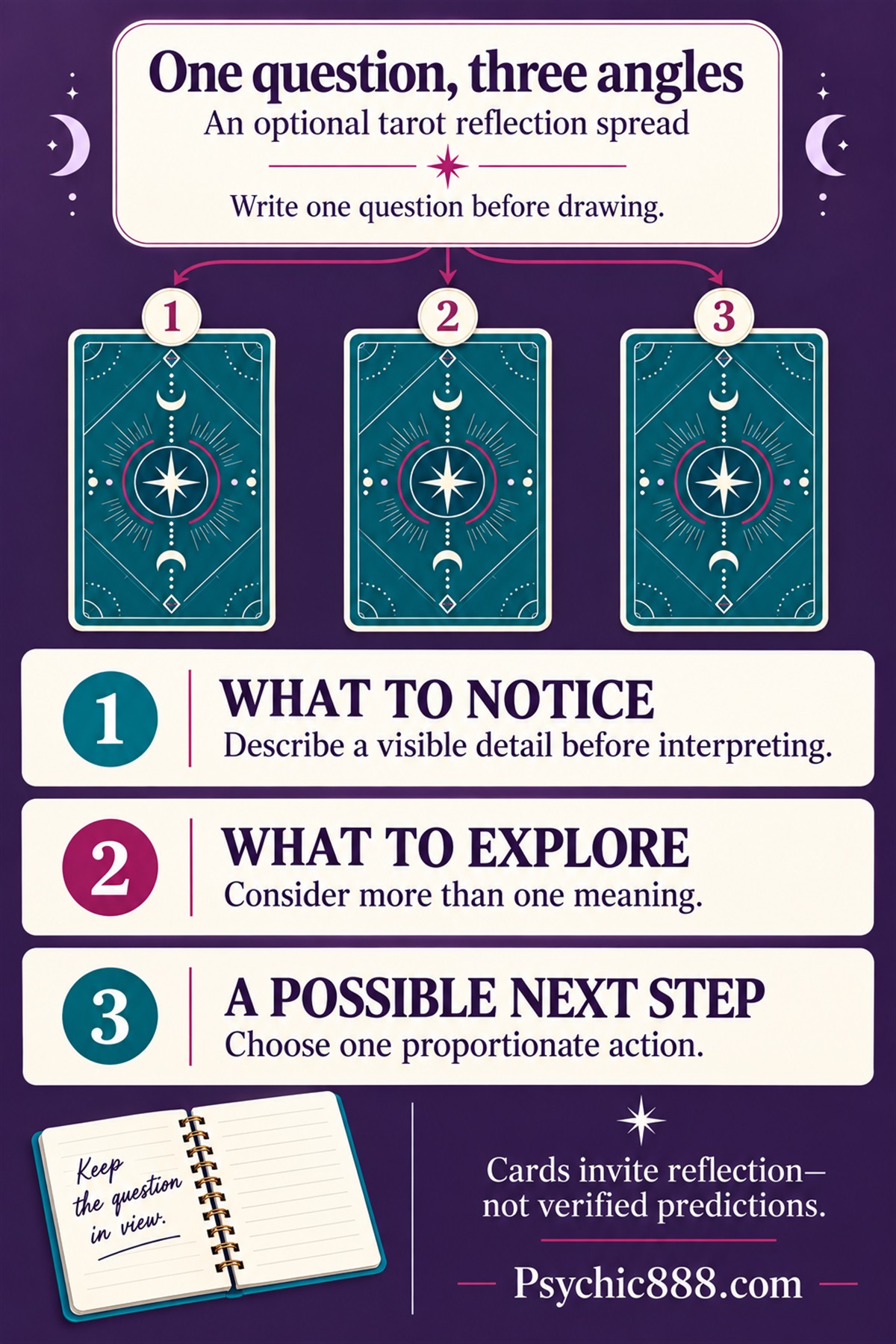
This optional exercise gives one question three angles. Use it with a reader or your own deck, and consult the deck’s guidebook if a symbol is unfamiliar.
- Choose and write the question. Keep it visible so the reading does not drift into unrelated worries.
- Give the three positions a purpose. Card one: what to notice. Card two: what to explore. Card three: a possible next step.
- Describe before interpreting. Write a detail you actually see—a figure, color, landscape or gesture—before attaching a meaning.
- Consider alternatives. Ask how the image might relate to your question and whether another interpretation also fits.
- Choose one proportionate action. A conversation, a small experiment or gathering information is more useful than a major decision made only because of a card.
- Close the reading. Record what you want to revisit after something changes. You do not need to keep drawing until you feel reassured.
For an imagined example, someone exploring a creative project might notice an image of a bridge. They could interpret it as collaboration, a transition or the need to connect an idea with practical steps. Rather than declaring “This project will succeed,” they might ask a friend for feedback on a first draft. The value lies in the reflection and next action, not in treating the symbol as evidence.
What about yes-or-no questions and general readings?
Some readers use yes-or-no methods, while others prefer open questions. Ask about their approach before booking. Even when a reader offers a yes or no, it is an interpretation—not a reliable guarantee of another person’s decision or an event.
You can follow a closed question with “What would help me understand my options?” without rejecting your spiritual practice. General readings can also be meaningful when you want broad reflection. If the discussion feels vague, choose one theme that resonates and ask how it relates to your present situation.
Our guide to preparing for a first psychic reading covers practical questions about format, boundaries and expectations. It is fine to tell a reader that you want reflection rather than a prediction, or to decline a topic.
When to pause rather than ask again
Wanting certainty is understandable, especially when a question involves love or change. But repeating the same reading until a favorable card appears can make it harder to hear your own priorities. Pause if you feel more pressured, frightened or compelled to spend after each session.
- Write down what you already learned instead of immediately drawing again.
- Take a break and do something ordinary that helps you settle.
- Identify what factual information or direct conversation is still missing.
- Return only if there is a new question, changed context or a genuinely useful angle to explore.
A reader should not use frightening interpretations to pressure you into paying for a cure, curse removal or repeated sessions. You can stop a reading, reject an interpretation and keep your choices. For a gentle way to end a reflective practice, see our spiritual self-care routines.
Leave the reading with something you can use
Before you finish, complete three sentences: “The theme I want to explore is…”, “The information I still need is…” and “One step I choose for myself is…”. You may leave with a new perspective rather than a final answer, and that can still be worthwhile.
Bring your real concern, ask with kindness and keep your freedom to choose. A thoughtful tarot question makes room for insight while keeping you at the center of your own life.
This article provides some useful guidelines about what to avoid when asking tarot card questions. It encourages positive and self-focused inquiries.
True. Shifting the focus to what we can control seems like a more constructive approach.
I agree. It’s important to focus on personal growth rather than expecting tarot cards to give definitive answers about others or specific events.
It’s intriguing how the article suggests focusing on self-improvement and dealing with present situations rather than fixating on the future or other people.
The emphasis on rephrasing questions to be more constructive is noteworthy. It aligns with the general principle of seeking guidance rather than absolutes.
The article’s recommendation to ask more specific questions makes sense because vague queries can lead to equally vague responses.
The part about not asking when one will die or win the lottery stood out to me. These are questions that inherently lack the depth needed for meaningful guidance.
I appreciate how the article promotes a responsible approach to decision-making, highlighting the limitations of tarot card readings.
Consulting medical professionals for health-related questions and legal experts for court cases, as suggested, is practical advice.
Absolutely. Tarot readings are no substitute for professional advice in these areas.
The notion of focusing questions on personal empowerment and better decision-making is a strong takeaway from this piece.