


Love & relationships · individuality · spiritual reflection
Falling in love can make everyday life feel brighter. You want to share stories, make plans and spend another evening together. That excitement is lovely—but it can also crowd out the friendships, interests and quiet moments that helped you feel like yourself before the relationship began.
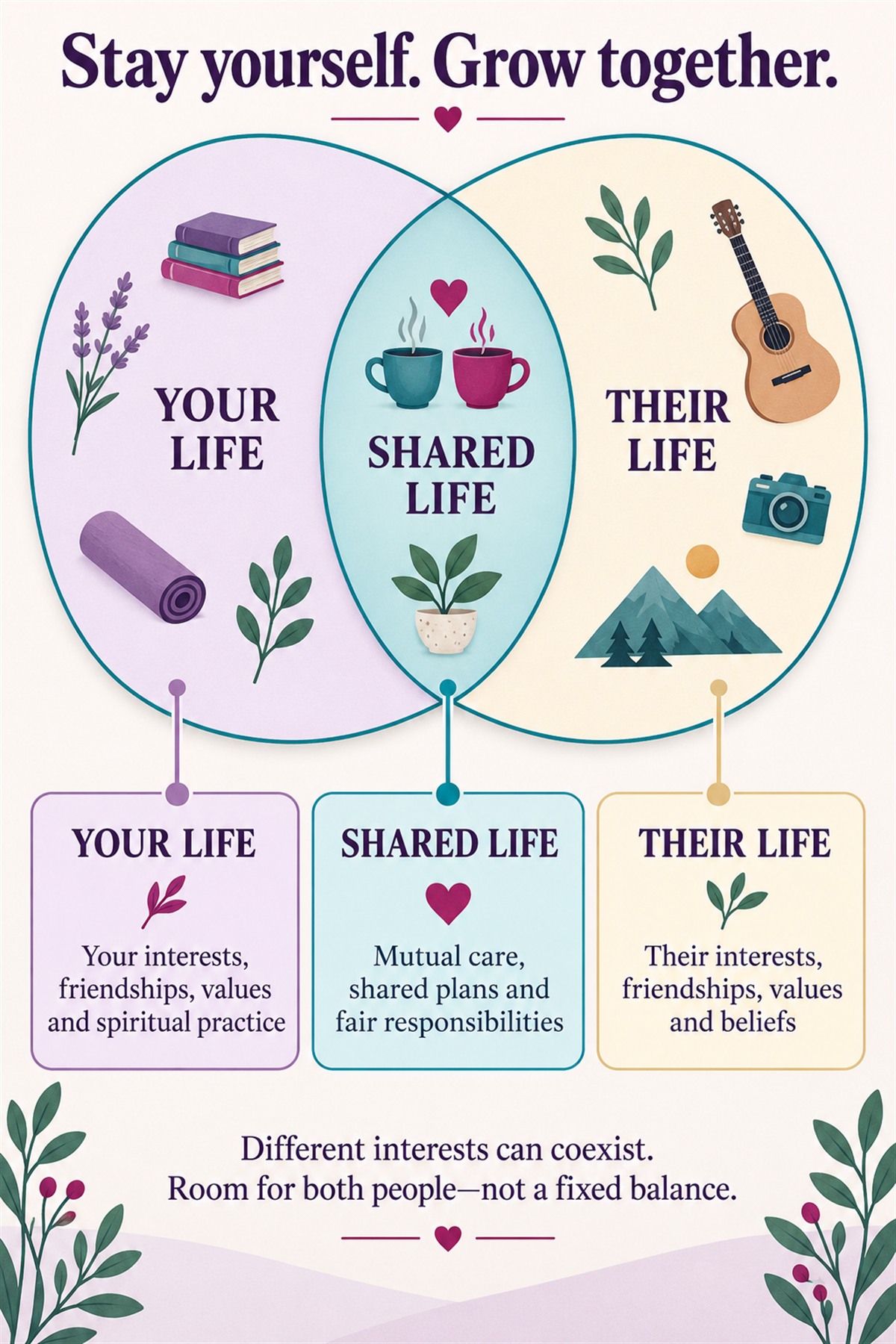
Not losing yourself in a relationship does not mean keeping your partner at a distance. It means making room for three things: your life, their life and the life you build together. You can be deeply connected without giving up your voice, values or spiritual practice.
If you have noticed that your world has become smaller, begin gently. You do not need to recover an old version of yourself perfectly. You can discover what matters to you now and bring more of it into your present life.
How can you tell you are losing touch with yourself?
A change in routine is not automatically a problem. New love, parenting, illness, work and shared responsibilities can all affect how much personal time you have. The question is whether the changes feel chosen, sustainable and open to discussion.
- You regularly say “I do not mind” when you have a preference.
- You have stopped contacting people you miss, even when you want to see them.
- You abandon a goal or spiritual interest mainly to avoid your partner’s disapproval.
- You feel guilty about ordinary rest, privacy or time apart.
- You struggle to name something you enjoy that is not connected to the relationship.
These are invitations to reflect, not a diagnosis or a verdict on your partner. Notice a specific pattern rather than deciding that you have disappeared. “I miss painting on Sundays” gives you a clearer starting point than “I have lost everything.”
Eight ways to stay yourself while growing together
1. Keep caring for your own needs
Make space for the things that sustain you: rest, meals, movement that suits your body, friendships, creativity and goals. Self-care is not a rule that your preferences must always win. It is a reminder that your needs belong in the conversation too.
Choose one small commitment you can keep this week. That might be twenty minutes with a book, a class you enjoy or a quiet morning prayer. If you share caring responsibilities, discuss a fair way for each person to have personal time rather than leaving one partner to carry the load.
2. Let “I” and “we” coexist
It is natural to enjoy saying “we.” You can also say, “I would like to try this,” or “That matters to me.” You remain an individual, and so does your partner.
Write three short lists: things you enjoy alone, things your partner enjoys independently and things you both enjoy. The lists do not need to match. If you love tarot and your partner prefers gardening, neither interest has to be converted into a shared hobby.
3. Distinguish compromise from self-erasure
Compromise can be caring: taking turns choosing a film or adjusting a weekend plan. It becomes harder to sustain when you repeatedly silence important values, accept disrespect or surrender something essential to avoid conflict.
Ask, “Is this a preference I can bend on, a shared responsibility we can negotiate, or a boundary I need to protect?” Also notice who adjusts. If the same person always yields, the issue may be the pattern rather than this evening’s decision.
Our guide to finding a relationship that fits your values explores compatibility beyond the excitement of attraction.
4. Stay connected to friends and supportive family
Keep relationships that offer kindness, perspective and a sense of belonging. You can spend time with others as a couple and independently. Not every family relationship is supportive, so choose people who respect your wellbeing rather than treating family contact as an obligation.
If you have drifted away, a simple message can reopen the door: “I have been caught up lately, but I miss you. Would you like to catch up next week?” You do not need an elaborate explanation to begin reconnecting.
5. Enjoy activities that are yours
A solo walk, a creative project or time with a friend can remind you of interests that belong to you. Time apart is not a guaranteed way to increase affection, and it should not be used to punish or provoke your partner. It can simply be part of a balanced life.
Start with something realistic. If a full afternoon is difficult, plan a shorter activity. For shared schedules, be clear about practical arrangements without treating ordinary independent time as something you must earn.
6. Set boundaries that protect rather than control
A boundary describes what you are comfortable with and how you will respond. It is different from telling your partner they are not allowed to have their own friends, beliefs or choices.
Love is respect’s boundary guidance explains that boundaries can involve emotional, physical and digital needs, and that they should not be changed through pressure. Your relationship does not have to look like anyone else’s, but mutual respect matters.
- Personal time: “I want to keep my Saturday class. Let’s plan time together afterward.”
- Privacy: “I am happy to talk about my day, but I do not want to share my account passwords.”
- Spiritual space: “My reading practice matters to me. You do not have to join, but I need it treated respectfully.”
- Conversation: “I want to discuss this, but I will pause if we start insulting each other.”
Boundaries work alongside care, not against it. Love with compassion and boundaries offers a spiritual perspective on caring without abandoning yourself.
7. Talk about a need, not just the frustration
Choose a reasonably calm moment when it is safe to speak. Name what you have noticed, what you miss and a practical request. “We spend every evening together, and I miss my art group. I would like to go on Thursday” is easier to discuss than “You never let me be myself.”
Listen to the response and make room for your partner’s needs too. A caring conversation may involve disappointment or adjustment; it does not require instant agreement. What matters is whether you can discuss differences without humiliation, intimidation or retaliation.
8. Allow growth without pretending
Staying true to yourself does not mean refusing every change. You may discover a new interest through your partner, reconsider an opinion or want to work on a habit that hurts others. Freely chosen growth is different from pressure to become someone you are not.
You do not have to fake enthusiasm for every hobby or accept every belief. Try, “I love that this brings you joy, even though it is not my thing.” Looking back at past relationships can help you recognize where you gave too much away and what you want to do differently now.
A spiritual check-in that keeps your choices with you
If tarot is part of your practice, use a simple three-card reflection to explore your own needs. It is not a way to read your partner’s private thoughts or establish whether a relationship is destined to last.
- What part of myself needs more room? Notice an interest, quality or value suggested by the card.
- What supports a caring connection? Look for a conversation, shared activity or form of respect you can practice.
- What small action is mine to choose? Turn the reflection into one step you can actually take.
For example, a card that evokes creativity might remind you to return to a neglected hobby. The useful next step is arranging time for it, not waiting for the deck to guarantee permission or an outcome. You can use the same prompts in a journal without cards.
Listening to intuition thoughtfully can help you separate an inner impression from something you know through observation. If you consult a reader, choose questions focused on your agency; our love-reading question guide offers examples.
Make a small plan for the coming week
Choose one personal activity, one supportive connection and one conversation. Keep the plan modest enough to fit your actual responsibilities.
- Something for you: return to a hobby, goal or spiritual routine.
- Someone beyond the relationship: contact a trusted friend or supportive relative.
- Something to discuss: ask for a workable balance of shared and individual time.
At the end of the week, ask what felt nourishing and what was difficult. Adjust rather than grading yourself. The aim is not a perfect balance every day; it is a relationship where both people’s lives and needs remain visible.
When the issue is control rather than closeness
If expressing an ordinary need leads to threats, monitoring, isolation or fear, treat that differently from a scheduling disagreement. You do not have to prove your independence through a confrontation that may put you at risk. Consider confidential support from a relationship-safety advocate, using a safer device if your activity may be monitored.
A spiritual bond, a promising reading or a label such as soulmate does not require tolerating harm. Your choices and safety still matter. Loving someone can be meaningful while leaving room for your own friendships, beliefs, hopes and voice.
While these tips are practical, they may be difficult to implement without mutual understanding from both partners.
The advice to maintain hobbies and friendships is well-reasoned. However, how do we measure the balance?
That’s a good point. Balancing personal time and relationship time seems challenging.
Perhaps it varies per relationship. Open communication might help to find that balance.
This article provides a comprehensive overview of maintaining individuality in a relationship, which is crucial for long-term happiness.
I agree. The emphasis on boundaries and self-care is particularly important.
The section on boundaries is quite enlightening. It’s an area where many relationships struggle.
Putting oneself first might seem selfish, but it’s actually a way to ensure both partners can thrive individually and together.
The mention of not compromising values is essential. This is often overlooked in many relationships.
Overall, a well-rounded article. Implementing these strategies can likely prevent many common relationship issues.
The focus on communication cannot be overstated. It’s the foundation of any healthy relationship.