

UNCERTAINTY / FEAR, CONTROL & SELF-TRUST
Uncertainty can range from self-doubt to changes in your relationship, career and the world around you. Some people enjoy not knowing what adventure is around the corner; others find comfort in safety, stability and a familiar daily life. Neither response makes you more or less capable.
When something important is unsettled, shifting your perspective may help you respond, but it cannot make every risk disappear. The aim is not to banish fear or predict the future. It is to find a workable next step while leaving room for what you do not yet know.
Tip 1: Label the fear without dismissing it
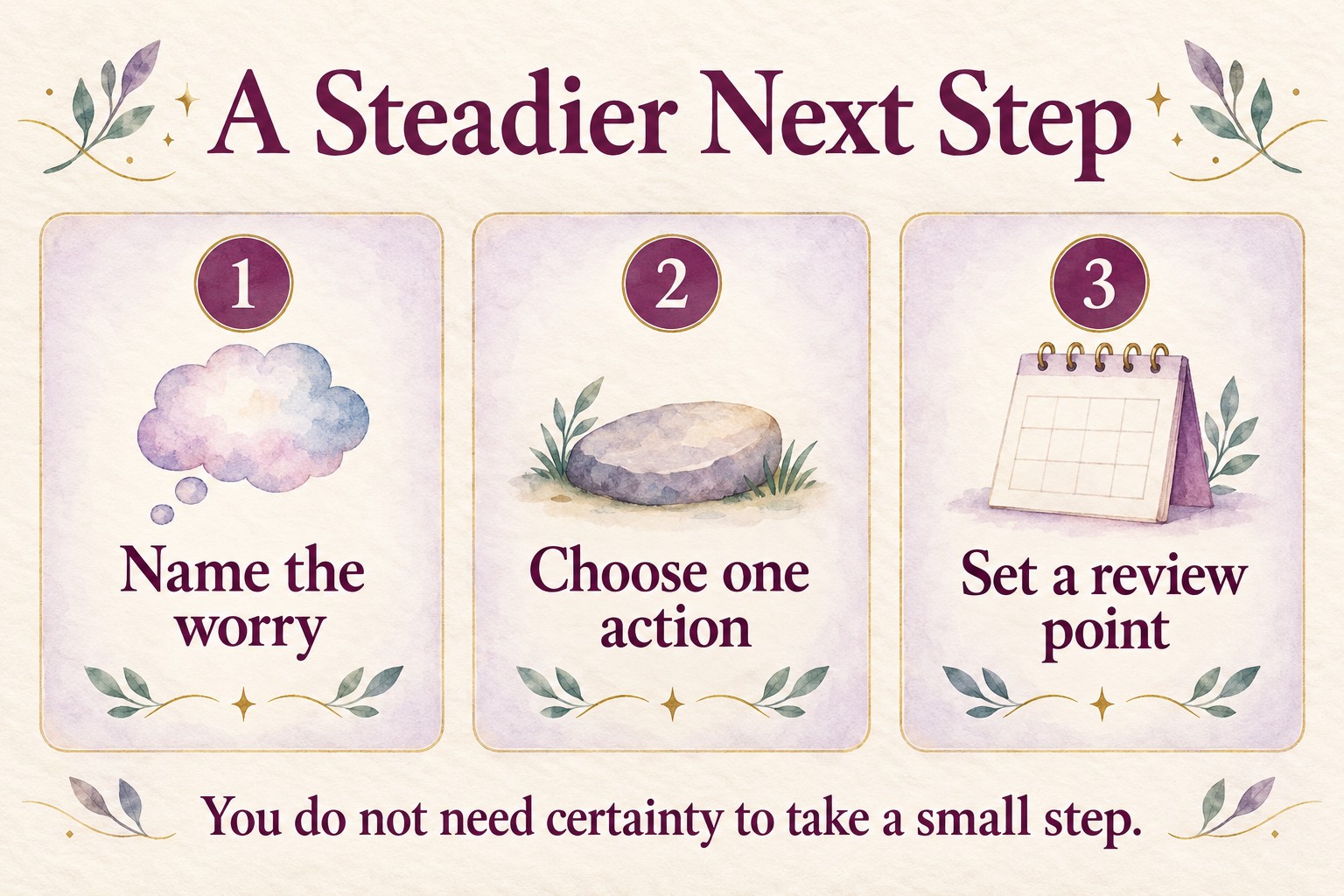
Fear and doubt may enter your life, and you should not automatically ignore them. Naming a fear gives you a chance to examine it: “I am worried that this change will leave me without support.” That is more specific than “Everything is going wrong.”
Separate what you know from what you imagine. If a friend has not replied, the known fact might be that a message remains unanswered. “They are leaving my life” is one possible interpretation, not an established fact. If a workplace has announced a change, the announcement is real; its effect on your particular role may still be unknown.
Ask whether there is an immediate concern to address, information to obtain or a possibility that cannot be resolved today. Naming fear must not become a reason to overlook threats, harmful behavior or practical deadlines.
The NHS guide to tackling worries distinguishes problems you can act on from hypothetical worries beyond your control. It also suggests writing down concerns and making specific plans where action is possible.
The original balloon image can remain an optional way to pause: imagine placing a repetitive worry in your open hand and watching it float away. You are setting aside the repeated rehearsal, not declaring the problem solved. If visualization is unhelpful, simply write, “I have considered this; my next check is tomorrow.” You do not need to produce a particular feeling.
Tip 2: Let go of total control, not useful action
Remind yourself that in any given situation there are factors you can control and factors outside your control. Instead of focusing only on doubt about the second group, turn your attention toward something you can actually do.
It can help to distinguish control from influence. You can send a clear request, but you cannot require a particular answer. You can prepare for an interview, but you cannot choose the hiring decision. You can ask about a plan, but you cannot make another person ready to commit.
Consider a fictional example: you are waiting to hear whether a course will run. Rather than repeatedly refreshing your inbox, you could check the published decision date, send one relevant question if needed and identify a backup option. Then choose when to check again. The course may still be canceled; the plan gives you something more useful than continuous guessing.
Letting go is not passivity. If the issue concerns health, housing, money or legal rights, seek appropriately qualified advice rather than relying on a prediction. A calmer outlook cannot replace the information needed for a consequential decision.
Our article on clarity and the law of attraction explores intentions alongside practical action. An intention can describe what matters to you; it does not control other people or guarantee an outcome.
Tip 3: Trust yourself enough to ask for help
Your skills and experience can be useful during change. Self-trust does not require having every answer or feeling confident all the time. It can mean recognizing a limit, checking an assumption and seeking outside assistance without treating that as failure.
Think of one previous difficulty you handled. What specifically helped: gathering information, asking a friend to sit with you, making a short list or taking time before replying? Borrow a useful action, not a promise that this situation will end the same way.
Intuition may draw your attention to a concern or preference. Give it room, then ask what evidence supports it and what else might explain the feeling. “I feel uneasy about this offer” can prompt you to read its terms or ask a question; it does not establish dishonesty or predict disaster.
Our guide to strengthening intuition offers ways to notice impressions without making them infallible. A trusted adviser should leave room for questions and your own judgment.
If prayer, quiet reflection or another spiritual practice helps you feel accompanied, it can be part of your routine. It need not provide an answer. You can hold hope while saying, “I don’t know yet,” and you do not cause an unwanted event merely by feeling worried.
Give waiting a shape
Choose a review point suited to the actual situation: a stated response date, a scheduled appointment or a reasonable follow-up time. An urgent issue needs an urgent response; this is not advice to postpone safety or healthcare concerns.
When the same non-urgent question returns, ask whether new information has appeared. If not, return to something available now: preparing a meal, completing a small task or contacting someone supportive. This is not avoidance if you have already identified the relevant action and timing.
The NHS guidance on change and uncertainty encourages short-term focus, manageable tasks and noticing strategies that have helped before. Your whole future does not have to fit into today’s plan.
Use a brief note if it helps: “The unanswered question is ____. My next action is ____. I will review it ____.” Keep the note private where appropriate. If writing starts to become another repetitive checking task, shorten it or choose a different approach.
Support matters more than perfect positivity
Feeling unsettled is not a spiritual failure. Ordinary care and connection matter alongside problem solving. Our article on self-alleviation can help you distinguish a responsibility you can carry from blame you do not deserve.
If distress persists, worsens or interferes with sleep, concentration or everyday activities, speak with a healthcare professional. The National Institute of Mental Health explains when to seek help and how a primary care provider can guide next steps. Self-help and spiritual support are not substitutes for needed care.
For now, choose one unanswered question rather than your entire future. Name it honestly, take a useful action if one is available and decide when to look again. You can be uncertain and still treat yourself with care.
Letting go of control is easier said than done, but it’s a necessary step to managing anxiety effectively.
Finding stability within oneself is a valuable lesson. External factors will always be unpredictable.
The article offers some good advice on handling uncertainty, though I wonder how applicable these tips are across different cultural contexts.
That’s an interesting point. Cultural differences can definitely impact how we handle uncertainty and fear.
Agreed. It would be useful to see more research into how these strategies work in various cultural settings.
The tips on managing fear and uncertainty seem quite practical. It’s important to acknowledge fear but not let it dominate our actions.
Labeling fear and letting it go seems like a mindful practice. It reminds me of meditation techniques.
I appreciate the emphasis on self-trust. It’s a crucial aspect of building resilience in uncertain times.
The article provides a balanced view on dealing with uncertainty. It’s a good reminder that perspective matters.
I believe these tips can be beneficial, especially in professional settings where uncertainty is a given.
Yes, especially the part about focusing on what you can control. It’s a key strategy in project management.
True. Understanding the limits of control can help in setting realistic goals and expectations in teams.