

SPIRITUAL WELLBEING / A GENTLER ENERGY RESET
Some days a room feels heavy, a conversation follows you home or your own thoughts seem louder than usual. If you understand those experiences as negative energy, you may want a ritual that helps you feel more grounded and connected to yourself. You do not have to fight your feelings or prove where they came from before offering yourself care.
A helpful reset makes room for both spiritual meaning and everyday needs. Perhaps you need quiet, food, rest, a clearer boundary or time to process something that hurt. Begin by listening rather than deciding that you, another person or your home is “bad.” The aim is not constant positivity. It is to create a little more space for an honest, manageable next step.
1. Rethink what “negative” means
Anger, sadness and disappointment are not signs that you have failed spiritually. They may be responses to a difficult experience, a need you have overlooked or a limit that deserves attention. You can welcome an emotion without letting it make every decision for you.
Before calling an experience someone else’s energy, separate what you felt from what you know. “I felt tense after that meeting” is an observation. “Everyone was sending me bad energy” is an interpretation. Your intuition can invite you to look more closely, while a journal helps you leave room for other explanations.
- What happened just before I began to feel this way?
- What emotion can I name without judging it?
- Is there a practical need I can meet now?
- What am I assuming about another person’s intentions?
For example, feeling drained after a busy gathering may mean you want a quieter evening, not that someone harmed your aura. You can choose solitude without assigning blame. If the idea of shadow work appeals to you, let it mean compassionate curiosity rather than a requirement to uncover a hidden wound in every uncomfortable moment.
2. Create boundaries around other people’s moods
You can care about someone without taking responsibility for all of their feelings. A boundary tells people what you can offer and what you will do; it does not require you to label them toxic or convince them that your spiritual interpretation is right.
Try a sentence that fits the situation:
- “I can listen for a few minutes, then I need to rest.”
- “I am not available for this conversation tonight.”
- “I would like us to speak without insults. I will step away if that continues.”
If you enjoy visualizing an energetic boundary, imagine a gentle edge around your personal space as you say the sentence to yourself. Then support that image with an action, such as ending the call or putting your phone aside. Our guide to getting your energy back after negativity offers more ways to connect a personal reset with clear limits.
A visualization should never ask you to tolerate threats or mistreatment. In an unsafe situation, prioritize distance, trusted support and practical help rather than trying to cleanse your way through it.
3. Make a bath or wash a simple transition
A comfortably warm bath, shower or hand wash can mark the transition between a demanding part of the day and your own time. Plain water is enough. As you wash, you might quietly say, “I can set this moment down and return to what I need.”
You do not need salt, expensive products or a particular scent for that intention. If you use a bath product, choose one intended for that use and follow its instructions. Avoid casually adding concentrated essential oils to the water or applying them directly to skin. Poison Control’s essential-oil guidance explains that misuse can cause poisoning or skin reactions and recommends following product directions.
Skip anything that irritates your skin, and keep oils away from children and pets. If bathing is uncomfortable or inaccessible, try changing into comfortable clothing or washing your hands. A ritual should adapt to you, not turn into another obligation. For a longer, gentle routine, see our spiritual-bath guide.
4. Use chakra colors as reflective prompts
If chakra meditation belongs in your spiritual practice, you can use a familiar seven-center framework to reflect on different parts of your life. Chakra teachings vary; the colors below are common in contemporary practice, not a test that can diagnose what is wrong with you.
- Root — red: What would help me feel more settled today?
- Sacral — orange: What feeling or creative interest needs room?
- Solar plexus — yellow: Which choice is mine to make?
- Heart — green: What would kindness include for me as well as others?
- Throat — blue: What do I need to express clearly?
- Third eye — indigo: What am I noticing, and what needs checking?
- Crown — violet or white: What helps me feel connected to meaning?
Sit comfortably and choose one color or prompt. Picture it gently if imagery comes easily, or simply read the question and write a sentence. You do not need to force a wheel to spin, feel a vibration or visualize all seven centers. Our sacral-chakra reflection guide includes adaptable creative practices you can try at your own pace.
5. Take a small mindfulness break
Mindfulness does not require a special cushion or an empty mind. Notice the support of your chair, the contact of your feet or the objects around you. Let your shoulders soften if that feels comfortable. You can keep your eyes open.
Allow a few gentle breaths without holding or forcing them. The NHS breathing guide describes comfortable, unforced breathing and an optional steady count. If focusing on breath feels unpleasant, return to an ordinary sound or the feeling of the chair instead.
When your attention wanders, there is no need to scold yourself. Notice where it went, then choose one anchor again. A short pause can be a way to check in, even when it does not change your mood immediately.
6. Let nature offer a change of surroundings
A tree-lined street, a garden, a view of the sky or an open window may give you a welcome change of pace. If you experience the earth as spiritually supportive, let that connection be personal and gentle. You do not have to go barefoot, swim in the ocean or travel somewhere special to belong in nature.
Choose a safe, accessible place and notice a few details: leaf shapes, shifting light or a bird’s call. Leave the pressure to feel transformed behind. A quiet moment outdoors can simply be a quiet moment outdoors. If going outside is not an option, look at a plant or a favorite landscape photograph.
7. Visualize release, then choose a real-world step
You might imagine warm light around you or picture a difficult thought resting on a leaf that floats away. Treat this as an optional image for reflection, not proof that an external force has been removed. If visualization is difficult, use words, music or a written intention instead.
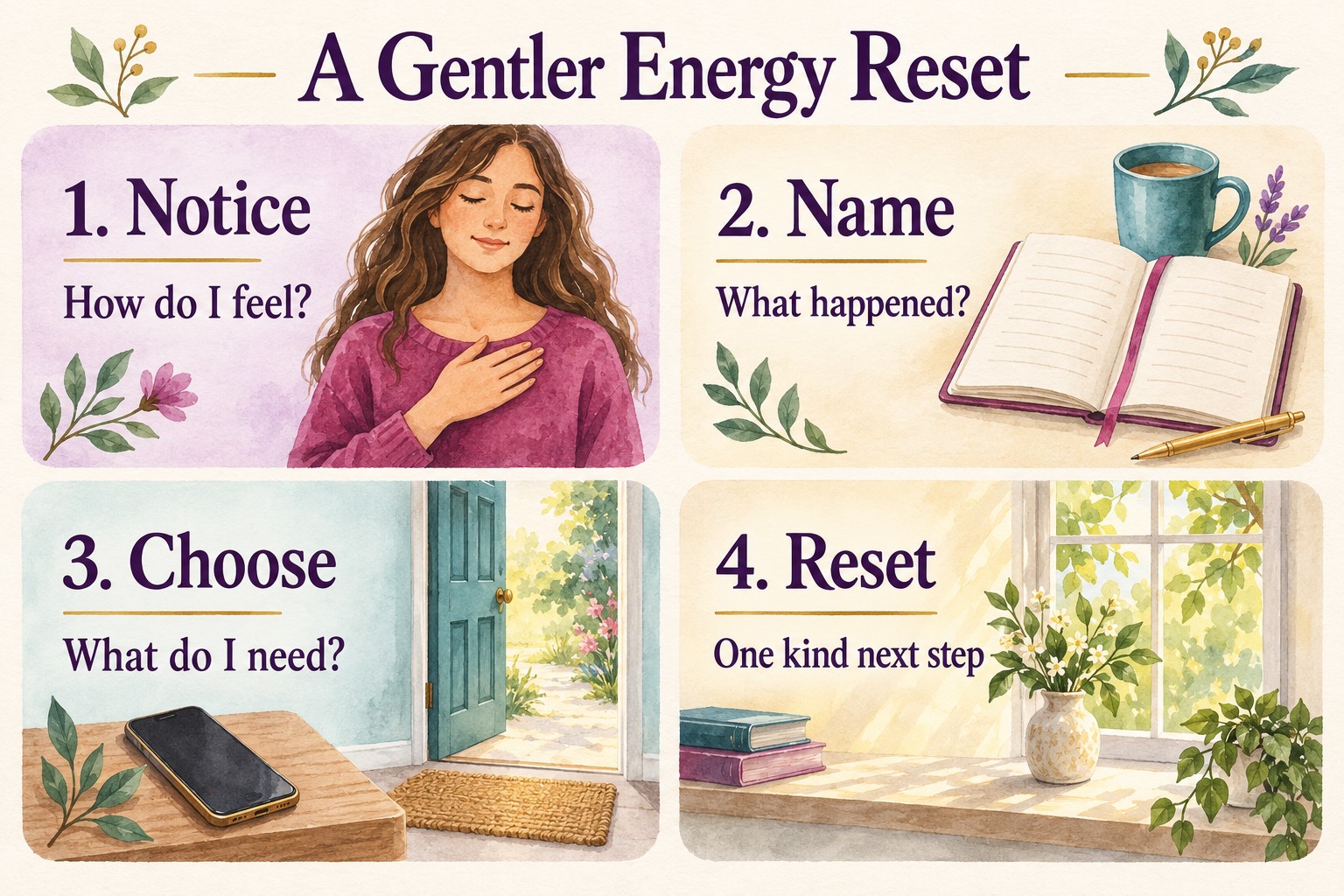
After a tense phone call, for example, you might notice frustration, name that the conversation ran longer than you wanted, choose a time limit for future calls and take a short break. A light visualization can accompany the reset; the time limit helps change the pattern.
For another symbolic approach, explore letting go of old energy. Choose one practice rather than collecting more rituals you feel you must complete.
If difficult feelings persist, disrupt your everyday life or leave you feeling unsafe, seek appropriate professional or trusted support. Spiritual practices can remain meaningful companions without replacing care. Be cautious of anyone who uses fear of a curse or “bad energy” to pressure you into repeated purchases.
You do not have to end the day perfectly calm to have cared for yourself well. Sometimes the most useful shift is knowing what you feel, respecting what you need and giving yourself permission to begin again tomorrow.
The connection between chakras and negative energy is intriguing. It’s interesting to see how ancient systems like the chakra system still hold relevance today.
The visualization techniques mentioned are quite creative and seem very effective for quick mental resets. This is something I would like to try more often.
The article provides a comprehensive overview of how negative energy can affect us and the various methods to mitigate it. The suggestions are practical and easy to implement.
I agree. The focus on mindfulness and visualization techniques is particularly useful for people who are new to managing their energy.
The historical context of chakras originating from the Vedas adds an important layer of depth to the discussion. Understanding the roots helps in appreciating the practices better.
The article does a good job of explaining complex concepts in a simple manner. The tips for chakra balancing meditation are quite useful for beginners.
Incorporating mindfulness and taking baths with essential oils are methods I’ve found helpful in my own life. The article’s suggestions are in line with what many wellness experts recommend.
Enjoying nature as a way to ground oneself is a timeless tip. The earth truly has healing properties that we often overlook in our busy lives.
I find the idea of ‘rethinking the negative framework’ particularly interesting. It’s a good reminder that not all negative feelings are inherently bad; they just need to be balanced.