

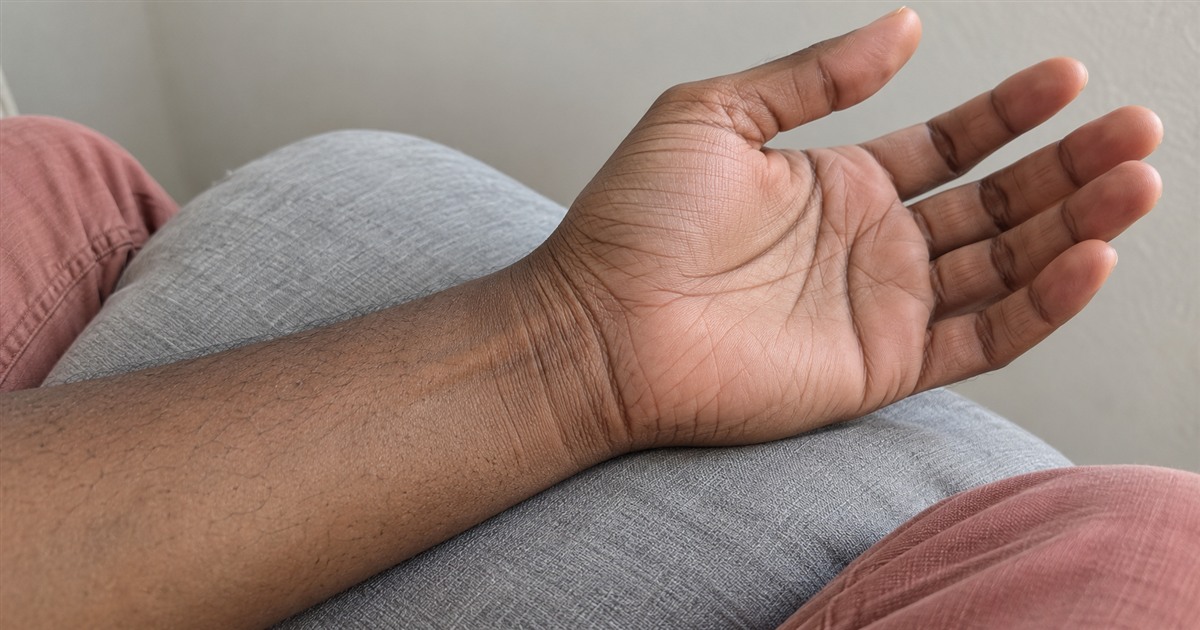
PALMISTRY / THE WRIST AND ITS SYMBOLS
When you turn your hand palm upward, notice the small horizontal creases where the palm meets the wrist. In palmistry, these are called bracelet lines, wrist lines or rascette lines. Their quiet position below the major palm lines makes them easy to overlook, yet they can become an interesting starting point for a reading about foundations, stability and the life you are building.
You do not need a perfect set of lines to explore their symbolism. A faint crease, a gap or a different pattern on each wrist is not a bad omen. This guide explains where to look, the meanings used in symbolic readings, how to compare both hands and why age predictions should not shape your expectations.
What are palmistry bracelet lines?
Look at the inner, palm-facing side of your wrist, just below the base of the hand. The transverse creases in this area are the features palmists call bracelets. The name describes their band-like appearance; it does not mean they must form complete rings around the wrist.
This location is different from the life line, which curves around the fleshy base of the thumb inside the palm. It is also different from a vein, scar or the impression left by a watch strap. If you are new to the subject, our introduction to palmistry places wrist lines within the wider hand-reading tradition.
Older writers included bracelets in their hand maps. For example, the 1895 book Indian Palmistry by Mrs. J. B. Dale describes lines across the wrist that may occur singly or in groups. Such books document historical beliefs; their medical and destiny claims should not be treated as facts about your body.
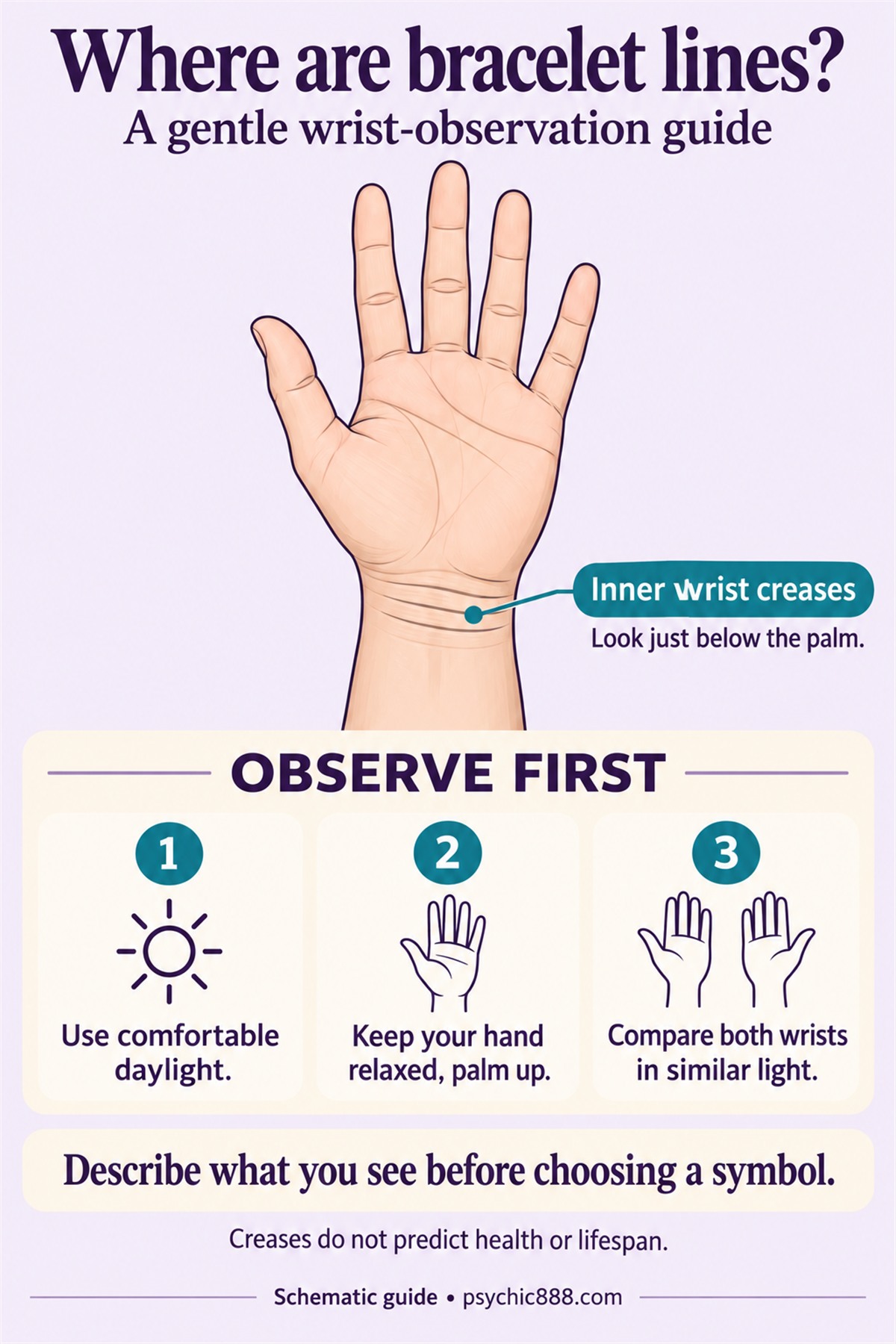
How to find your rascette lines: five gentle steps
- Choose comfortable daylight. Sit near a window or use a lamp. A little side light can help you see the creases without making every small shadow look significant.
- Rest your forearm and turn the palm upward. Keep your fingers loose and the wrist comfortable. There is no need to pull the hand back or hold a strained position.
- Find the first crease closest to the palm. Then look farther down the inner wrist for additional bands. Count the lines you can actually distinguish, rather than trying to reach a particular number.
- Notice shape before interpretation. Write “two clear creases and a faint lower one,” for example. That is an observation; “I am destined to be wealthy” is an interpretation.
- Compare the other wrist in similar light. Note differences without deciding that one hand is better. If you take photographs, use the same angle and relaxed position.
Skin creases can look different when the wrist bends or the lighting changes. Palmistry does not provide a reliable test that separates an “energetic line” from an ordinary skin fold. You can study the visible pattern without pretending it belongs to a separate anatomical category.
What do the first, second, third and fourth bracelet lines mean?
The original themes of vitality, comfort, recognition and spiritual growth can be useful when treated as invitations to reflect. Readers differ in their systems, so ask your palmist what they mean by each position. The following is a symbolic framework, not a universal code or a set of predictions.
| Position | Symbolic theme | Reflection question |
|---|---|---|
| First: nearest the palm | Foundations, vitality and steadiness | What helps me feel supported in everyday life? |
| Second: below the first | Comfort, resources and security | What would make my routines or commitments more sustainable? |
| Third: farther down the wrist | Contribution, recognition and influence | Where would I like to contribute without chasing approval? |
| Fourth: an additional lower band, if visible | Wisdom, legacy and spiritual growth | What do I want to carry forward or share with others? |
First bracelet: the foundation you return to
Some readings call the first bracelet a life-force or vitality line. You might use that language spiritually to consider what restores your sense of steadiness: a manageable routine, supportive people, quiet prayer or time outdoors. A strong-looking crease does not prove good health, and a faint one does not mean your energy is weak.
The useful question is not “What is wrong with my first line?” but “What foundation would I like to strengthen?” Let your actual experience answer. If you are feeling tired or unwell, seek appropriate care rather than trying to diagnose the cause from your wrist.
Second bracelet: comfort and the life you are building
The second line can be explored through themes of resources, responsibility and stability. In a reading, this may open a conversation about where you feel secure or which commitments you would like to simplify. It cannot verify your finances, forecast a job change or promise wealth.
A practical response might be choosing one routine you can maintain, reviewing a commitment or asking for help with a responsibility. The action is valuable because it addresses your life, not because a particular crease guarantees success.
Third bracelet: contribution and recognition
The third-line theme of influence need not mean fame. It can invite reflection on teaching, caring for family, creating something meaningful or participating in a community. You may feel drawn to work that has an impact beyond your own immediate needs.
Not seeing a third line does not limit your contribution. Being a thoughtful friend or a trusted guide is shown through your actions, not certified by a hand pattern.
Fourth bracelet: wisdom and spiritual growth
If you can distinguish a fourth band, you may enjoy exploring legacy, mature perspective or the lessons you hope to share. These are gentle spiritual themes, not evidence that you are more evolved than someone else. An extra line does not establish a longer life, superior gifts or a special destiny.
One, two, three or four lines: does the number matter?
You may see one prominent line, several bands, or a mixture of clear and faint creases. Do not force small fragments into a count simply because an online chart promises a desirable meaning. Different readers may count the same wrist differently.
- One visible line: begin with the foundation theme. It does not mean a short life or limited potential.
- Two visible lines: explore the relationship between personal steadiness and practical security. It does not prove a particular level of resilience.
- Three visible lines: consider how your foundations support contribution to others. Three lines do not guarantee wealth, recovery or recognition.
- Four visible lines: include a legacy or wisdom question if it interests you. More lines do not make a person luckier, healthier or spiritually superior.
There is no need to assign yourself a score. A reading becomes more personal through the questions you bring, not through collecting the largest number of markings.
Can bracelet lines predict age or lifespan?
No: do not calculate your age, remaining years or date of death from bracelet lines. You may encounter old formulas assigning a span of years to each band. Historical formulas are part of palmistry folklore, not a dependable method of predicting how long someone will live.
In his 1897 Practice of Palmistry for Professional Purposes, C. de Saint-Germain records differing year assignments and expresses doubts about traditional rascette interpretations. Even this historical text does not present one consistent rule. Reading it as a record of the tradition is different from accepting its predictions.
If a reader offers a frightening age estimate, you can decline that topic or end the session. You do not have to purchase a cleansing, another reading or a remedy to “correct” a wrist line. A respectful spiritual consultation should leave room for your choices.
Breaks, chains, forks, islands and curved lines
Small details can add variety to a symbolic reading, but they should not become a search for hidden problems. First describe the visible shape. Then consider whether a suggested theme feels useful, without treating it as proof of an event.
Straight and curved lines
A straighter band may be used as an image of consistency; a curved one may suggest flexibility. Both can be positive themes. You might ask, “Where would more structure help?” or “Where can I make room for change?” The shape does not determine whether you are practical, emotional or dependable.
Breaks and gaps
A gap can become a symbol for transitions, pauses or a fresh chapter. It does not reveal a divorce, accident or career disruption. If you are already navigating a transition, the symbol may help you talk about what you want next; it cannot establish that the transition occurred.
Chained or loop-like markings
A line that seems made of linked little loops may prompt reflection on overlapping responsibilities or a need to simplify. It does not measure stress or nervous-system tension. If the responsibility theme resonates, name the real task or relationship behind it rather than blaming the shape of your hand.
Forks and splits
A fork resembles a small branch or Y. As a reflection symbol, it can represent alternatives, movement or two directions that deserve attention. Consider what information you need before choosing. The mark does not confirm travel, relocation or a future opportunity.
Islands and enclosed shapes
An enclosed oval-like marking can be used as an image of a contained chapter, a pause or a need for breathing room. It is not a sign of disease, infertility or a particular period of exhaustion. If you cannot clearly distinguish the shape, leave it unlabelled.
Left hand versus right hand: compare without ranking
Some palmists use the dominant hand to discuss lived choices and the non-dominant hand to discuss potential or inherited themes. Other readers use a different approach. Ask which system they follow, especially if you are left-handed or use both hands for different tasks.
Differences in visible creases do not prove that you have lost vitality, healed trauma or developed psychic gifts. You can still enjoy the comparison as a conversation about what feels familiar and what you are choosing now. Neither hand needs to “catch up” with the other.
If you photograph the lines again later, changing appearance is not proof of spiritual progress or decline. Compare like with like: the same light, angle and relaxed posture. Your journal of actual experiences offers a more useful record of growth than trying to interpret every change in a photograph.
Bracelet lines, love and personal boundaries
The original relationship theme is worth keeping as a reflective conversation. Stability might invite you to consider consistency, reciprocity and the support you give and receive. A chain-like pattern might be a visual reminder to ask whether your responsibilities leave room for rest.
These interpretations cannot reveal another person’s feelings, establish your loyalty or decide whether a relationship should continue. Use a reading to explore your own needs, then ground decisions in communication and observable behaviour. Our guide to keeping your sense of self in a relationship explores that companion theme.
Bracelet lines and spiritual sensitivity
You may experience palmistry as part of your intuitive or spiritual practice. A reader might describe the wrist as a symbolic bridge between receiving, expressing and acting. You can use that image to ask how you want to bring an impression into daily life.
No bracelet pattern can certify psychic ability or make someone a healer. Rather than searching for a “gifted” wrist, try a simple practice: notice an impression, write it down, and distinguish it from what you later learn. Our guide to listening to intuition offers ways to combine spiritual curiosity with clearer choices.
A quiet closing ritual, such as washing your hands or taking a few comfortable breaths, may help you mark the end of a reflection session. Treat it as a personal ritual, not a necessary removal of harmful energy or a treatment for your nervous system.
Three illustrative reading examples
These are imagined examples for learning, not client accounts or verified case histories.
Two clear creases and a faint lower band
You observe the pattern, then explore foundation and security. A useful question might be, “Which part of my routine feels reliable, and which part needs attention?” You choose one manageable action, such as setting aside time for a task you have been avoiding. The faint band is not a negative verdict.
A visible gap in the second band
You use the gap as an image of a transition you already know about. If you have recently moved, you might reflect on what makes the new space feel like home. Do not work backward from the gap to invent a disruption that has not happened.
An additional lower crease
You choose the legacy theme and ask, “What lesson would I like to pass on?” Perhaps you write a family story or offer guidance in an area where you have experience. You do not conclude that the extra band makes you wiser than another person.
Bring bracelet lines into the whole-hand reading
Within palmistry, bracelets are only one feature. Readers may compare them with the life line, the fate line or the Mount of Venus. These comparisons can create a richer symbolic conversation about life rhythm, direction and affection; they do not turn the hand into a diagnostic chart.
Ask the reader to explain their reasoning rather than accepting an isolated mark as a fixed verdict. Before booking, review what to know before a psychic reading, including your questions, spending limit and permission to stop.
A short bracelet-line reflection journal
- Observation: what can I actually see on each wrist?
- Symbol: which theme would I like to explore—foundation, security, contribution or wisdom?
- Personal context: what real experience makes this question relevant?
- Choice: what small, practical step can I take?
- Review: did the reflection help me understand something, or am I searching for certainty the lines cannot provide?
For example: “I see two clear bands. Security is the theme I chose. My schedule feels crowded, so I will discuss one commitment before adding another.” That is a useful reflection without claiming the bands diagnosed the problem.
Common mistakes to leave behind
- Treating a line count as a lifespan or age calculator.
- Assuming a broken or faint crease means poor health, bad luck or weak spiritual gifts.
- Using wrist lines to predict fertility, money, a partner’s feelings or a specific event.
- Forcing every tiny wrinkle into a named marking.
- Believing a changed photograph proves healing or a new destiny.
- Paying for a remedy because a reader makes you afraid of your hand.
Final thoughts: curiosity without a fixed fate
Palmistry bracelet lines can offer a gentle way to reflect on the foundations of your life. You can appreciate the tradition, enjoy its symbolism and discuss the themes that resonate without turning the wrist into a forecast. The most meaningful part of the reading is not whether you have one line or four; it is the understanding you carry into your next choice.
I enjoyed the nuanced approach here. The discussion about bracelets as energetic foundation markers rather than fatalistic signs is refreshing. The comparisons between dominant and non-dominant hands, and the ethical cautions against lifespan predictions, show respect for readers’ emotional safety while offering genuinely useful insight into resilience.
Great point about ethics. I especially liked the stress on not scaring clients and focusing on supportive guidance. Those cautions make me trust modern palmistry more, and I appreciate how the article blends observation with compassion and practical tips for self-care and interpretation.
Nice article. I like how it talks about wrist lines and what they mean. It explains things in a simple way I can follow. I feel encouraged to look at my own wrist now and learn more. Thanks for the gentle tone and clear steps.
This article balances practical advice with symbolic interpretation very well. I liked the reminders not to treat bracelet lines as deterministic and to consider context, lifestyle, and other hand features. It feels like a thoughtful guide for curious beginners and seasoned readers alike, offering useful tips and ethical cautions.
This is a remarkably lucid exposition bridging folkloric symbolism and pragmatic interpretation. The text resists reductionism, carefully delineating observational criteria such as depth and continuity of lines from speculative prognostication, and thereby affirms a humane methodology that privileges empowerment, context, and ethical practice over sensationalism.
This piece is both gentle and informative. It encourages reflection without drama, describing how bracelet lines relate to resilience, relationships, and boundaries. I liked the practical advice about comparing both hands and paying attention to changes over time rather than panicking about single markings. Very reassuring and useful.
Informative and approachable. I appreciated the step-by-step suggestions for examining your own wrist, like using side light and letting the hand relax. Those small tips make the practice accessible and reduce the chance of misreading transient wrinkles versus true bracelet lines, which is really useful for a first self-check.
I particularly valued the integration of physical, psychological, and energetic frames; by situating bracelet marks within broader relational and developmental narratives, the author provides a robust hermeneutic toolkit for readers seeking insight without ceding agency to deterministic claims about fate or lifespan.
Thanks for the how-to tips. I tried the lighting idea and could see my lines better right away. The part about bracelets changing with life made me feel hopeful because it means I can work on balance and recovery over time. That encouragement really matters. 😊
Very helpful piece. The examples about breaks, chains, and curved lines made the ideas clear without being scary. I appreciate how the author emphasizes growth and practical care instead of dramatic endings. It made me feel calmer and curious about trying a careful self-check at home. 😊
Enjoyed this read. The clear definitions and examples helped me to understand terms like islands, chains, and forks. It made palmistry feel less mystical and more observational, which suits me. I appreciate the ethical emphasis and the encouragement to use readings for personal growth rather than fear or fatalism.