

NUMEROLOGY / FOUR CHAPTERS OF GROWTH
Some seasons of life seem to invite a fresh start. Others ask you to become steadier, speak more honestly or make room for what matters now. In numerology, your four pinnacle numbers offer a symbolic way to explore those longer chapters.
A pinnacle reading can feel encouraging when you are reflecting on change. Its value is not in telling you that marriage, success or a difficult lesson must arrive on schedule. It is in giving you a thoughtful question to carry into the experiences you are already having.
What is a pinnacle number?
A pinnacle is one of four long-term cycles in a numerology chart. Each cycle receives a number derived from your birth date. Numerologists interpret that number as a theme for personal development, rather than treating every year as a completely new pinnacle.
Your Life Path number is another birth-date calculation. It is not interchangeable with a pinnacle number: in the timing method below, its single-digit value helps determine the length of the first cycle. Your four pinnacles then provide a sequence of themes to explore.
You can use that sequence when thinking about relationships, work, learning or spiritual growth. For example, a theme of expression might invite you to practice speaking clearly; a theme of structure might encourage a routine. These are invitations you can adapt, not instructions to change your life merely because a number says so.
Choose one calculation method before you begin
Numerologists do not all handle master numbers in the same way. Felicia Bender’s explanation of pinnacle calculations illustrates how reducing birth-date components can produce a different master-number notation from retaining them. Hans Decoz’s chart-calculation guide uses a master-number-preserving approach.
This beginner walkthrough uses single digits throughout. Reduce each birth-date component to a digit from 1 to 9, and reduce each pinnacle result the same way. If your reader uses 11, 22 or 33, ask them to explain their convention rather than mixing their results with this method halfway through.
To reduce a number, add its digits and repeat if needed. For example, 23 becomes 2 + 3 = 5; 1987 becomes 1 + 9 + 8 + 7 = 25, then 2 + 5 = 7. You only need your complete birth date for this walkthrough, not your name or birth time.
Calculate all four pinnacles: a worked example
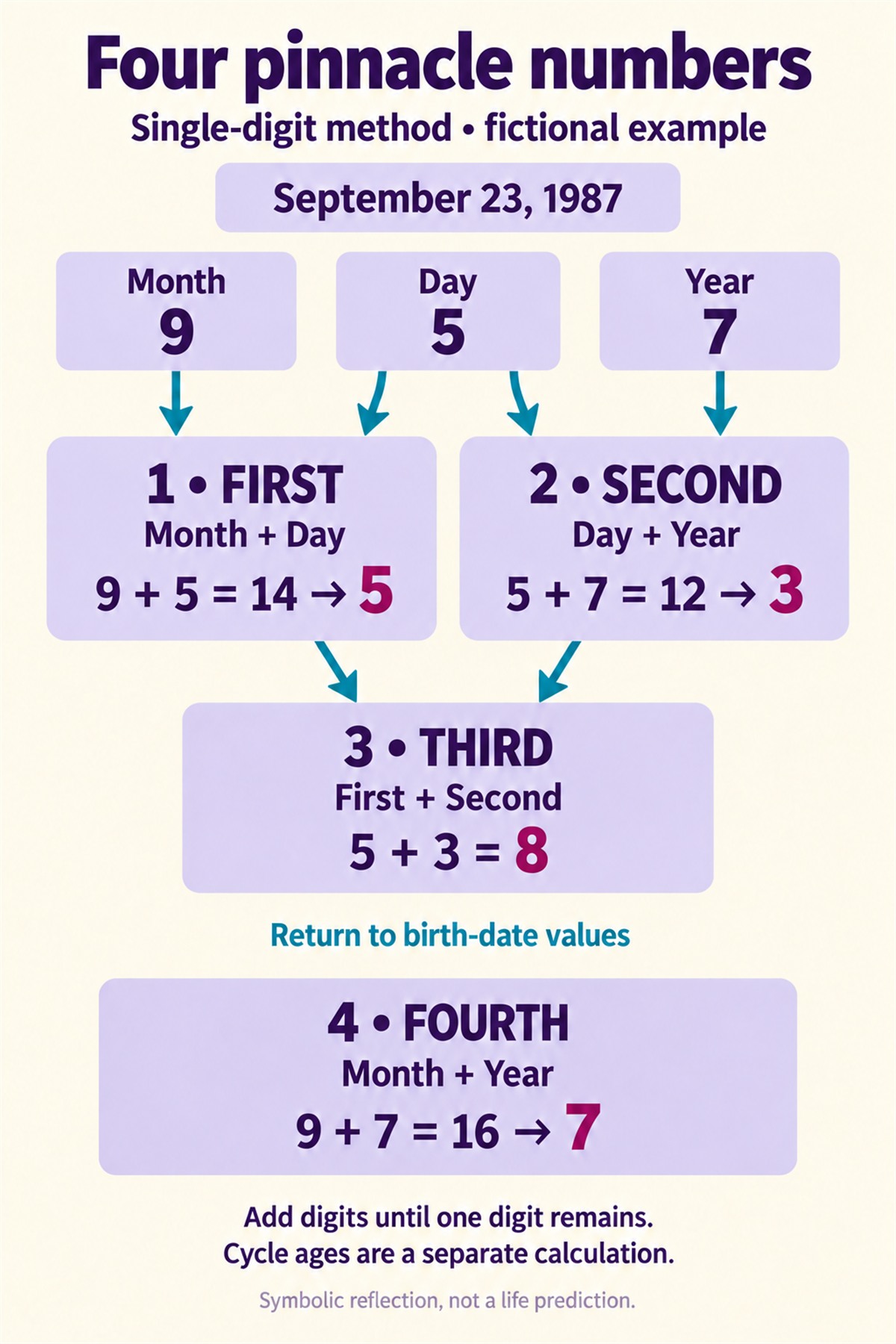
Let’s use the fictional birth date September 23, 1987. Writing the month in words avoids confusion between month/day and day/month date formats.
- Month: September = 9.
- Day: 23 → 2 + 3 = 5.
- Year: 1987 → 1 + 9 + 8 + 7 = 25 → 2 + 5 = 7.
Keep those three values visible: month 9, day 5, year 7. Then use the following combinations.
| Cycle | Add these values | Worked example |
|---|---|---|
| First | Reduced birth month + reduced birth day | 9 + 5 = 14 → 5 |
| Second | Reduced birth day + reduced birth year | 5 + 7 = 12 → 3 |
| Third | First pinnacle + second pinnacle | 5 + 3 = 8 |
| Fourth | Reduced birth month + reduced birth year | 9 + 7 = 16 → 7 |
The four pinnacle numbers in this example are 5, 3, 8 and 7. Notice that the third uses the first two pinnacle results, while the fourth returns to the month and year. You do not calculate the third by adding nine, and you do not subtract a pinnacle number from 36.
Check the additions once before interpreting them. A simple arithmetic mistake can change the whole sequence, while a difference caused by a stated master-number convention is a separate issue.
When does each pinnacle cycle begin and end?
For this example, the single-digit Life Path calculation is 9 + 5 + 7 = 21 → 3. Subtract that Life Path value from 36: 36 − 3 = 33. The first transition is therefore at age 33. Add nine years for each of the next two transitions: 33 + 9 = 42, then 42 + 9 = 51. The fourth cycle continues from that point onward.
This follows the cycle-length pattern described in Bender’s pinnacle timing guide. The table uses birthdays as boundaries: a cycle ends where the next begins, so there is no overlapping year.
| Cycle | Example ages | Number |
|---|---|---|
| First | Birth to the 33rd birthday | 5 |
| Second | 33rd birthday to the 42nd birthday | 3 |
| Third | 42nd birthday to the 51st birthday | 8 |
| Fourth | 51st birthday onward | 7 |
Some charts print whole-year labels such as “0–33” and “34–42,” while others show shared transition ages. Ask which labeling convention is being used if two reports seem one year apart. A birthday boundary is a chart convention, not a promise that an event will happen on that date.
For Life Paths 1 through 9, the first transition under this rule falls between ages 35 and 27. If your Life Path is written as a master number, use its single-digit value for this age formula rather than subtracting 11, 22 or 33 from 36.
How to read the four chapters without forcing a life script
First pinnacle: discovering your own way
The first chapter spans childhood and early adulthood in this system. You might explore how you learned to make choices, develop confidence and find your place. Your upbringing and opportunities matter; a chart should not erase them or blame you for circumstances outside your control.
Second pinnacle: developing what you have begun
Rather than assuming this cycle must mean marriage or business success, ask what responsibilities and connections you want to develop. That could involve a relationship, a craft, further study, a community role or a change in priorities.
Third pinnacle: bringing experience into practice
This chapter can be a useful place to reflect on what you have learned and what you want to strengthen. Maturity does not require permanent peace or certainty. You can refine a plan, learn a new skill or revise an old belief at any age.
Fourth pinnacle: choosing what to carry forward
The last chapter is not a deadline for retirement or a prediction of emotional security. It can invite reflection on meaningful work, companionship, contribution and the kind of everyday life you want. New beginnings remain available.
The same number may appear in more than one chapter. That does not mean you failed a lesson. A theme such as care or independence can take a different form as your circumstances change.
Pinnacle meanings from 1 to 9
Below are familiar numerology themes, accompanied by original questions you can use in your own journal. The themes appear in practitioner interpretations such as Bender’s pinnacle series. Read them as possibilities for reflection, not descriptions you must fit.
| Number | Symbolic focus | An original reflection question |
|---|---|---|
| 1 | Initiative and independence | What decision can I take responsibility for without shutting out support? |
| 2 | Cooperation and patience | Where would a clearer conversation make working together easier? |
| 3 | Creativity and expression | What idea would I enjoy sharing before it feels perfectly polished? |
| 4 | Structure and steady effort | Which small routine would support the life I want to build? |
| 5 | Freedom and adaptability | What safe, manageable change would help me explore something new? |
| 6 | Care, home and responsibility | How can I care for others while honoring my own capacity? |
| 7 | Study and spiritual reflection | What deserves deeper attention instead of a rushed answer? |
| 8 | Leadership and resources | How can I use my time, influence or money more deliberately? |
| 9 | Compassion and completion | What can I finish, appreciate or release with kindness? |
A 5 does not require risky adventures; it might mean trying a different walking route or learning something unfamiliar. An 8 does not guarantee wealth; its theme can become a careful review of how you use resources. A 9 does not demand that you leave a relationship or forgive before you are ready.
Turn your number into a practical reflection
- Name the theme. Write your current pinnacle number and one word from its interpretation that feels useful.
- Notice your actual circumstances. Record what is happening in your life, including anything that does not match the theme.
- Choose a question. Use the table’s prompt or write one that is closer to your situation.
- Pick a manageable action. Make it something you can do without a large purchase or an irreversible decision.
- Review what helped. Return to your notes after a week or two. Keep the practice if it supports clarity; change it if it feels limiting.
For instance, someone exploring a 3 pinnacle might record a voice note about an idea, share a poem with a trusted friend or practice asking for what they need. The number supplies a focus; the person still chooses the action.
You can pair this with listening to your intuition, while checking feelings against the facts in front of you. For a card-based reflection, our guide to thoughtful tarot questions can help you turn “What will happen?” into “What can I understand or practice?”
Questions to bring to a numerology reading
If you would like a practitioner to interpret your chart, bring your calculations and ask for an explanation you can follow. Useful questions include:
- Do you reduce birth-date components, or retain master numbers?
- How do you label transition ages?
- How does this pinnacle differ from my Life Path or Personal Year?
- How might the theme apply to my situation without assuming a particular event?
- What small reflection practice could I try afterward?
Agree on the session cost and length before booking. A responsible conversation should leave room for your own perspective, not create pressure to buy another reading to prevent a predicted problem. Our first-reading preparation guide covers practical questions to ask.
If a calculated transition feels unsettling, return to a familiar routine and people you trust. A gentle self-care practice may be more useful than repeatedly recalculating the same date. Your pinnacle sequence can be a meaningful companion to reflection, but it is not a measure of your worth or a requirement to live on someone else’s timetable.
I appreciate the detailed explanation of the pinnacle cycles. It seems like a useful way for individuals to introspect and make sense of their life experiences.
The article provides a comprehensive overview of pinnacle numbers, yet it lacks scientific validation. I’m interested in how numerology practitioners defend these concepts.
While the idea of pinnacle cycles is intriguing, I’d like to see more empirical evidence supporting the effectiveness of numerology in predicting or influencing life events.
It’s fascinating how the pinnacle numbers can potentially guide individuals through different stages of life. I’m curious about the accuracy and applicability of these numbers.
The breakdown of the four pinnacle cycles seems well-structured. It would be interesting to compare these stages with psychological and developmental theories.
Understanding the stages of the pinnacle cycles can be beneficial for personal development. However, it’s essential to approach such concepts with a balanced perspective.
The concept of pinnacle numbers as cycles in one’s life is intriguing. It seems like an interesting tool to reflect on personal growth and the changes one experiences over time.
The process of calculating pinnacle numbers and their implications for life changes is quite methodical. I’d be interested in learning how these principles align with other metaphysical concepts.
I agree, the methodical approach to calculating these numbers is intriguing. It would be beneficial to cross-reference this with major life events to see any correlations.
Absolutely, understanding how these principles compare to other metaphysical or psychological frameworks could provide deeper insights into their validity.