

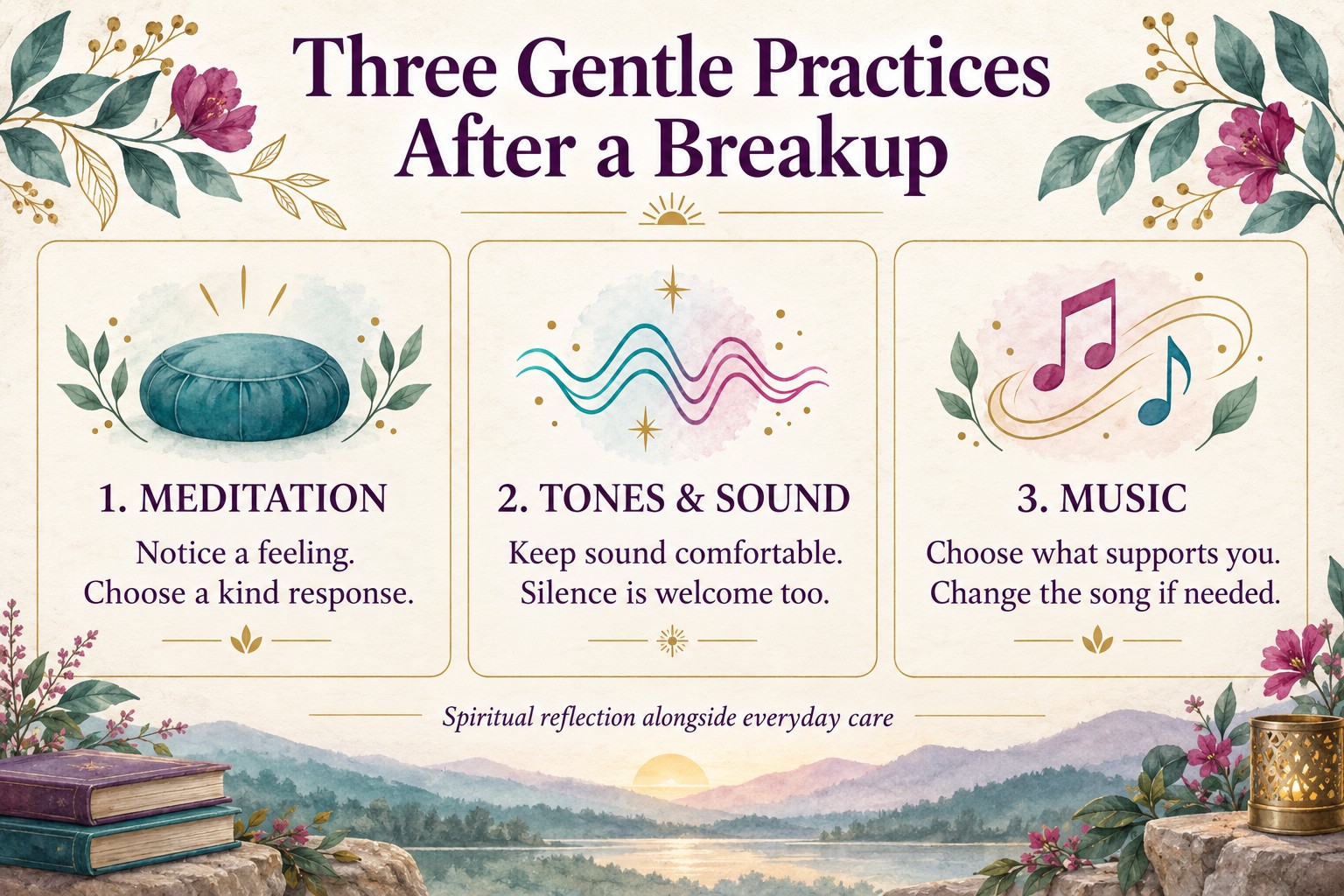
AFTER A BREAKUP / CHAKRA REFLECTION & GENTLE CARE
A breakup can leave familiar parts of life feeling unfamiliar: where you belong, what you want and how to spend the hours you once shared. If chakra teachings are part of your spiritual world, they can offer a language for exploring those changes with compassion.
You may describe this as “unblocking” or returning to balance. Here, that means giving attention to a need or feeling—not diagnosing an invisible injury. Sadness, anger, numbness or uncertainty after a breakup do not prove that your chakras are broken.
The three practices below are meditation, simple tones and music. Each gives you a different way to pause and reconnect with yourself. None requires an expensive tool, a perfect mood or a promise that your former partner will return.
Use the seven chakras as reflection themes
You do not need to work through all seven centers. Choose a theme that fits today, and turn it into a question you can answer. These are common contemporary spiritual associations, not tests of physical or mental health.
- Root—stability: What would help me feel more supported in my daily life?
- Sacral—feeling and creativity: What would I enjoy exploring without pressure?
- Solar plexus—agency: Which choice is mine to make now?
- Heart—compassion: How can I include myself in the care I give?
- Throat—expression: What do I need to say or write honestly?
- Third eye—discernment: What do I know, and what am I assuming?
- Crown—meaning: What still gives me a sense of connection?
For example, a root-chakra reflection might lead to arranging a meal with a friend. A throat-chakra reflection might become an unsent journal entry. You are responding to ordinary needs through symbolism, not proving that a center has reopened.
Our seven-chakra guide explains the framework in more detail. There is no requirement to feel connected to every theme, and sexual interest is not a measure of whether your sacral chakra is healthy.
1. Meditation: make room for a feeling without solving it
Meditation can provide a quiet place to notice what is present. After a breakup, that may be more useful than trying to clear your mind or force the sadness away. Choose a short, comfortable pause rather than an intense session.
- Settle into the room. Sit with support and notice one object nearby. Keep your eyes open if you prefer, and let your breathing remain natural.
- Name what is here. Try “I miss the familiar routine” or “I feel uncertain today.” You do not need to explain the whole relationship.
- Choose one kind phrase. “I can care for myself in this moment” leaves room for the feeling. A prayer or a gentle image of light is optional.
- Return to an ordinary action. Look around, stretch comfortably or get some water. Choose one manageable task instead of judging whether the meditation worked.
If you enjoy chakra imagery, use a color or symbol as a reminder of your chosen theme. You do not have to see vivid pictures, concentrate on a body part or feel energy moving.
Stop or switch to an outward activity if meditation makes you more distressed. NCCIH notes that meditation can bring unwanted experiences and should not replace conventional care. Our guide to a manageable meditation practice offers further ways to adapt it.
2. Tones and sound: use a simple focus, not a frequency prescription
This practice uses a single gentle sound rather than a song. You might listen to a soft sustained tone, say a familiar prayer slowly or hum comfortably for a brief moment. If sound does not appeal to you, silence is an equally valid choice.
Some chakra traditions associate centers with particular sounds. You may explore those within a teaching you value, but a recording labeled with a frequency does not establish that it repairs a chakra, treats depression or releases an ex’s energy.
- Choose a quiet setting and a sound that feels comfortable.
- Keep the volume low; if humming, use your natural voice without holding or forcing your breath.
- Notice the beginning and ending of the sound. Let it give your attention a simple place to rest.
- Pause and ask which everyday need deserves attention next.
For a throat-chakra theme, you could follow the sound with writing, “Today I need some privacy,” then decide how to communicate that boundary. The sentence is a practical expression of the theme; you do not need a special tone to authorize it.
Avoid loud bowls, recordings or headphones used in the hope that stronger sensations mean stronger healing. The WHO’s safe-listening guidance emphasizes managing volume and exposure and taking breaks. Stop if sound feels painful or uncomfortable.
3. Music: choose a listening experience that supports this moment
Music brings melody, rhythm, lyrics and personal memories into the practice. That makes it different from focusing on one tone. A song might offer companionship in sadness, room for expression or a reminder of interests that belong to you beyond the relationship.
You do not have to choose cheerful music. Nor do you need to keep listening to a painful song to “release everything.” Notice your response and give yourself permission to change the track or stop.
- For company: choose a song that makes your feelings seem less lonely.
- For expression: sing quietly, draw or write while listening, if that feels welcome.
- For a transition: choose a track to accompany a small task such as tidying one shelf or preparing a meal.
You could make a short playlist with an intention for each song: “make room for sadness,” “remember what I enjoy” and “return to today.” This is a personal listening exercise, not clinical music therapy or proof that sound has balanced all seven chakras.
If a song linked to your former partner keeps you absorbed in the past, try something unfamiliar. You can put meaningful songs aside for now without erasing the relationship.
Choose one practice, then one act of care
Choose just one of the three approaches. If you feel no change, you have not failed. Review what you need rather than increasing ritual time, volume or spending. Food, rest, practical arrangements and supportive people belong beside spiritual reflection.
If touchstones appeal to you, our heart-chakra crystal guide offers a symbolic approach. A stone is optional; buying something is not a requirement for moving forward.
Let recovery have its own pace
These practices cannot determine your ex’s feelings, guarantee reconciliation or tell you when you will be ready to date. Missing someone does not obligate you to contact them, and forgiveness does not require renewed access to your life.
If distress persists, interferes with daily life or feels difficult to manage, seek appropriate professional support. Do not explain symptoms away as a chakra blockage. If you feel unsafe or at immediate risk, seek urgent local help rather than continuing a ritual.
Your spiritual life can remain a source of meaning while your needs change. One day you may welcome quiet; another day you may need conversation or practical help. Start with a practice you freely choose, keep it gentle and let care—not a perfect energy state—guide the next step.
The article provides a unique perspective on how chakras are influenced by relationships and breakups. It’s an interesting approach to emotional healing.
Healing chakras might be an overlooked aspect of emotional health. It’s good to see articles bringing attention to it.
The connection between chakra healing and meditation is quite compelling. I might explore these methods more deeply.
The article’s approach to breakups through the lens of chakras is enlightening. It adds a new layer to understanding emotional pain.
Yes, it provides a holistic perspective that could be very beneficial for emotional recovery.
Understanding how each chakra is affected by relationship dynamics is insightful. It adds depth to personal emotional experiences.
Absolutely. It can help individuals identify and address specific emotional issues more effectively.
It’s a comprehensive way to approach healing and could be beneficial for those seeking alternative methods.
The idea that music and singing can heal chakras is fascinating. It makes sense considering the holistic benefits of music.
I agree. Music has always had a profound effect on my mood. Maybe there’s more to it than we realize.
Indeed, the therapeutic aspect of music shouldn’t be underestimated. It’s worth diving into this connection further.
I appreciate the practical advice on meditation and music for chakra healing. It’s accessible and easy to implement.
I’m curious about how different tones and sounds can impact chakras. More scientific research would be helpful in understanding this better.