

LAW OF ATTRACTION / HOPE, CHOICE & FOLLOW-THROUGH
What would you like to welcome into your life: work that uses your strengths, a relationship with mutual affection, or more room to enjoy the people you love? The Law of Attraction can give those hopes a spiritual language. For many believers, setting an intention is a way of opening to possibility and participating in the life they want to build.
That participation matters. An intention can become a reminder to send an application, start a conversation or protect time for a meaningful project. You do not have to feel cheerful every moment for those choices to count.
This guide pairs belief, gratitude and inspired action with a practical four-part plan. Let your spiritual outlook encourage you while leaving room for real obstacles, other people’s choices and a future that may unfold differently from your first picture.
What the Law of Attraction means for your goals
The Law of Attraction is commonly described as the belief that thoughts, feelings or energy draw corresponding experiences into a person’s life. You might express that belief through prayer, affirmations, a vision board or a quiet moment of intention.
A useful distinction is between spiritual meaning and a guaranteed mechanism. You can experience an intention as alignment with the universe without claiming that thoughts control employers, money, health or someone else’s affection. A hopeful practice is not a contract promising a particular result.
Focus on how your intention changes your participation. Does it help you notice a suitable opportunity, prepare for it or speak more honestly about what you want? Those are choices you can examine. Whether every external event matches your wish is not a measure of your spiritual worth.
Choose a goal that belongs to you
Before asking how to manifest something, ask why you want it. A goal borrowed from social media, family expectations or an old comparison can keep you busy without bringing you closer to what you value.
Complete these three sentences in your own words:
- I would like… Name one change, not a whole new life.
- It matters because… Identify the quality underneath it: connection, stability, freedom, learning or contribution.
- My part in this is… Describe an action you can choose, separate from the outcome you hope others will choose.
For example, “I want a more satisfying job because I value learning. My part is to identify roles that use my skills and prepare a clear application.” That gives you something to work with even before an offer arrives.
In love, choose mutuality rather than control: “I want a relationship where we both feel heard. My part is to communicate honestly and notice whether that care is returned.” Another person’s yes or no remains theirs. A boundary is not a failure of manifestation.
A four-part intention-to-action plan
Use the following sequence for one goal. You can write it in a journal or keep a short note where you will see it. It is a practical companion to your beliefs, not a ritual you must perform perfectly.
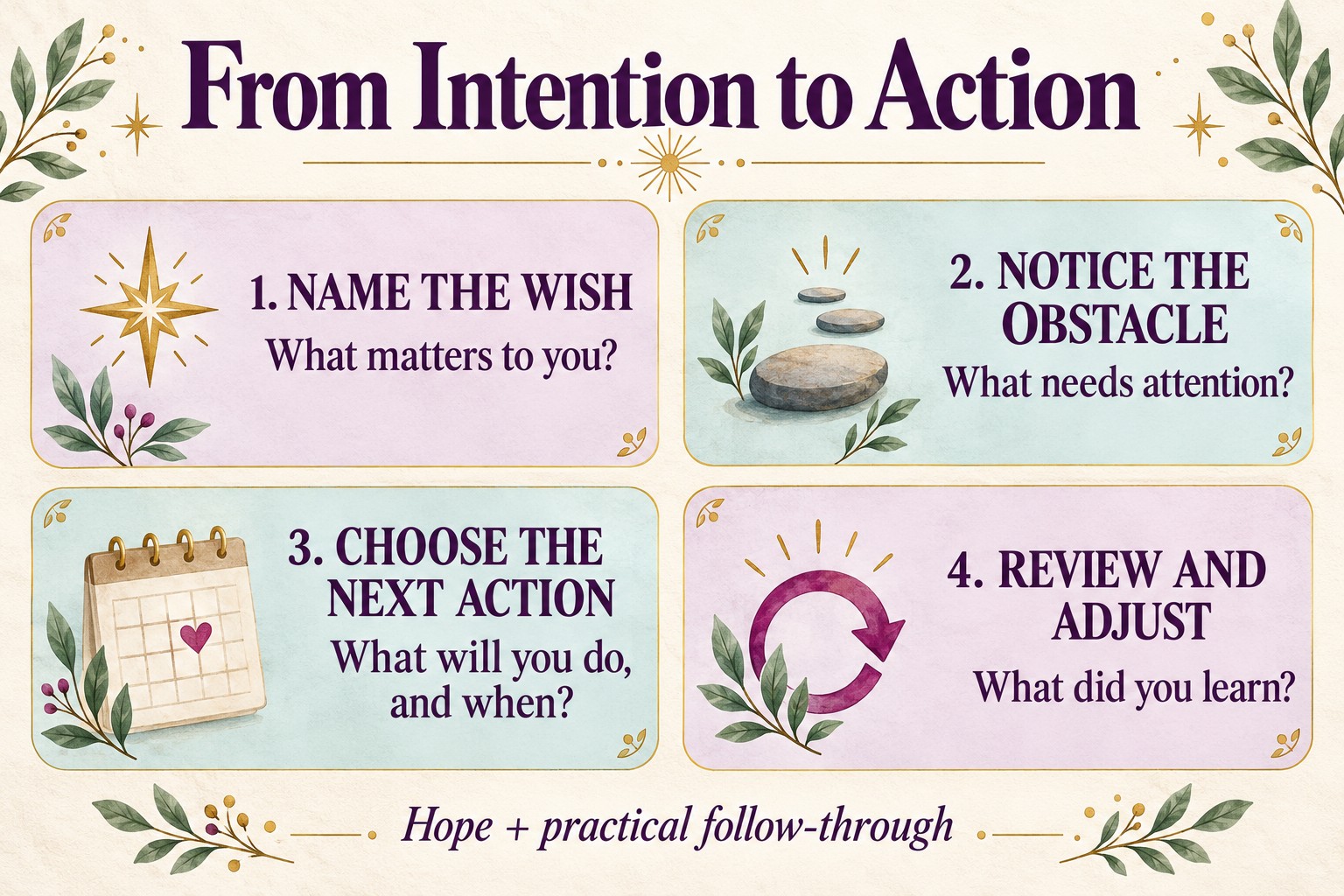
- Name the wish. Write one clear intention with a reason that matters to you. Keep the desired outcome flexible enough to recognize a good opportunity that looks different from your first idea.
- Notice the obstacle. Identify a specific difficulty: an unfinished portfolio, a crowded schedule, missing information or fear of making the first call. An obstacle is planning information, not evidence of “low vibration.”
- Choose the next action. Make it small and attach it to a time or situation. “After breakfast on Saturday, I will select two work samples” is easier to follow than “I will become successful.”
- Review and adjust. Set a reasonable check-in. Notice what you did, what you learned and what needs changing. Continue, simplify or choose another route without turning the review into a judgment of your worth.
The practical planning technique called an implementation intention links a situation with a response: if this happens, then I will do that. This can help connect a goal to action; it does not establish that the universe guarantees the outcome.
Use gratitude and affirmations without hiding your feelings
Gratitude can be very ordinary: a friend who listened, a task you finished or a moment of rest. Name something specific, then ask how you might care for it. Feeling thankful for a friendship could lead to making time for a call rather than waiting for the universe to arrange one.
Choose affirmations you can say honestly. “I can prepare for an opportunity” may be more useful than “Every opportunity is already mine.” “I deserve respectful treatment” can sit beside a practical boundary. You do not need to force yourself to believe a sentence that feels untrue.
When one rejection becomes “Nothing will ever work out,” pause and separate the event from the prediction. The NHS guide to reframing unhelpful thoughts suggests checking the evidence and considering a more balanced perspective. You can acknowledge disappointment and still decide on a helpful response.
For an optional reflective practice before planning, try our meditation and visualization exercise. You do not need vivid images or a perfect mood to begin.
Respond to setbacks with information, not self-blame
Rejection, illness, bereavement and financial hardship are not proof that someone thought incorrectly or failed to deserve a better life. Your feelings do not make you responsible for harm done by others. Hope is more supportive when it allows you to ask for help.
After a setback, consider three questions: What actually happened? What information or support would help? What is the smallest useful choice available now? That might mean requesting feedback, resting, changing the plan or speaking with someone qualified to help.
Sometimes the caring choice is to stop pursuing a particular outcome. A role may be unsuitable; a relationship may lack mutual interest. Making room for another possibility does not mean abandoning your hopes. It means respecting what you have learned. Our guide to self-care routines offers ways to keep your needs in view.
Let a psychic reading support reflection, not replace your choices
If you enjoy psychic or tarot readings, you might ask, “What value am I overlooking in this goal?” or “What could I reflect on before taking my next step?” Use the conversation to explore your intention, not to obtain certainty about an employer’s decision or another person’s private feelings.
Keep your own judgment, budget and practical support in place. Be cautious of promises of guaranteed wealth, love or success, especially when extra payments are described as necessary to remove a blockage. Doubt does not create an obligation to purchase another session.
Our guide to preparing for a psychic reading can help you clarify questions and boundaries. Your next step can be modest: name one hope, understand one obstacle and make one plan. Spiritual encouragement and everyday follow-through can share the same page.
The article’s view on victim mindset is intriguing, though it may oversimplify complex social and psychological issues.
Indeed, while mindset plays a role, external factors should also be considered. It’s a blend of internal and external influences that shape our lives.
Belief in one’s worthiness is crucial. However, it’s essential to combine this belief with structured plans and actions to truly manifest changes.
Absolutely, belief must be matched with effort. Real change is a synthesis of both mindset and tangible actions.
Spot on! Without actionable steps, the Law of Attraction remains a theoretical concept rather than a practical tool.
While the Law of Attraction presents an optimistic view on life, it is important to balance it with practical actions. Both mindset and actions contribute to success.
Creating distance from negative emotions is a valuable strategy. It allows individuals to focus on constructive solutions rather than dwelling on setbacks.
The notion that the Universe rewards those who take proactive steps towards their goals is encouraging. It underscores the power of personal responsibility.
The call to cultivate more joy through small acts resonates well. It is often the little things that can make a significant impact on our overall well-being.
The idea of the Law of Attraction is fascinating. The concept of shifting one’s mindset to create positive changes in life aligns with numerous psychological principles.
The emphasis on gratitude and positive thinking is commendable. However, it is also vital to acknowledge and address tangible challenges one might face.