

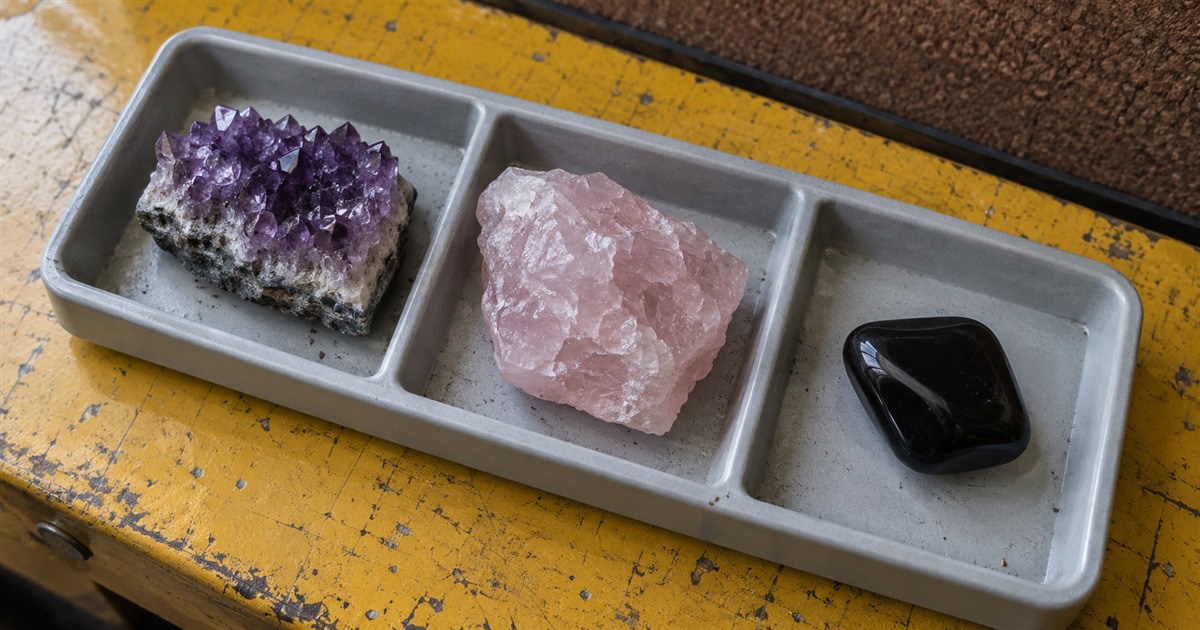
CRYSTALS / CHOOSING WITH CARE & INTENTION
The best crystal for your spiritual practice does not have to be the largest, rarest or most expensive stone in the shop. It can be one whose color, texture or symbolism invites you to pause and reconnect with an intention. A small stone you enjoy using may be a better beginning than a collection you feel pressured to buy.
People often use the phrase “healing crystals” for stones associated with comfort, renewal or spiritual reflection. Here, healing describes that personal intention, not a medical treatment. A crystal should not be relied on to cure illness, remove anxiety or replace professional care. You can treasure its meaning without asking it to do everything.
Start with an intention, not a promised result
Before you shop, complete this sentence: “I would like a reminder to…” Perhaps you want to speak kindly to yourself, make time for meditation, approach a conversation with confidence or enjoy a quieter evening. Choose something you can practice rather than something a stone is supposed to guarantee.
If you enjoy asking the universe for guidance, you can make that a gentle personal ritual. Notice which stone catches your attention, then check its name, price and care requirements. Attraction can help you choose; it does not mean you must buy immediately or that an expensive stone was destined for you.
Ask permission before handling shop specimens. Look for a piece that feels comfortable and has no sharp edges if you plan to hold it. A reaction such as warmth, tingling or a sense of calm is not proof of healing power. You also do not need to feel anything unusual for a stone to become a meaningful companion.
Seven popular stones and reflective ways to use them
Crystal associations differ between books, shops and traditions. The ideas below are possibilities for personal reflection, not fixed instructions or guaranteed effects. Begin with one stone and one intention.
1. Amethyst: a reminder to pause
Amethyst’s purple color is often associated in contemporary crystal practice with meditation and intuition. You might place it beside a journal as a reminder to sit quietly before deciding what you think. Try the prompt, “What am I noticing, and what am I assuming?”
You do not need it to awaken a psychic gift. Let it support a routine you already find meaningful. Keep it away from prolonged strong sunlight or heat; the Gemological Institute of America’s gemstone-care guidance notes that excess light can fade or damage stones including amethyst.
2. Citrine: a symbol of encouragement
Citrine is often linked with optimism, confidence and abundance in modern crystal writing. Instead of expecting it to remove stress or deliver money, use that symbolism to identify one manageable action. “What would a hopeful but realistic next step look like?” is a useful question.
Ask the seller how the stone is identified and whether it has been treated. Treatment information helps you understand what you are buying and how to care for it. A beautiful appearance and a clear description matter more than a claim that one version guarantees prosperity.
3. Clear quartz: a focus for an intention
Clear quartz is frequently used as a symbol of clarity or intention. Write down one question, place the stone near the page and separate what you know from what you still need to find out. Its role can be to remind you to return to the question thoughtfully.
A quartz point is not needed to make that practice effective for you. If you will carry or hold a stone, a smooth piece may be more comfortable than a sharp specimen. Do not press a point into your skin.
4. Jade: gratitude and steadiness
Jade carries different meanings in different cultural and personal settings; it should not be reduced to a universal money charm. If you associate your piece with abundance, try reflecting on resources already available to you: time, skills, supportive relationships or a place to rest.
Ask what material the seller means by “jade” and what is known about treatments. Avoid paying for a vague name plus a promise of luck. Your personal gratitude practice does not require a costly purchase.
5. Moonstone: a symbol of change
Moonstone is often connected with cycles and new beginnings in contemporary spiritual practice. You might use it for a monthly reflection: “What am I ready to begin, and what needs more time?” That offers a way to explore change without demanding that manifestation happen on a schedule.
Care matters: GIA’s moonstone guide warns that hard knocks, high heat and sudden temperature changes can cause damage, and recommends warm soapy water rather than steam or ultrasonic cleaning. Ask about any setting or treatment before cleaning your particular piece.
6. Obsidian: boundaries and grounding
Obsidian is often used symbolically for grounding and protection. Consider pairing it with a practical boundary: “I will put my phone aside during this break,” or “I will not agree to a request before checking my time.” Protection can be something you actively practice, not something you have to purchase.
Inspect the piece before handling it. Choose smooth, undamaged edges for a holding stone and keep sharp or fragile specimens as display objects. It does not have to carry a gendered meaning or prove that another person has sent negative energy.
7. Rose quartz: compassion without pressure
Rose quartz is commonly associated with love and tenderness. It can accompany a kind sentence to yourself or a reflection on how you want to give and receive care. Try, “What would kindness include here, including kindness toward me?”
A stone cannot make someone reciprocate affection or repair a relationship by itself. Nor should difficulties be explained as a karmic debt you must endure. For more ideas, explore our heart-chakra crystal reflection guide.
What about tiger’s eye, hematite or bloodstone?
You may also encounter tiger’s eye associated with confidence, hematite with grounding and bloodstone with courage. These can be useful symbolic themes if they resonate with you. They do not make one stone compulsory for a particular zodiac sign, personality or health concern.
If you like matching crystals with astrology, treat the correspondence as an optional source of inspiration. You can choose another stone because you prefer its appearance, feel or care requirements. There is no need to buy several stones to cover every possible need.
Using a crystal with chakra reflection
In a commonly used seven-chakra framework, the centers are associated with these broad themes: root with stability, sacral with feeling and creativity, solar plexus with agency, heart with compassion, throat with expression, third eye with intuition and crown with spiritual connection. Teachings and crystal pairings vary.
You can choose a theme and keep a stone nearby while journaling or meditating. Placing it on a body area is not required, and sensations do not diagnose a blocked chakra. Avoid balancing heavy or sharp objects on yourself. A stone beside your notebook is enough for a symbolic practice.
Our sacral-chakra guide offers gentle creativity and boundary prompts. You can use them with a stone, without one or with an ordinary object that holds personal meaning.
Five useful questions to ask before buying
- Identification: What is the stone’s material name, not just its spiritual marketing name?
- Treatment: Is anything known about dyeing, coating, heating or other treatments?
- Care: What cleaning and storage methods suit this particular piece?
- Use: Is it comfortable to hold, suitable to wear or better displayed?
- Price: Does it fit my budget without promises of guaranteed health, love or wealth?
It is okay to take time, compare descriptions or leave without buying. A seller should be able to discuss the object without making you afraid of what will happen if you do not purchase it.
A simple crystal practice and care routine
For example, rose quartz might remind you to approach a difficult conversation kindly. Your action could be writing what you want to say and choosing a calm time to speak. The stone holds the intention; communication does the practical work.
If you enjoy spiritual “cleansing,” use a non-damaging symbolic option such as a quiet intention or a short visualization. Physical cleaning is different: identify the material first and follow appropriate care advice. Do not assume that every stone tolerates soaking, salt, sunlight or heat. Store pieces separately to reduce scratching and keep small stones away from children and pets.
Keep crystals out of drinking water, food and the mouth. Do not make crystal-infused drinks, ingest powders or add unidentified herbs to a ritual. You can enjoy a shelf display, journal photograph or seasonal intention without treating the stone or its picture as a medical intervention.
For practical placement ideas, see using crystals at home. Begin with beauty, curiosity and clear care information. A thoughtful choice is one that fits your life, respects your budget and supports a practice you genuinely enjoy.
The explanations about various crystals like Amethyst, Citrine, and Jade offer a good introduction to their individual uses.
Adding peer-reviewed research could enhance the article’s credibility.
True, but it would be interesting to see if modern science supports these claims.
The historical context of crystals in various cultures is fascinating. It is interesting to see how their usage has evolved over time.
Indeed, the integration of crystals in ancient machinery is a topic worth exploring further.
I agree. Ancient civilizations had a lot of unique ways to incorporate crystals, which speaks volumes about their perceived value.
The article does a good job correlating different crystals with specific emotional and physical benefits, making it practical for interested readers.
The chakra-specific usage of crystals is intriguing. More references to studies or historical texts might add more credibility.
Highlighting the importance of intention when using crystals adds a good psychological perspective.
The different types of crystals and their purported benefits are well-explained. It’s helpful for someone new to the topic.
The guide on selecting crystals based on physical reactions and chakras is quite practical for beginners.
As a novice, I found those tips particularly useful and easy to follow.
It provides a more personalized approach to choosing crystals, which is beneficial.
The article provides a detailed look into the modern uses of crystals, especially in terms of personal well-being.
While it is detailed, some scientific validation on the effectiveness of crystals would be beneficial.
Exactly, a more empirical approach could strengthen the arguments presented.