

Emotional vampires • Self-reflection • Mutual care
Have you worried that your conversations have become mostly about your problems? Perhaps someone has asked for space, or you have noticed yourself wanting reassurance again and again. That can be uncomfortable to acknowledge, but it can also be the beginning of a kinder, more balanced way to connect.
You do not need to call yourself an “emotional vampire” to make a change. Needing support, feeling helpless or having a difficult life does not make you harmful. The useful question is how you ask for care, respond to limits and make room for the other person.
What does “emotional vampire” mean?
The phrase is an informal metaphor for interactions that repeatedly feel draining or one-sided. It is not a diagnosis or proof that someone literally consumes another person’s energy. If you use spiritual language, “my energy feels depleted” can describe your experience without deciding someone else’s identity or intentions.
This guide focuses on your own habits, not identifying villains. If you are trying to respond to someone else’s repeated demands, our guide to draining relationship patterns takes that different perspective.
Context matters. Grief, illness, discrimination, money pressure and caregiving can create genuine needs. A person may need more support during a hard season. Neither their suffering nor a friend’s inability to help establishes who is “the problem.” Look at specific behavior instead of using distress as a character judgment.
Ten questions for honest reflection—not a scored quiz
Think about a few recent conversations. There is no “five yes answers” cutoff. Choose one question that points toward a change you can actually practice.
1. Do I say what kind of support I need?
Someone may not understand whether you want advice, company or a listening ear. Rather than assuming they should know, try “I don’t need a solution right now; could you listen for a few minutes?” A clear request gives them something they can answer.
2. Do I separate real barriers from the part I can influence?
You do not have to pretend an obstacle is small or entirely within your control. Identify one possible action beside it: gathering information, seeking appropriate support or choosing what to postpone. Naming a barrier and considering a next step can coexist.
3. Can I accept that someone is unavailable?
“I can’t talk tonight” may describe their capacity, not how much they value you. Notice whether you keep calling, demand an explanation or accuse them of not caring. A respectful reply could be “Thanks for telling me. I’ll look for another source of support.”
4. Do I ask for attention directly rather than test for it?
You might hope someone will notice silence or a vague upset message. It is often clearer to say “I’d like some company this week—would you be up for a walk?” They still have the right to decline. Affection does not require passing a hidden test.
5. Do I leave room for the other person’s experience?
Venting is not automatically wrong, but a conversation can become one-sided if every topic returns to your problem. Ask a follow-up question when they share something. Listen to the answer without immediately comparing it with your own story.
6. Do comparisons help me, or leave me more stuck?
You may notice that someone has resources or opportunities you do not. That can be a real difference. Consider what the comparison is showing you—a need for rest, security or assistance—rather than assuming their life has no difficulties or yours has no possibilities.
7. Can I disagree without insults or pressure?
Arguments do not automatically mean a relationship is unhealthy. Notice your words and actions during them. If you interrupt, shout or threaten to withdraw affection, choose a different response. A pause should have a purpose, not become a punishment.
8. Can I name my part without taking blame for everything?
Responsibility can be specific: “I interrupted you three times.” It does not require accepting an accusation that every conflict is your fault. Likewise, your distress does not excuse hurtful behavior. Separate what you did from what the other person did.
9. Do I explain a need for space when it is safe?
If you need time to settle after a disagreement, you might say “I need a break. Could we return to this tomorrow?” That is different from disappearing to make someone anxious. You do not owe continued contact or a confrontation when doing so would be unsafe.
10. Am I relying on one person for every kind of help?
A friend can care deeply and still be unable to provide everything you need. Consider other suitable sources: another trusted person, a community resource or a qualified professional. Feeling helpless is a reason to seek support, not a verdict about your character.
A conversation habit: ask, listen, repair
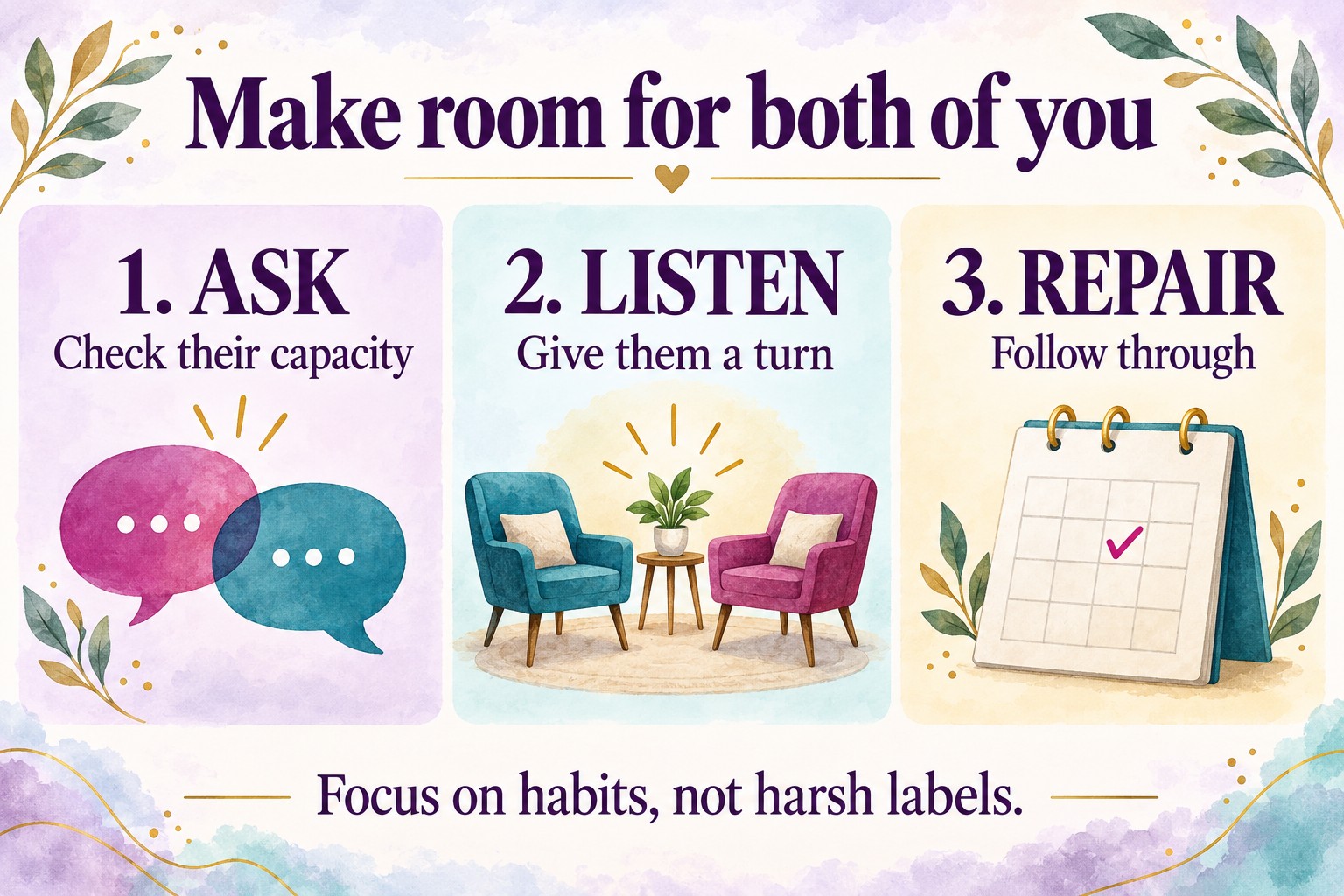
The cover’s three steps are a reminder for ordinary conversations, not a treatment plan or a way to prove that you have changed:
- Ask—check their capacity. “Do you have time to listen? I’m looking for encouragement, not advice.” Respect the time or topic limits they give.
- Listen—give them a turn. When they speak, let the conversation stay with their experience. Ask what would help, rather than making yourself the immediate solution.
- Repair—follow through. If you ignored a limit or said something hurtful, name it and make a specific change. Keep the commitment in the next interaction.
The NHS guide to talking about mental health encourages explaining what support you would like and recognizing that not everyone can provide it. Asking clearly is compatible with accepting an honest answer.
Do not use the final sentence as a required exchange: someone sharing their own life is not payment for listening. The aim is a relationship with room for both people over time, not perfectly equal minutes in every conversation.
Repair a specific moment without a harsh identity label
Suppose you continued describing a work problem after your friend said they needed to go. An apology might sound like this:
Love is respect’s apology guide emphasizes naming the action, acknowledging its impact and following words with changed behavior. “I’m sorry you felt upset” avoids naming what you actually did; “I’m terrible, please reassure me” can make the other person responsible for comforting you.
An apology does not entitle you to immediate forgiveness, renewed contact or a particular response. If the person has asked for no contact, respect that rather than sending repeated repair messages. You can still work on your habits without requiring their participation.
Practice appreciation without minimizing your pain
Gratitude can help you notice care you have received, but it should not become “Other people have it worse, so I must stop hurting.” You can acknowledge both: “This is difficult, and I appreciate that someone made time for me.”
For the next few interactions, choose one small habit: thank someone for a specific effort, ask a genuine follow-up question or keep a stated time limit. Do not buy gifts you cannot afford or expect appreciation to cancel an ignored boundary. Notice your follow-through, not whether someone praises your improvement.
If prayer or spiritual imagery helps, take a quiet moment before reaching out: “May I ask honestly and receive an answer with care.” Then make the actual request. A ritual can remind you of your intention; it cannot change someone else’s consent.
Our guide to reflecting on strong emotions offers ways to separate feelings from assumptions. For a friendship you want to nurture, explore everyday care in a soul friendship.
Responsibility and support can go together
You can need help and still work on how you treat people. If conflict, distress or difficulty respecting limits keeps recurring, consider qualified counseling or other appropriate support. A psychic conversation may offer spiritual reflection, but it should not diagnose a disorder or replace mental healthcare.
If someone uses this label to dismiss real harm, discrimination or abuse you describe, you do not have to accept it. Safety matters more than completing a self-improvement exercise. Seek trusted, appropriate support if you feel afraid, and contact local emergency services in immediate danger.
The goal is not to become endlessly positive or never need anyone. It is to ask with clarity, listen with curiosity and make repairs through action. You remain worthy of care while learning to make more room for the people you care about.
This article offers a comprehensive perspective on emotional vampires and their impact on relationships. It’s important to self-reflect and identify these traits in ourselves or others.
The concept of emotional energy being drained by these individuals is an interesting way to describe these interactions. It’s a helpful metaphor for understanding their impact.
Awareness and self-reflection are crucial steps in overcoming these negative traits. It’s a journey towards self-improvement.
The need for attention and validation mentioned is a significant trait of emotional vampires. This behavior often pushes people away rather than bringing them closer.
True. The constant need for validation can be exhausting for those around them.
Indeed. It creates a negative cycle that is hard to break without awareness and effort.
This article provides a clear and detailed explanation of emotional vampires. It’s beneficial for anyone looking to improve their emotional health and relationships.
The term ’emotional vampire’ is quite vivid and accurately describes the behavior of those who drain others emotionally. It’s crucial to address these behaviors for healthier interactions.
I agree. Recognizing and addressing these traits can significantly improve one’s emotional well-being.
Identifying as an emotional vampire can be a tough realization, but it’s a step towards personal growth and healthier relationships.
The article makes a valid point about the co-dependency between emotional vampires and individuals with low self-esteem. This dynamic can be quite destructive.