

CRYSTAL RITUALS · RICE SYMBOLISM · THOUGHTFUL CARE
If you work with crystals, a cleansing ritual can mark the end of one experience and the beginning of another. Rice offers a simple, familiar symbol of nourishment and renewal. You might use it when a stone reminds you of a difficult week, before setting a new intention or when you want to refresh your personal practice.
In spiritual language, this is often called clearing negative energy. Treat that description as a belief or intention rather than a measurable property of the rice. A meaningful ritual does not require proof that grains absorb energy, and it should not damage a stone or turn ritual materials into food or skin treatments.
What does cleansing with rice mean?
Some crystal practitioners use dry rice as a symbolic resting place for a stone. The idea is to pause, release an association you no longer want to carry and return to the crystal with a fresh intention. Others prefer sound, prayer or simply placing the stone in a quiet space.
There is no single required method. You do not have to cleanse a crystal after every use, and missing a ritual does not mean that something bad will happen. If rice is meaningful to you, let it support a deliberate moment of reflection rather than become a task you feel compelled to repeat.
Our guide to using crystals at home offers ways to connect a stone with a place, purpose and everyday habit.
Rice symbolism deserves context
Rice has a place in particular religious and cultural traditions, but those traditions are not all the same. For example, Kokugakuin University’s Encyclopedia of Shinto explains hatsuho, an offering historically associated with the first harvested rice ears. That is a specific tradition, not evidence that every modern crystal-rice practice has an ancient origin.
You can appreciate rice as a personal symbol of nourishment, gratitude or a new beginning without presenting your home ritual as a Japanese ceremony. Choose words that reflect your own beliefs. “I am grateful for what sustains me” is a simple intention that does not borrow a cultural identity or promise an energetic effect.
Check the crystal before choosing a method
A spiritual cleansing and physical cleaning are different tasks. Rice does not remove grime in the way an appropriate cleaning method does. Before handling a stone, identify it and check care guidance for that material, including any coatings, dyes, repairs or jewelry settings.
Even familiar stones need individual care. GIA’s amethyst care guide notes that prolonged intense light can fade some amethyst and abrupt temperature changes can cause fractures. It advises against steam cleaning and heat. A full day on a hot, sunny windowsill is therefore not a universal cleansing method.
GIA’s rose quartz guide recommends warm, soapy water for that gemstone and advises against ultrasonic and steam cleaners. Do not extend one stone’s instructions to every mineral, a mixed specimen or a mounted piece.
- Unknown stone: choose a non-contact intention ritual until you can identify it and confirm its care needs.
- Fragile, rough or decorative piece: avoid burying it, rubbing grains against it or shaking it in a container.
- Jewelry: consider the setting and other stones, not only the crystal you are focused on.
- Visible damage or loose parts: put the piece aside and ask a qualified jeweler or mineral supplier about handling it.
You can keep the symbolism of rice without putting a stone directly into the grains.
A six-step, non-contact rice ritual
This version uses a separate dish so that the crystal and rice do not touch. It is a suggested personal practice, not a required formula or a claim that a particular duration produces a measurable result.
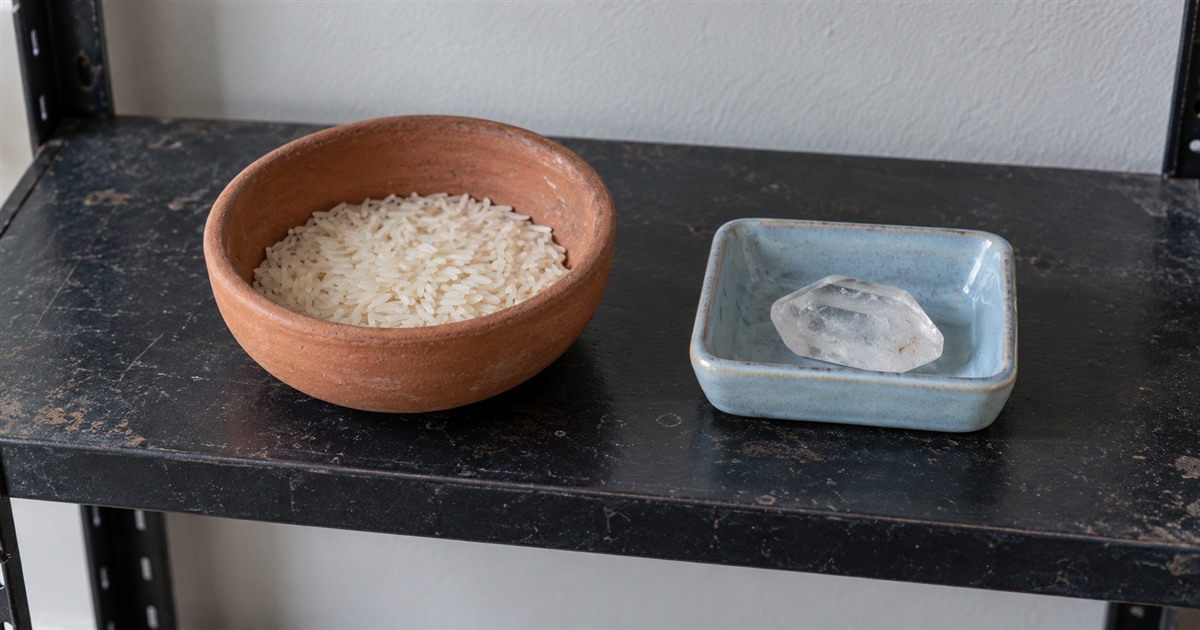
- Prepare a quiet surface. Choose a stable indoor spot away from direct sun, heat, food preparation, children and pets. Use a clean, dry bowl and a separate small dish.
- Use a modest amount of dry rice. A shallow layer is enough for the symbolism. There is no need to fill a large container or buy a special variety.
- Keep the stone separate. Place it in the small dish beside the rice bowl, or on a stable solid saucer above the grains if the arrangement is secure. Do not balance a heavy specimen precariously.
- Name what you are releasing. Try: “I release the association with that difficult conversation, and I welcome a calmer beginning.” Keep the intention focused on your own experience.
- Take an unhurried pause. Sit quietly for a few minutes if that feels comfortable. An evening or overnight pause can be a personal choice, but twelve or twenty-four hours is not a verified requirement.
- Close with a present-day action. Return the crystal to its place and choose one helpful step: tidy your reading space, write a boundary or make time to rest.
Let the ritual be simple enough that you can finish feeling settled, not worried about whether you followed every detail perfectly.
Should you bury a crystal in rice or add water?
Burying a crystal is a familiar version of this practice, but it is not necessary. Direct contact can leave grains or dust in crevices and makes retrieval and handling less straightforward. The separate-dish option preserves the ritual’s meaning without those complications.
Do not make rice water and assume it is suitable for every crystal. Mineral care varies, and a coating, setting or mixed specimen may need different treatment. If a crystal is physically dirty, follow appropriate care guidance rather than using a ritual mixture.
Sunlight, moonlight, flowers and herbs are optional symbols, not ingredients you must add. An indoor intention can be just as personally meaningful. Keep damp plant material and liquids separate, and skip anything that makes the arrangement harder to care for.
What should you do with the rice afterward?
There is no universal spiritual rule requiring you to eat it or throw it away. Decide in advance whether the rice is food kept separately or material dedicated to the ritual.
- If crystals have touched it: treat it as non-food material. Do not cook or eat it, turn it into a drink, or use it in baths, foot soaks or skincare. Washing or cooking is not a reliable way to establish that an unknown mineral-contact material is suitable for those uses.
- If it remains sealed and separate: you can leave ordinary food rice in its original sealed container beside the crystal. That keeps the symbolism without direct contact or unnecessary waste.
- If you dedicate loose rice to ritual use: keep it clearly separate from kitchen supplies. If it becomes damp, dirty or moldy, dispose of it appropriately rather than trying to “clear” it for reuse.
There is no need to describe discarded grains as dangerous or filled with harmful spiritual energy. Likewise, there is no need to pour ritual rice water on plants to transfer a blessing. A spoken thank-you can close the practice without another use for the material.
Choose the rice by practicality, not fear
For a dry, non-contact symbolic practice, plain uncooked rice is sufficient. White or brown rice can be a personal preference. There is no established crystal-care reason to require a special “high vibration” variety or to claim that genetically modified rice cannot support an intention.
If you would rather not use food at all, keep the bowl empty as a symbol of making space. You can also put the crystal on a clean cloth, say a prayer or spend a quiet moment with a journal. The value of your practice need not depend on a purchase.
Make the reset useful beyond the ritual
Afterward, write three short lines:
- What I am leaving behind: name an association, not a curse or a diagnosis.
- What I am choosing now: choose a quality such as patience, compassion or steadiness.
- How I will practice it: name one action you can take today.
For example: “I am leaving behind the tension of a rushed evening. I am choosing patience. I will take a pause before answering the next difficult message.” Your crystal can become a reminder of that choice.
Heart chakra crystals offers compassion-focused reflection, while spiritual self-care routines can help turn an intention into a manageable habit. If you enjoy creating a dedicated intention space, explore making a psychic energy love box.
A rice ritual can be a warm, thoughtful way to refresh your connection with a crystal. Keep the stone’s care needs separate from spiritual symbolism, use only what you need and finish with an intention that supports your life outside the bowl.
The cultural practices surrounding rice, such as its use in weddings in different parts of the world, showcase its universality. These traditions highlight rice’s deep-rooted significance across civilizations.
Indeed, rice’s role in traditions across various cultures underscores its significance beyond just a dietary staple.
Absolutely. The historical context of rice being a gift from the gods in Japanese mythology adds a rich layer to its cultural importance.
It’s interesting to see the various ways rice can be utilized, from cleansing crystals to personal care routines. It shows how versatile this grain is beyond its nutritional value.
The idea of using rice water for personal care and plant nourishment after cleansing crystals is quite practical. It offers an environmentally friendly way to repurpose the rice.
Repurposing rice water for personal and plant care is indeed a sustainable practice. It’s an excellent way to ensure that the energy is put to good use after cleansing.
I agree. Using rice water for plants could potentially give them an extra boost. It’s an eco-friendly way to make sure nothing goes to waste.
While the article presents intriguing methods of using rice for cleansing and energy balancing, it would be beneficial to see some scientific studies to support these claims.
I concur. Empirical evidence would certainly add more credibility to the practices mentioned and help in understanding their effectiveness.
The process of meditating with rice to enhance personal vibrations is an intriguing practice. It emphasizes the interconnectedness of energy, mindfulness, and natural elements.
The dual nature of rice containing both masculine and feminine energies because of its connection to the earth and sun is a compelling thought. It provides a new perspective on everyday items.
Using rice for cleansing crystals is an interesting concept. I hadn’t heard of it before, but the explanation provided makes it sound like a plausible method given rice’s historical significance.
The historical and cultural significance of rice as detailed in this article is quite fascinating. It’s intriguing to see how different cultures have utilized rice not just as a food source, but also in ceremonial and symbolic contexts.