

EVERYDAY INTUITION · LOST ITEMS · A CALMER SEARCH
You put your keys down for a moment, turn to do something else, and suddenly they seem to have disappeared. Losing a familiar object can feel surprisingly unsettling—especially when it is a treasured piece of jewelry, a gift or something you need right away.
If you believe in spiritual guidance, you may feel drawn to ask your angels, listen to your intuition or consult a psychic. Those practices can have a place in your search without replacing the practical steps that protect your belongings. Start with what you know, give yourself room to remember, and treat any spiritual impression as a possible lead to check—not a promise that the item will return.
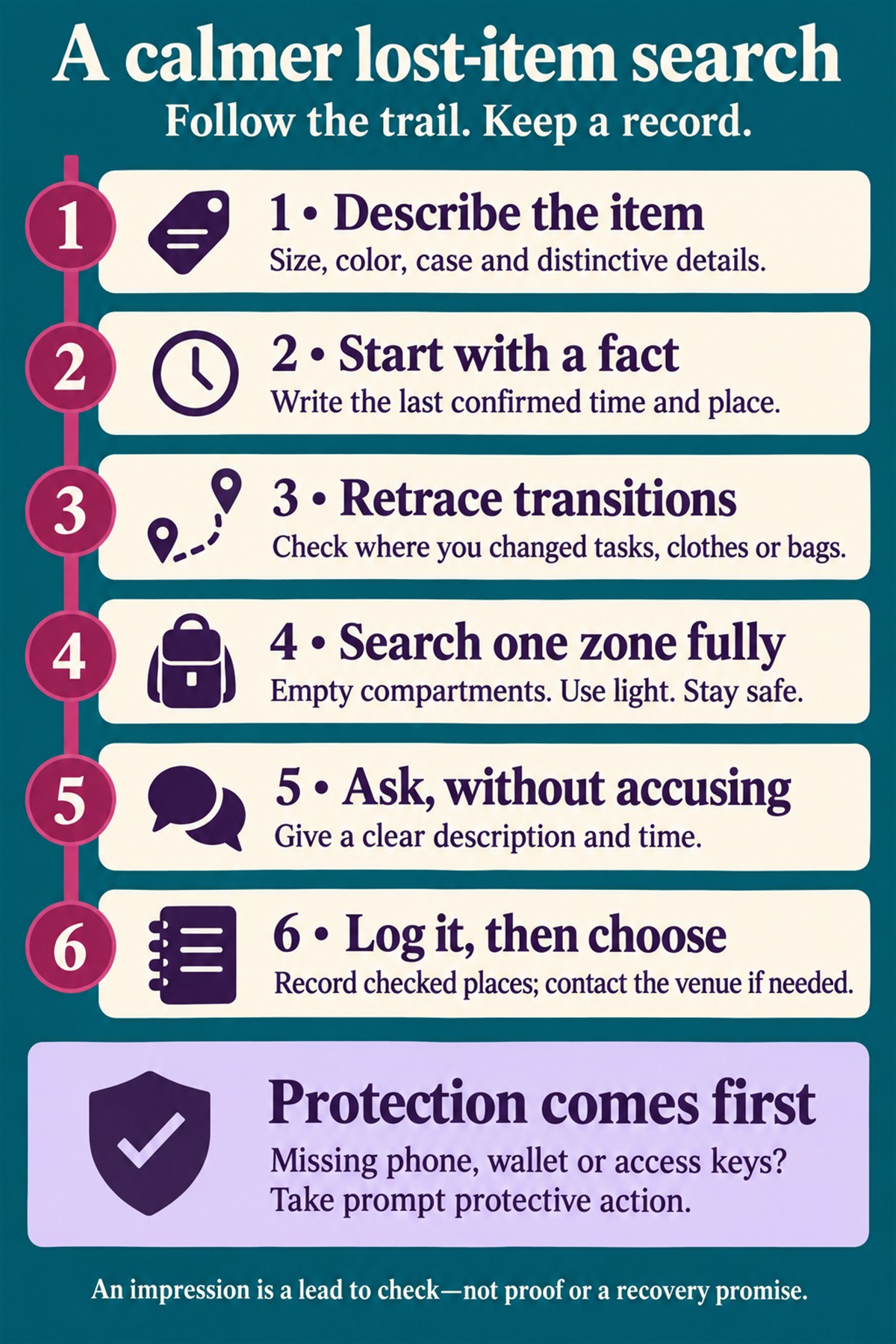
A six-step plan for finding misplaced things
Repeatedly opening the same drawer can leave you feeling busy without bringing you closer to an answer. A small plan gives your attention somewhere useful to go.
- Describe the exact item. Note its size, color, case, attachments and anything that makes it distinctive. “Small silver ring in a blue pouch” is easier to communicate than “my jewelry.” Find an existing photograph if you have one.
- Separate the last confirmed sighting from a guess. Write “I used my keys to open the door Tuesday evening” rather than “They must be on the kitchen counter.” Include the time, place, clothing and bag you actually remember.
- Retrace the transitions. Look at what happened between activities: arriving home, changing clothes, answering the door, unloading groceries, charging a device or moving from one bag to another. Check the temporary surfaces you used during those moments.
- Search a small zone thoroughly. Empty a pocket or bag onto a clear surface instead of feeling around the top. Check linings, side compartments and the space beneath nearby furniture. Use adequate light, move only what you can safely handle, and avoid reaching into hazardous spaces.
- Ask a clear, neutral question. “Have you seen my blue glasses case since yesterday?” gives another person a useful starting point. Ask whether someone moved the item for safekeeping; do not assume it was taken.
- Record what you checked and choose the next action. Make a short list so you do not repeat the same search. Contact the shop, transport service, workplace or venue if the item may have been left outside your home.
For example, imagine you cannot find a necklace after a weekend visit. Instead of searching every room, you remember removing it before a shower. You check the bathroom ledge, the towel you used, your travel pouch and the clothes you changed into. This is an illustrative search sequence, not a prediction: its value is turning a vague worry into specific places to examine.
Let intuition suggest a place—not a conclusion
An image of a coat pocket or a sudden thought about the laundry basket might feel meaningful. You can honor that impression by looking there. You do not need to decide whether it came from memory, intuition or spiritual guidance before checking an ordinary, safe location.
Try this brief reflection before your next search:
- Sit comfortably and let your breathing settle without forcing it.
- Picture the object as clearly as you can: its texture, weight and how you usually hold it.
- Recall the last moment you know it was with you. What were you doing immediately before and afterward?
- Write down up to three places that come to mind, labeling them as suggestions rather than facts.
- Check those places once, then return to your written search plan.
If nothing comes to mind, that is okay. A blank moment does not mean your intuition is weak or that the object is beyond reach. Our guide to listening to your intuition offers ways to notice impressions without making every thought carry a special message.
Angel guides, dreams and spiritual reflection
A simple request to your guides
If asking angels or spirit guides for help is part of your practice, keep the request gentle: “Please help me stay calm and notice what I have overlooked.” You might say it quietly, write it in a journal or spend a moment in meditation. The purpose is to make space for your own attention, not to bargain for a guaranteed result.
You can feel grateful for the support you experience without interpreting a missing item as punishment, a curse or a test you failed. Being frustrated does not make you responsible for the loss, and you do not have to remain perfectly positive to continue looking.
Dreams as a source of possible clues
Before bed, you might briefly picture the object and ask yourself what you remember about using it. Keep a notebook nearby if you enjoy recording dreams. In the morning, distinguish the dream image from an actual memory: “I dreamed of a green cabinet” is different from “I remember putting the ring in that cabinet.”
A dream may give you a new association to explore, but it cannot confirm a location, identify a thief or guarantee recovery. Do not delay locking a lost phone or contacting a venue while waiting for a dream. Rest can be welcome when a low-urgency search has become exhausting; it need not become another task you must perform correctly.
Writing or drawing your impressions
Some spiritual seekers like to write freely or sketch the first place that comes to mind. Keep those notes separate from your confirmed timeline. A sketch of a shelf can become a prompt to check shelves, not evidence that a specific person has your belongings. If this approach appeals to you, our automatic writing guide explains a reflective practice with clear boundaries.
Can a psychic help you find a lost object?
Some readers offer lost-object readings using clairvoyant impressions, mediumship, tarot or other forms of divination. A believer may find the experience encouraging or feel that a suggestion helps them approach the search differently. A reading is not a reliable tracking service, however, and no reader should promise a precise location or guaranteed recovery.
The original appeal of this kind of reading is understandable: you want a fresh perspective when you have run out of ideas. Keep that perspective alongside ordinary evidence. A reader saying “near water” might remind you to check a bathroom or kitchen, but it is too broad to establish where the item is.
Before paying, ask:
- Do you offer lost-object readings? Do not assume that every medium or tarot reader specializes in them.
- What will the session provide? Clarify whether you are receiving symbolic impressions, reflective questions or something else.
- What is the total cost? Agree on a spending and time limit you can comfortably afford.
- What happens if there is no useful lead? Understand the provider’s terms before booking; do not assume a refund.
- Will you respect my decision to stop? Avoid pressure to purchase repeated sessions, expensive rituals or a “curse removal” to release the object.
Our first psychic reading guide can help you prepare. If a reader uses cards, you can adapt the reflective prompts in what to ask the tarot cards: “What part of my search have I neglected?” is more useful than treating a card as proof of someone else’s actions.
When practical protection comes first
A missing keepsake and a missing phone call for different priorities. You can still take a quiet moment for spiritual reassurance, but do not let it postpone an action that protects your accounts, access or safety.
- A phone or tablet: use the manufacturer’s official tools. Apple’s lost iPhone and iPad guidance explains Find My and marking a device as lost. Google’s Android guidance explains Find Hub, playing a sound and securing a missing device. Available options depend on the device and its settings; review the official instructions before taking irreversible steps.
- A wallet or payment card: contact the card issuer promptly about locking or replacing missing cards. For identity documents, follow the issuing authority’s replacement instructions.
- Keys or an access badge: consider whether someone could connect them to your home or workplace. Contact the relevant building manager, employer or locksmith for advice appropriate to that access.
- An item left at a business or on transport: use its official lost-property channel and provide a description, approximate time and contact method. Keep a distinctive detail private so you can help verify a genuine match.
- A location you do not recognize: do not confront a stranger or enter private property because of a device map, dream or psychic impression. If theft is suspected, seek appropriate local assistance.
Never share passwords, verification codes or device passcodes with someone claiming to have found your belongings. Be cautious of unsolicited offers requiring a fee to recover money already lost to a scam; the FTC explains refund and recovery scams. An impression is also not evidence that a family member, colleague or neighbor stole an item.
Make the next loss less likely
When the item turns up, notice where it was and how it got there without criticizing yourself. That information can help you build a kinder routine: one tray for keys, one pouch for jewelry, a consistent charging spot and a quick bag check before leaving a venue.
If it has not returned, choose a sensible next step and a time to reassess rather than searching endlessly. Some objects carry memories that feel larger than the object itself. You can honor that meaning even while making practical replacement plans.
Spiritual reflection and an organized search do not have to compete. Let your beliefs bring patience and hope, let observations guide your actions, and give yourself permission to pause when you have done what you reasonably can.
It’s fascinating to read about psychics leveraging dreams to locate lost items. The suggestion to visualize the item before sleeping could be a simple yet effective technique for some people.
The role of meditation and manifestation in locating lost items is a notable point. These practices can help calm the mind and possibly improve recollection, regardless of one’s belief in psychic abilities.
The article presents an intriguing perspective on using psychics and spiritual mediums to locate lost items. It’s fascinating how various specialties within the psychic community are highlighted as potential aids in finding missing objects.
Visualizing the lost item and imagining holding it in your hands seems like a practical technique. Whether or not one believes in spiritual guidance, focusing intently on the details of the lost item could aid in recollection.
The idea of psychics using automatic writing or drawing to locate lost items is a unique concept. It’s intriguing to think about how different psychic abilities can be applied to everyday issues like losing important objects.
The suggestion to stay calm and avoid panic when searching for lost items is practical advice. Stress often hampers our ability to think clearly, making it harder to remember where we left things.
While the concept of using psychic readings to find lost objects is certainly intriguing, it’s important to approach it with a balanced perspective. Not everyone may find success through these methods.
I find the idea of connecting with the energies of lost items quite interesting. While it may seem unconventional, the methods described here such as cartomancy and clairvoyance provide a unique approach to solving everyday problems.