


Updated
Choosing a next step becomes clearer when you compare real options against the same requirements. A decision worksheet can organize your thinking, but it cannot calculate a guaranteed future. Its value is showing what you know, what you prefer and what still needs checking.
Personal success can mean more room for family, a skill you enjoy, a sustainable working day or a creative project that feels like your own. Begin with what matters to you now, not only what would look impressive to someone else. Hope and spiritual reflection can accompany the process while practical details remain visible.
Start with two or three actual options
Write down choices you could realistically investigate. For a work-related goal, these might include a short course, a small independent project or keeping your present arrangement while researching alternatives. Include the current arrangement if it is a genuine option.
Avoid comparing a detailed, imperfect option with an imagined perfect one. Describe each at a similar level, including the ordinary work involved rather than only the attractive outcome.
Separate requirements from preferences
A requirement is something the plan needs to satisfy, such as an accessible location or hours that fit caring responsibilities. A preference might be working outdoors or meeting new people. A preference should not hide a failed requirement.
Make an “unknown” category. If you do not know a course’s workload, do not give it a favorable score because the advertising looks appealing. Contact the provider and keep the answer with your notes.
Use a simple comparison table
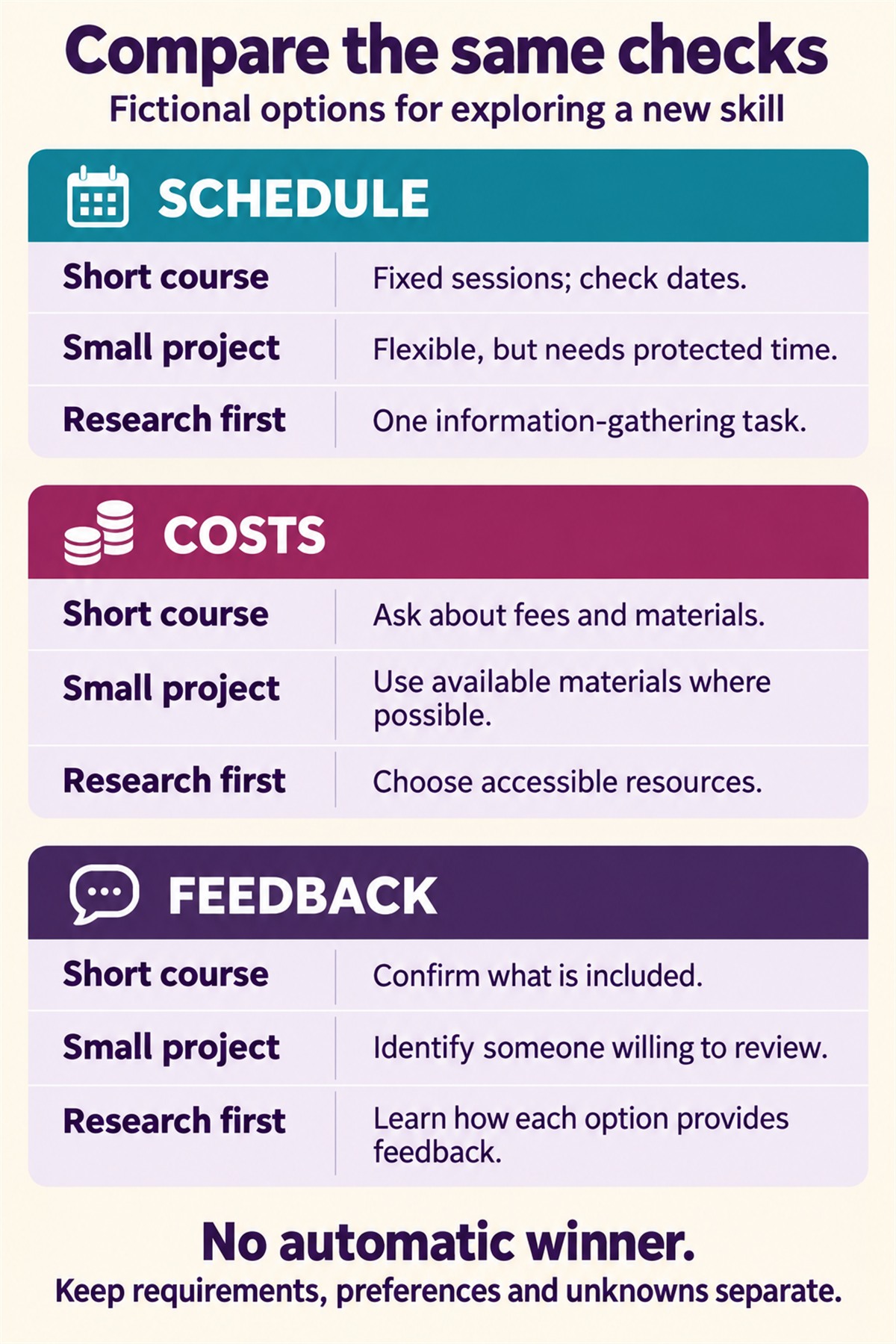
| Check | Short course | Small project | Research first |
|---|---|---|---|
| Schedule | Fixed sessions; check dates. | Flexible, but needs protected time. | One information-gathering task. |
| Costs | Ask about fees and materials. | Use available materials where possible. | Choose accessible resources. |
| Feedback | Confirm what is included. | Identify someone willing to review. | Learn how each option provides feedback. |
The table does not announce a winner. Different requirements can lead different people to reasonable choices. You may also find that none of the options currently fits.
Use these five steps to turn the example into your own worksheet:
- Name the purpose. Write one sentence about what you hope the next step will support.
- List the non-negotiables. Include time, access, responsibilities and a spending limit you are comfortable with.
- Compare the same details. Give each option the same rows, and keep preferences separate from requirements.
- Mark missing information. Write “unknown” and a specific question rather than supplying an optimistic guess.
- Choose the next check. Identify one answer or small trial that would make the decision more informed.
If you use scores, label them as your preferences—not probabilities of success. A high total does not make an inaccessible option workable, and a low score may hide a feature that matters greatly to you. Review the reasons behind a score before trusting the number.
Test one uncertainty before making a larger commitment
Choose the question that could most change your decision. It might concern workload, access, the daily activities of a role or whether you enjoy a particular task. Seek a concrete answer through information or a small, affordable trial.
The NHS problem-solving guide suggests considering the pros and cons of options, what you need to try them and a specific plan for action. A plan can name what you will do, whose support you need and when you will begin.
A fictional example: checking the schedule first
Imagine someone wants to explore illustration while keeping evenings available for caring responsibilities. A course sounds appealing, but its advertised description does not list all session times. An independent drawing project is flexible, though the person is unsure where feedback would come from.
The schedule is a requirement, not just a preference. The next step could be asking the course provider for the actual timetable and workload. For the project, it could be asking a willing friend or community group whether feedback is available, without assuming anyone owes that time.
If the course conflicts with a non-negotiable responsibility, enthusiasm alone does not solve the conflict. The person could investigate another format, try a modest project or keep researching. That is a decision based on fit, not proof that the course is bad or that postponing means failure.
Keep symbolic reflection in its own column
If an I Ching reading or another spiritual practice gives you an association, label it as reflection. It may suggest a question you had not considered, but it cannot confirm fees, qualifications or a future result.
Our I Ching guide separates a source text from a personal interpretation. That distinction is useful when you bring a symbolic practice into a practical decision.
Review the decision as conditions change
Keep a brief note of the reasons for your choice. Later, compare those reasons with what happened. A disappointing result does not necessarily mean the original decision was careless; some outcomes depend on circumstances you could not control.
You can revise the option, reduce the commitment or pause. Personal success can include making a well-informed choice and noticing when the plan needs to change.
Make a decision note you can return to
My next step: What will I do first?
Why it fits: Which requirements are met, and what preference does it support?
Still unknown: What must I check before a larger commitment?
My limits: What time, money or responsibility boundary will I protect?
Review point: When will I reconsider, and what information would change my plan?
Choose a review point that suits the actual task rather than repeatedly checking for reassurance. You might revisit a plan after receiving an answer or completing a small trial. There is no special number of days that makes the decision spiritually correct.
If your hopes involve manifestation, our guide to the limits of the Law of Attraction explores the difference between your participation and outcomes outside your control. A thoughtful choice does not guarantee the result, and an unwanted result does not determine your worth.
Your path can be both meaningful and practical. Keep your values in view, ask the ordinary questions and allow yourself to adjust as you learn. A smaller step that fits your life can be more useful than a dramatic commitment made to prove your confidence.
I find the emphasis on defining personal success very insightful. Society’s expectations often cloud our own understanding of happiness.
The concept of making do with what you have is a practical approach. Initial stages of any career often involve humble beginnings.
The notion of defining goals as tangible achievements rather than abstract desires is very practical for reaching success.
The article addresses the complexities of finding one’s path to success quite well. Individual perfection is indeed a personal journey that requires dedication.
A well-rounded article. The point about forgiving oneself and learning from mistakes resonates well, especially in a professional context.
The advice to take risks and step outside comfort zones is crucial. Fear of disapproval can indeed limit our potential.
An enlightening read. Understanding that success is a personal journey and not a universal template is key to finding true fulfillment.
It’s interesting how the article mentions procrastination as a sign of stagnation. Recognizing the need for change is often the first step.
Absolutely, recognizing stagnation is crucial. It’s easy to blame procrastination without addressing underlying dissatisfaction.