

Money chakras • Spiritual reflection • Grounded choices
Money can carry more than a number. It may bring up safety, freedom, generosity, family expectations or the hope of doing work that matters. If chakra teachings are part of your spiritual life, their symbolism can give you a compassionate way to explore those feelings.
“Money chakras” is best understood here as a reflection framework, not a special set of organs or an energy technique that produces income. You can welcome spiritual encouragement while still looking honestly at your circumstances and the practical choices available to you.
What do chakras have to do with money?
The seven-chakra model uses themes such as stability, creativity, personal agency and communication. In this article, those themes become questions about your relationship with money. They do not measure your worth, explain every financial difficulty or determine whether an investment will succeed.
Financial pressure can arise from low income, high costs, illness, caregiving, unexpected bills or other circumstances. It is not evidence that your thoughts are wrong or your energy is defective. Being introverted, worried or unhappy at work does not establish a chakra blockage.
If you are new to the symbolism, begin with our introduction to the seven chakras. Different teachers use different associations. The questions below are optional ways to reflect, not universal rules about the body or a substitute for financial advice.
Seven chakra themes for money reflection
Choose one theme that fits a real concern. Pair the reflection with a small action; there is no requirement to complete all seven or buy anything to begin.
1. Root chakra: safety and the essentials
The root theme, commonly associated with red, can represent steadiness and basic needs. Rather than asking whether you “feel wealthy enough,” ask what would make the coming week more manageable.
Reflect: Which essential expense or uncertainty is taking up the most space in my mind?
Try: Write down expected income dates and upcoming bills. Note what you know and what still needs checking. If something will not fit, an early conversation about available options may be more useful than waiting to feel perfectly calm.
A gentle intention: “I can look at my situation one piece at a time.” Spiritual grounding can accompany that process; it cannot promise protection from every expense.
2. Sacral chakra: creativity and enjoyment
The sacral theme, often associated with orange, invites you to notice creativity and pleasure. Money goals need not be driven only by fear. You might want room for an enjoyable hobby, a meaningful project or work that uses a skill you value.
Reflect: What do I enjoy creating, and what would it cost to explore it modestly?
Try: Sketch a low-cost experiment before making a major career change. For a craft idea, list supplies, time and the price people would need to pay; do not assume enthusiasm guarantees demand or profit. You can also enjoy creativity without turning it into a business.
A gentle intention: “I can explore what interests me without staking my security on one idea.” Losing interest in a job does not mean your sacral chakra must be repaired before you can earn.
3. Solar plexus: agency and manageable decisions
The solar-plexus theme, commonly associated with yellow, can symbolize taking part in your own decisions. Confidence is useful, but it does not require knowing everything or acting alone.
Reflect: What is one decision I can clarify rather than postponing because the whole situation feels large?
Try: Pick a specific task: read one account statement, review a recurring charge or gather information about a course before enrolling. Write the decision and the information needed. Asking for qualified help can be an act of agency, not a failure of independence.
A gentle intention: “I can learn what I need for the next decision.” An uncertain day does not remove your ability to take a small useful step.
4. Heart chakra: generosity that includes you
The heart theme, often associated with green, can open a conversation about giving, receiving and fairness. You may love helping others and still need to protect money for your own essentials.
Reflect: Am I giving freely within my means, or hoping a gift will keep someone pleased with me?
Try: Decide what support is genuinely available before answering a request. “I can’t lend money, but I can help you look for resources” is a caring response. Receiving agreed payment for your work can also coexist with kindness; forgiveness does not guarantee compensation or make someone else’s debt disappear.
A gentle intention: “My care has room for my own needs.” If pressure or guilt is shaping a relationship, our article on recognizing financial pressure from a partner explores that separate concern.
5. Throat chakra: clear money conversations
The throat theme, commonly associated with blue, can symbolize expressing questions and expectations. Useful financial communication is concrete: what is owed, when it is due and what the terms actually say.
Reflect: Which money conversation needs more clarity?
Try: Prepare one direct question: “What is the total cost, including fees?” or “Could you send the payment agreement in writing?” For shared expenses, discuss who pays what and when, rather than expecting someone to understand an unspoken arrangement.
A gentle intention: “I am allowed to ask before agreeing.” Speaking confidently cannot make an unsuitable investment safe, and a quiet voice does not prevent you from managing money well.
6. Third eye: intuition alongside verification
The third-eye theme, often associated with indigo, invites reflection on perception and perspective. A feeling can tell you to pause, ask a question or notice what attracts you to an offer. It cannot establish future returns.
Reflect: What am I feeling, and which parts of this situation have I actually verified?
Try: Separate your impression from the evidence. Check written terms and relevant qualifications before committing money. If someone rushes you, creates fear or tells you that doubt will block prosperity, take space to investigate independently.
A gentle intention: “I can listen inwardly and check outwardly.” Investor.gov’s fraud checklist flags pressure to invest immediately, risk-free claims and promises of guaranteed returns. An uplifting spiritual message does not override those warning signs.
7. Crown chakra: values and a wider perspective
The crown theme, commonly associated with violet, can represent meaning and connection. Here, it invites you to consider what money is for in your life: stability, family care, learning, creative time or contribution.
Reflect: What does “enough” mean for this particular goal, rather than for someone else’s picture of success?
Try: Name one value and a realistic way to support it. If learning matters, compare affordable ways to study. If generosity matters, time and attention may be available when a donation is not. Values can guide choices without turning income into a measure of spiritual development.
A gentle intention: “My worth is larger than my bank balance.” Questioning a teaching or declining a purchase does not cut you off from wisdom or belonging.
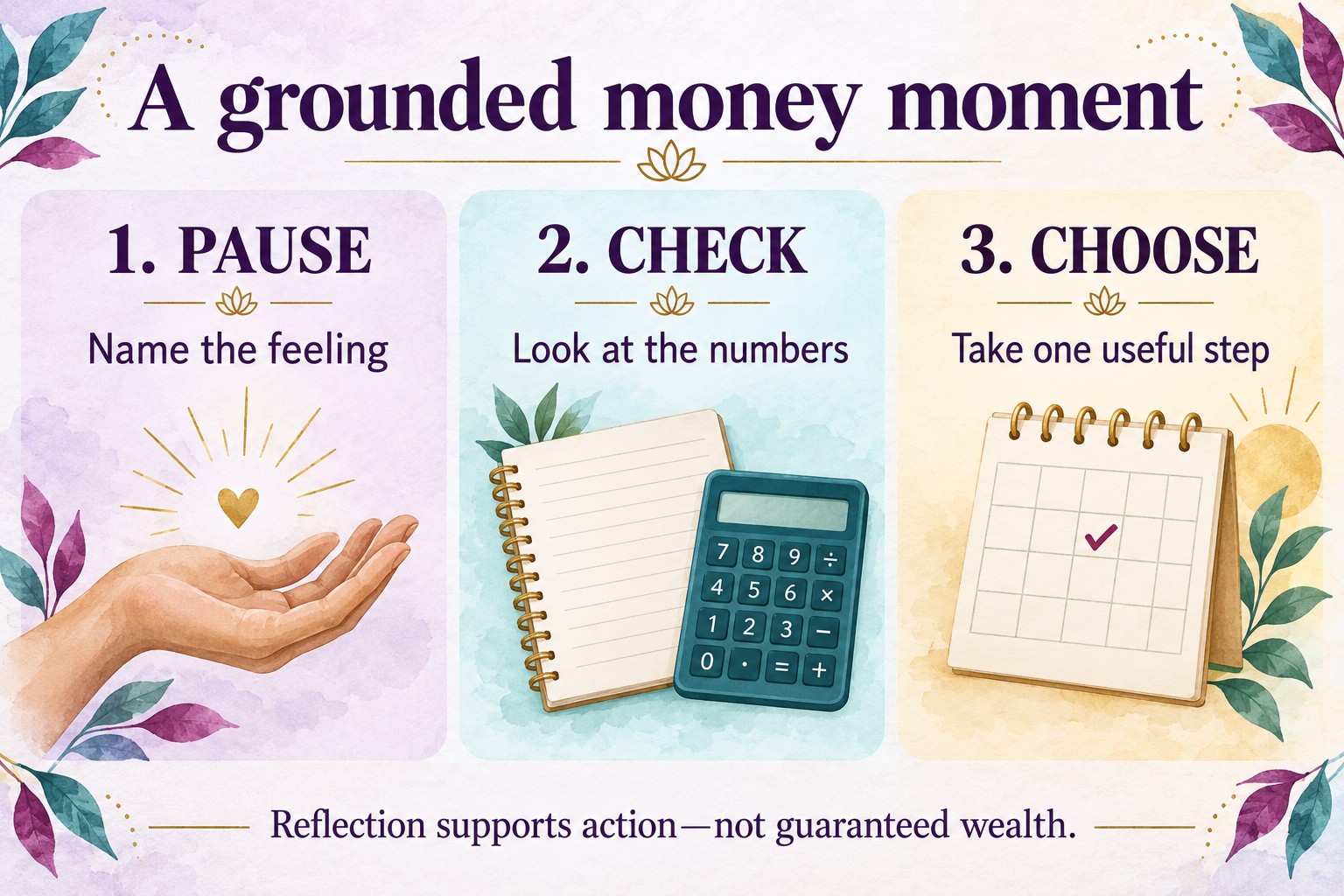
A grounded money moment: pause, check, choose
You can use this short practice before opening a bill, replying to a request or considering a purchase. It translates the cover image into three simple steps:
- Pause—name the feeling. Notice whether you feel anxious, excited, guilty or hopeful. You do not need to make the feeling disappear.
- Check—look at the numbers. Confirm the amount, timing and terms. Distinguish an expected payment from money that has actually arrived.
- Choose—take one useful step. Ask a question, update a calendar, compare an option or decide not to proceed yet.
For example, imagine wanting a new course while a household bill is approaching. You might name the excitement about learning, check the total course price and the bill’s due date, then ask whether a later course date or a lower-cost option exists. You have not rejected your dream; you have given it a more informed next step.
The Consumer Financial Protection Bureau’s Your Money, Your Goals toolkit includes a spending tracker, bill calendar and cash-flow budget. These free tools offer a concrete companion to reflection.
Keep spiritual support within a clear role
Meditation, prayer or a psychic conversation may help you explore hopes and emotional patterns. Our guide to intention and visualization pairs imagination with participation rather than a demand for a particular outcome.
If you choose a paid reading, set a limit that fits your circumstances and keep it separate from essential expenses. A reading cannot determine a suitable investment, erase debt or guarantee a job. Do not pay escalating fees because someone says prosperity requires removing a curse or repairing an energy blockage.
For investment, debt, tax or legal decisions, seek appropriately qualified support for your situation. If stress or physical symptoms persist, seek healthcare rather than treating them as a chakra diagnosis. Spiritual practice is most supportive when it leaves you free to question, choose and ask for practical help.
You do not have to feel abundant every day to deserve steadiness and opportunity. Let the chakra themes offer language for your experience, then return to one useful question and one possible action. Hope and honest numbers can belong in the same notebook.
The explanation of the solar plexus and heart chakras is quite insightful. Understanding these energy centers can potentially lead to better self-awareness and mental health.
The article provides a detailed exploration of how unbalanced chakras can affect different aspects of life, like creativity and financial management. The specific examples make the concepts more relatable.
The concept of chakras and their impact on our physical and mental well-being is intriguing. The relationship between energy centers and daily practices for maintaining balance offers an interesting perspective.
The association of chakras with colors and their impact on our emotional states is an interesting angle. It shows how ancient practices tried to create a holistic understanding of health and well-being.
The linkage between chakra imbalances and feelings of insecurity or lack of confidence, as described for the root and sacral chakras, offers an interesting psychological perspective. It could be useful to explore these connections further.
It’s fascinating to see how the article ties physical and emotional health to chakra balance. The focus on specific chakras and their effects on confidence and decision-making is particularly notable.
I agree. The emphasis on the root and sacral chakras highlights the importance of foundational energy in maintaining overall stability and creativity.
Indeed, but it’s also important to critically assess the tangible impacts and scientific validation of such claims. More empirical evidence could strengthen these assertions.
While the idea of chakras influencing various aspects of our health and well-being is compelling, it would be beneficial to see more scientific research supporting these concepts. Nevertheless, the holistic approach has its merits.
The discussion on how chakras can be cleared through daily practices is quite practical. Integrating such practices into daily routines might enhance one’s mental and emotional well-being.