

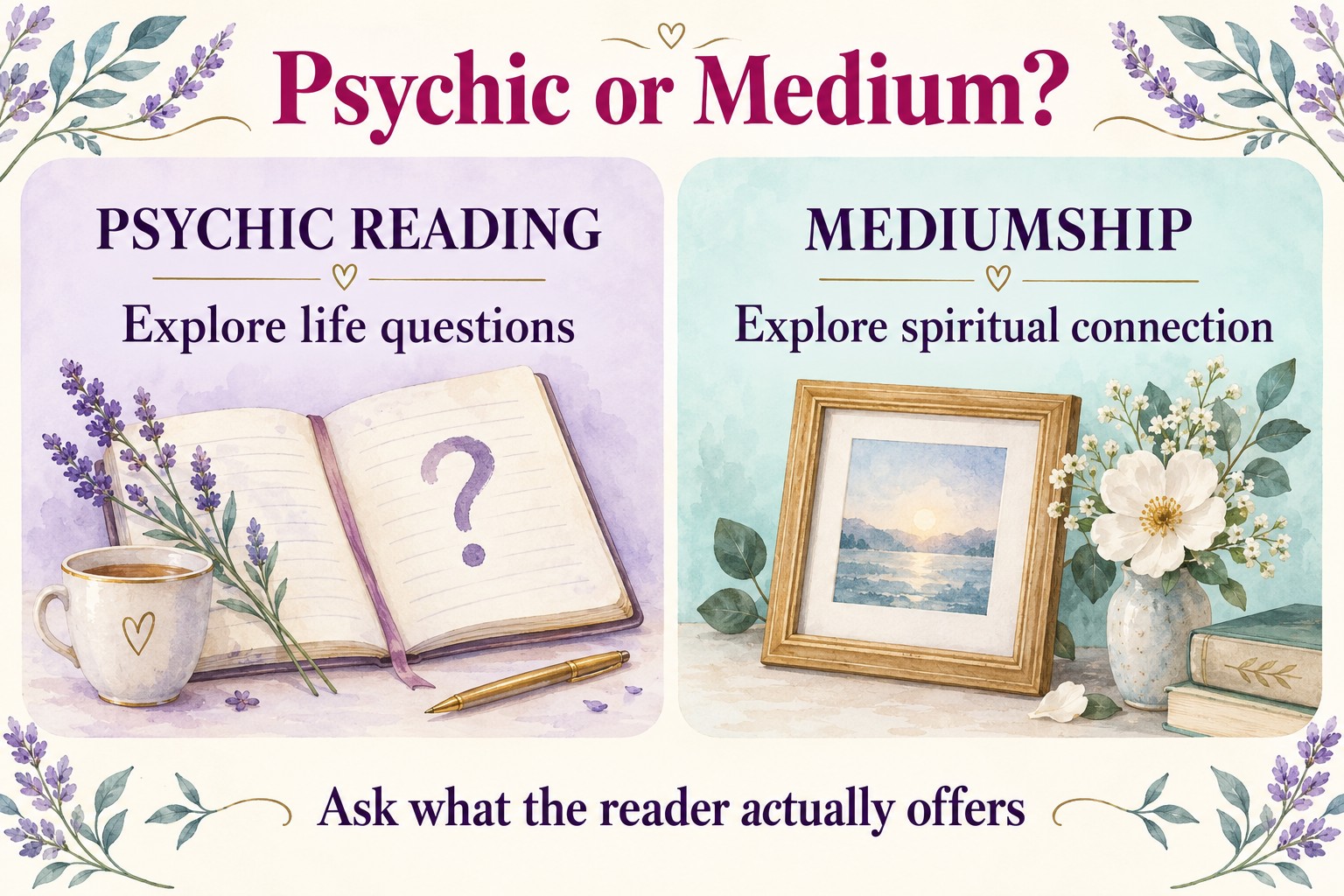
Choosing a reading • Intuition • Mediumship
If you are choosing between a psychic and a medium, start with what you hope to explore. A psychic reading usually centers on life questions and intuitive interpretation. Mediumship centers on a reader’s claimed communication with deceased people or, for some practitioners, pets. A person advertising as a “psychic medium” may offer both, but you should ask which service you are booking.
The terms overlap, and readers use them differently. You do not need to master every spiritual phrase before making a choice. A clear conversation about the session’s focus, methods and limits is more useful than an impressive title.
The difference: focus, not a ranking of gifts
Think of the cover’s comparison as a starting point: psychic reading—explore life questions; mediumship—explore spiritual connection; ask what the reader actually offers. Neither label guarantees accuracy, contact, comfort or a particular outcome.
| Consider | Psychic reading | Mediumship |
|---|---|---|
| Typical focus | Life themes, choices and intuitive impressions | Messages interpreted as spiritual connection with someone deceased |
| Useful question | “How do you approach my topic?” | “What happens if no recognizable message comes through?” |
| Tools | May use cards or another framework, or no tools | Methods vary; clarify whether cards or other tools are included |
| What not to assume | Knowledge of private thoughts or guaranteed future events | Guaranteed contact, proof of the afterlife or resolution of grief |
What a mediumship session is intended to offer
A medium may describe receiving images, words, sensations or impressions they interpret as messages from someone who has died. People approach these sessions with different beliefs: some seek a sense of connection, while others are curious or unsure. You can bring hope without committing yourself to accepting every statement.
Ask whether the reader offers individual or group sessions and whether they work with a particular loved one, whoever they believe comes through, or both. If you hope to remember a deceased pet, check whether that is part of their practice. An advertised specialty is a service description, not a promise that contact will occur.
Compassion, tact and room for uncertainty matter. A message that feels meaningful to you need not become proof you must defend. Equally, an unfamiliar detail does not have to be made to fit. You can say, “I do not recognize that,” or “I would rather leave that open.”
Mediumship should not be treated as an obligation to receive instructions from someone you miss. A reader’s interpretation does not determine whether your loved one cared about you, whether you grieved correctly or what you must do next. Lack of a recognizable message is not a judgment on your bond.
What “psychic medium” means—and what it does not
A psychic medium may offer intuitive discussion about your life as well as mediumship. Those services may be separate appointments or parts of one session. Do not assume that booking one automatically includes the other.
For example, you might ask, “I want to explore a move, not receive messages from deceased relatives. Do you offer a session focused on that?” Or, “I am interested in mediumship only. Could we keep career predictions outside the session?” A respectful reader should explain their scope before you pay.
It is also too rigid to say that mediums never use tarot or discuss the future. Practitioners combine approaches in different ways. The important question is what this particular person offers and how they distinguish their interpretations. If cards are your main interest, our tarot-versus-psychic comparison explores that separate choice.
The clairs and other reading methods
A reader may use “clair” language to describe how they experience impressions. These terms belong to spiritual practice; they are not a checklist that establishes a reader’s reliability.
- Clairvoyance: described as intuitive images or “clear seeing.”
- Clairsentience: described as intuitive feelings or “clear sensing.”
- Clairaudience: described as intuitive words or “clear hearing.”
- Clairalience: described as intuitive scent impressions or “clear smelling.”
- Clairgustance: described as intuitive taste impressions or “clear tasting.”
- Claircognizance: described as sudden intuitive understanding or “clear knowing.”
The same vocabulary may appear in psychic or mediumship descriptions. Ask the reader to explain a term in plain language and show how it affects the session. “What would I actually hear or discuss with you?” is a perfectly reasonable question.
Other readers use tarot, oracle cards, runes, scrying, astrology, numerology or palmistry. Some describe these as intuitive methods; others emphasize learned symbolism. Aura reading and object reading are additional approaches. No tool—or absence of a tool—automatically makes a reading more genuine or better suited to a specific question.
You do not need to interpret an unexpected sensory experience as a gift because a reader uses similar language. If an experience worries you, seek suitable professional advice rather than relying on a spiritual label.
Three choices to make before you book
1. Name your purpose
Write one sentence: “I would like a conversation about ___.” If it concerns your choices, relationships or a life transition, ask about an intuitive reading focused on that topic. If it concerns a deceased loved one and you want to explore mediumship, look for someone who explicitly offers it.
You may also decide you want remembrance without a reading: sharing a story, making a memory page or visiting a meaningful place. None of these choices makes you more or less spiritual.
2. Decide what is outside the session
Choose a boundary in advance, such as “I do not want health predictions,” “I do not want descriptions of a death,” or “Please ask before moving from mediumship into other topics.” You can change your mind or stop a conversation.
If grief is very raw, consider whether a reading would feel supportive today. The NHS bereavement guide describes varied grief experiences and support from trusted people, counsellors or healthcare professionals. Spiritual reflection need not replace that support.
3. Confirm the practical details
Ask about the format, duration, total price or per-minute rate, minimum charges, cancellation terms and any follow-up. Find out how to end the session and whether additional services will be offered. Ask about recording and handling of your information rather than assuming a particular privacy policy.
If you are undecided between phone, chat and email, our reading-format comparison can help you consider how you prefer to communicate. Choose a budget you are comfortable spending even if the session is not what you hoped.
A simple inquiry you can send
For instance, someone remembering their grandmother might ask about mediumship while excluding predictions about their own lifespan. Someone considering a course might request an intuitive discussion and exclude mediumship altogether. These are illustrative booking choices, not accounts of actual readings.
A clear answer helps you decide whether the service matches your intention. If you receive vague claims of universal abilities instead, ask once more for specifics or choose another option.
During and after the reading, keep your own judgment
You can listen thoughtfully without supplying a match for every impression. Ask what was meant, correct a detail or leave a statement unresolved. Do not let pressure to be “open” turn into pressure to agree.
Afterward, separate what the reader said, what it meant to you and what you can independently check. A comforting phrase can be part of a remembrance practice without becoming an instruction to spend money, change treatment or make a major decision.
Pause if a reader uses fear, claims you are blocking contact, demands urgent payments to remove a curse or promises a particular person’s love. Do not book repeated sessions simply to obtain a desired answer. Psychic readings and mediumship do not replace medical, legal, financial or grief support.
Our first-session guide offers more help with clarification and follow-up. The choice can be a psychic, a medium, someone who offers both—or no reading. Let your purpose, comfort and boundaries guide you, while leaving room for spiritual meaning and uncertainty together.
The distinctions between mediums and psychic mediums are crucial for someone seeking a targeted reading. It’s clear from the article that understanding these differences can enhance the client experience.
The explanation of the six ‘clair’ gifts is particularly enlightening. Understanding these different types of psychic abilities can help clients choose the right kind of psychic for their needs.
The advice to ask psychics about their methods directly is very practical. Clients can benefit from knowing how a psychic works to get a reading that meets their specific needs.
It’s interesting to see that some psychics can read auras or use personal objects to perform readings. This article demystifies the various methods used in psychic readings.
This article provides a comprehensive overview of various psychic terms and methods. It’s helpful to know that some psychics use divination tools, while others rely solely on their intuitive gifts.
The emphasis on researching a psychic’s abilities and skills before a reading is valuable. It ensures clients have realistic expectations and are more satisfied with their readings.
Understanding that mediums communicate with spirits and don’t predict the future is an important clarification. This can help manage client expectations when seeking different types of readings.
The section on divination tools highlights the diversity in psychic practices. It’s good to know that some readers use these tools to focus their intuition.
This knowledge can lead clients to choose a reader whose methods align more closely with their own expectations and questions.
Indeed, understanding the use of divination tools can make a significant difference in what a client expects from a reading.