

CHOOSING A READING / SYMBOLS & INTUITION
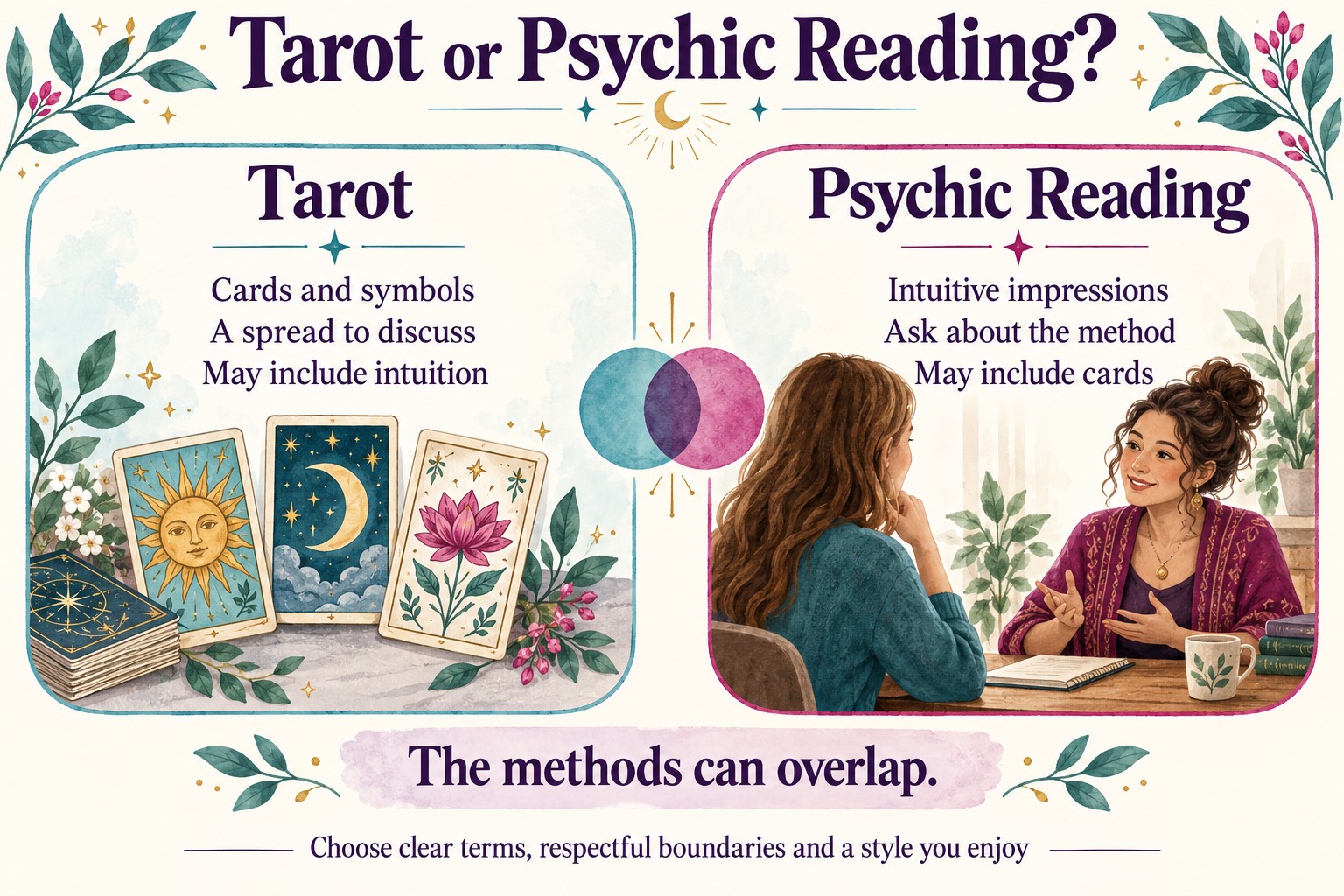
Should you book a tarot reading or a psychic reading? The choice is less about finding a “better” spiritual method and more about the kind of conversation you would enjoy. Tarot gives you cards and symbols to explore. A psychic reading may center on intuitive impressions, sometimes with cards and sometimes without them.
There is overlap: a tarot reader may describe their work as psychic, while another uses tarot for reflective conversation without claiming psychic ability. Before booking, ask how the person actually works. A label alone will not tell you what your session will be like.
The difference at a glance
| What to consider | Tarot reading | Psychic reading |
|---|---|---|
| Main starting point | Cards, imagery and a spread | The reader’s stated intuitive method |
| What you may discuss | How symbols relate to your question | Impressions, themes or possibilities |
| Useful clarification | “How are you interpreting this card?” | “What do you mean by that impression?” |
| Possible overlap | May include intuitive impressions | May include tarot or other tools |
| Shared limits | No guaranteed outcome; your decisions remain yours | No guaranteed outcome; your decisions remain yours |
Neither format is automatically more accurate, more spiritual or more suitable for everyone. A clear explanation, respectful boundaries and a comfortable conversational style matter more than an impressive-sounding title.
What a tarot reading can feel like
A tarot reader selects or lays out cards in a spread, then interprets their images and positions in relation to your question. You might discuss a theme such as change, patience, connection or a choice between approaches. Seeing the cards can make the conversation easier to follow because you have a shared visual reference.
Many familiar tarot decks contain 78 cards, though designs and interpretations vary. Tarot’s history is also worth separating from modern spiritual practice: the V&A’s history of tarot cards describes its earlier use as a game, surviving 15th-century cards and the development of fortune-telling use in the late 18th century. Today’s readers bring different beliefs and approaches to that visual tradition.
Tarot may appeal to you if you enjoy symbolism, prefer a structured discussion or want to ask how the reader reached an interpretation. A card is not a fixed verdict about your life. Two readers may emphasize different details, and you can disagree with an interpretation without being “bad” at receiving a reading.
Ask whether the session is predictive, reflective, intuitive or a mixture. Also ask whether you will see the cards on video or receive their names during a call or chat. If you like preparing questions around a theme, try our guide to what to ask the tarot cards.
What a psychic reading can feel like
A psychic reader may describe working with intuitive feelings, mental images, words or impressions. Some call these experiences clairvoyance, clairaudience or clairsentience. These are descriptions within spiritual practice, not a guarantee that the reader can access every fact about you or another person.
A session may be conversational rather than organized around a visible spread. You can ask what the reader means, offer brief context or correct a detail. You do not have to supply a connection to every statement. What matters is whether you can explore a message openly without pressure to agree.
The term “psychic reading” is broad. Some readers also use tarot, astrology or another framework. Others offer aura or chakra work; our aura and chakra reading guide explains questions to ask about that particular style. Mediumship, which focuses on claimed communication with deceased people, is a distinct focus and should not be assumed to be included in every psychic session.
Choose a reader whose stated approach interests you, rather than someone promising to reveal private thoughts, control a relationship or eliminate uncertainty entirely. You can enjoy intuitive conversation while still checking facts and making your own choices.
Three questions to help you choose
1. Do I want a visible symbolic starting point?
If you like discussing images and how they connect to a question, tarot may feel approachable. You can ask about the picture, the spread position and the interpretation. If you would rather hear and discuss intuitive impressions without a card structure, ask about a reader who works that way.
You do not have to know card meanings beforehand. Equally, choosing an intuitive reading does not require you to accept vague language without explanation.
2. What is the actual topic I want to explore?
A relationship question, creative block or life transition can be explored in either format. The topic does not automatically dictate the method. Consider the reader’s focus and boundaries as well as your own comfort. For a love-related conversation, our questions to ask a love psychic can help you focus on your needs and choices.
If grief is your concern, approach the session gently. A reading may feel comforting to some people, but should not promise closure or a particular message from someone you miss. You can seek spiritual comfort alongside support from people you trust or a grief professional.
3. What kind of experience fits my time and budget?
Both styles may be offered in person, by phone, chat, video or email, depending on the reader. A live conversation allows immediate clarification. An email reading gives you written material to revisit, but follow-up questions may be limited. Check the exact format rather than assuming every option is available.
Confirm the total cost, any minimum time or introductory conditions, how billing works and how to end the session. Privacy and recording practices also vary. Ask what is stored or shared; do not assume confidentiality just because the service is spiritual.
Try one question in either format
Neither answer should replace reviewing your circumstances, speaking with relevant people or getting qualified advice where needed. You might leave with a journal prompt or a useful question, not an instruction to resign, move or spend money.
Our first-session walkthrough explains how to clarify messages and separate what was said from what you choose to do afterward.
Choose a respectful reader, whichever method you prefer
Look for clear service descriptions and terms, an explanation of the method, room for correction and a willingness to respect your limits. Reviews may tell you about other people’s experiences, but they do not establish that a future prediction will come true for you.
Avoid pressure to purchase repeated readings until you hear the answer you want. Claims that a curse must be removed urgently, that guaranteed love can be purchased or that a prediction should override medical, legal or financial advice are reasons to pause.
You can choose tarot, an intuitive session, a reader who combines them or no reading at all. There is no spiritual test to pass. The best starting point is an approach that interests you, fits your budget and leaves you feeling free to think for yourself.
The confidentiality aspect of psychic readings could be comforting for many people seeking personal advice.
The emphasis on choosing a skilled reader for accurate tarot interpretations is crucial. The interpretation really defines the quality of the reading.
It’s worth noting that while these readings can offer guidance, they should not replace professional advice in critical areas like health or finances.
It’s interesting that both forms of readings aim to provide clarity and peace of mind, which can be of great psychological benefit.
This article provides a comprehensive overview of the differences between tarot card readings and psychic readings. It’s helpful for those who are unfamiliar with these practices.
Both types of readings appear to focus on the interpretation of personal energies and symbols, which can be subjective but interesting for those who believe in them.
The article does a good job outlining how both types of readings can be conducted online, making them more accessible.
The historical context about tarot cards originating in the 15th century adds credibility to the practice.
Indeed, historical context is important for understanding why certain methods gain popularity.