

HIGHER SELF / INNER WISDOM & EVERYDAY CHOICES
When life feels noisy, connecting with your higher being can be a way of returning to what feels honest, compassionate and meaningful. You may think of it as your higher self, your inner wisdom or the part of you that feels closest to the divine.
This connection does not have to arrive as a dramatic vision. It may begin with a sincere question, a moment of quiet or a choice that honors a value you had been overlooking. The practice below gives you room to listen without demanding certainty or a particular spiritual experience.
What does “higher being” mean?
In this guide, “higher being” means the higher self rather than a separate authority that must take over your decisions. Some spiritual people understand the higher self as an aspect of the soul connected with divine love; others use the idea to describe their wisest, most compassionate perspective.
You do not need to prove that it lives in another dimension or settle every question about reincarnation before exploring the practice. Let the language fit your beliefs. If “inner wisdom” feels more natural, use that.
Your higher-self practice is also different from seeking a message from an external spirit guide. You can include guides in a prayer if that is meaningful to you, but neither approach guarantees access to hidden facts. Our article on knowing your spirit guides explores that distinction with room for personal interpretation.
A gentle practice for connecting with your higher self
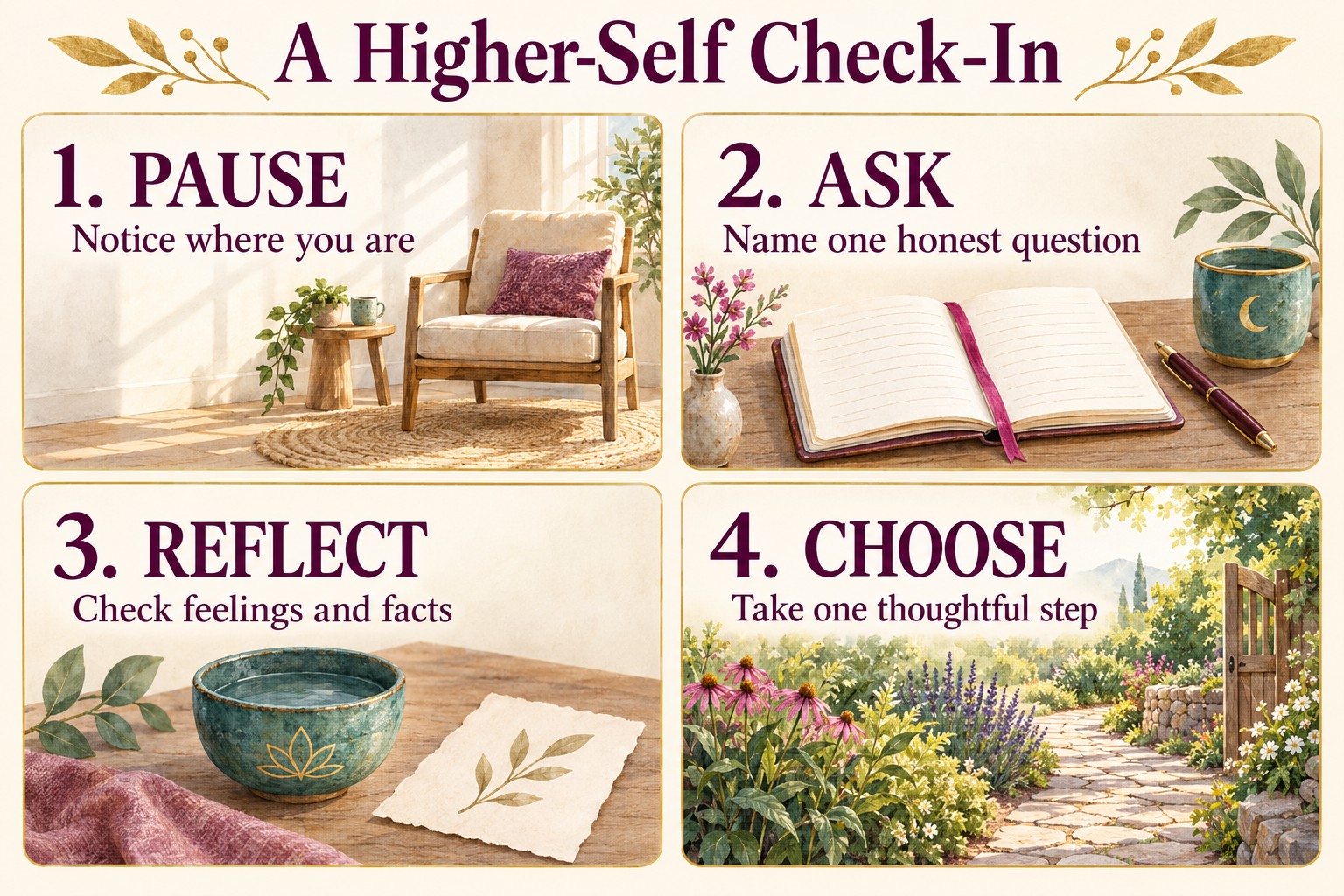
Choose a comfortable place and begin with a few minutes. There is no need to empty your mind, hold your breath or keep meditating until something unusual happens. Use the following steps as invitations rather than a performance to get right.
- Notice where you are. Feel the support of the chair or the ground. Keep your eyes open, softly focused or closed, depending on what feels comfortable.
- Let your breathing be ordinary. Follow a few natural breaths. If focusing on breathing feels uncomfortable, notice a sound, the texture of an object or the view outside instead.
- Welcome a symbol of kindness. If you enjoy visualization, imagine a gentle golden light around you or near your heart. You can choose another color, a warm word or no image at all. Not seeing light does not mean you are disconnected.
- Offer a simple invitation. You might say, “May I meet this moment with honesty and compassion.” If it suits your faith, ask the divine or your guides for support. You remain free to question anything that arises.
- Ask one question. Try “What needs my care today?” or “What would a thoughtful next step look like?” Give the question some space rather than pushing for an immediate answer.
- Notice without declaring it truth. A word, memory, feeling or idea may appear. You may also notice nothing in particular. Record an impression as something to explore, not an instruction you must obey.
- Return and choose. Look around the room, move comfortably and write down one small action or one question that still needs information. End the practice without forcing a feeling of peace.
If you like using images to explore intentions, our meditation and visualization guide offers a flower exercise paired with practical action. You can keep the symbol that fits you and leave the rest.
Ask for help with a real obstacle
Instead of asking your higher self to remove every challenge, bring it a specific situation. “Why is my life difficult?” may be too broad to work with. “How can I handle tomorrow’s conversation with more honesty?” gives you something concrete to consider.
Separate what you feel from what you know. You might feel reluctant to accept an invitation, know you are tired and still be unsure whether the event would be enjoyable. An impression of “I need space” could lead to a shorter visit, a request for more details or a kind decline—not necessarily ending a friendship.
Try these five journal questions:
- What happened, without adding a prediction about what it means?
- What am I feeling, and what might that feeling need?
- Which value do I want to honor: honesty, kindness, steadiness, creativity or something else?
- What information or perspective am I missing?
- What small, reversible step could I take?
When your choice affects another person, include their boundaries and consent. Spiritual meaning does not give you access to their private thoughts or permission to decide what they should want.
Bring discernment to spiritual impressions
A calm feeling can be meaningful, but calmness alone does not make an idea accurate. An urgent feeling can matter too, without proving that it is a message. Consider whether an impression is consistent with your values, the available facts and the well-being of the people involved.
Give major choices time when possible. Seek qualified advice for health, legal or financial questions rather than using a meditation to diagnose a problem or guarantee an outcome. Our guide to using intuition as a gift explains how reflection and practical checks can work together.
Do not treat an impression that tells you to harm someone, ignore care or surrender control to a paid adviser as higher wisdom. You can step back, question it and seek support. A thoughtful spiritual teacher should respect your decisions and allow uncertainty, not sell guaranteed divine answers.
Let love include your ordinary human needs
Connecting with your higher self is not a reason to reject your “ego,” silence anger or shame yourself for wanting rest and reassurance. An uncomfortable emotion may point to a boundary, a disappointment or a need for care. You can listen kindly without following every impulse.
Try saying, “I can be learning and still be worthy of kindness.” Then choose an ordinary expression of that kindness: eat, rest, ask for help or make a realistic plan. Spiritual alignment can be reflected in how you treat yourself and others, not just how a meditation feels.
If inward attention brings distress, stop and return to your surroundings. A walk, a shorter practice or a conversation may suit you better. The NCCIH meditation and mindfulness guide discusses possible unwanted experiences and advises against replacing or postponing conventional care with meditation. Seek professional support if distress persists or interferes with daily life.
Make room for a steady connection
You might return to one question before a busy day or spend a few minutes reviewing a decision at night. A brief practice that fits your life is enough; you do not have to stay in a “higher state” for as long as possible. Our guide to building a manageable meditation habit offers ideas for a gentle routine.
Notice what the practice helps you do: speak more honestly, consider another perspective or make a little room for something important. No image, sensation or instant revelation is required. Let your higher-self connection remain an invitation to thoughtful living—hopeful, open and grounded in choices you can make.
Embodying one’s higher self as a way to enhance vibrations and pursue a soul path adds depth to the understanding of personal development.
The concept of the higher self is intriguing. It seems to emphasize self-awareness and spiritual growth.
The idea of asking one’s higher self for guidance during challenges is an interesting approach to problem-solving.
Relaxation techniques and focusing on inner light seem like effective methods for reaching a heightened state of self-awareness.
The connection between spiritual awareness and physical experiences is a fascinating perspective. It seems to bridge the gap between the material and the spiritual.
The steps provided for connecting with one’s higher self appear practical and well-structured. It could be beneficial for those seeking inner peace.
Aligning oneself with a divine self as a path to wisdom and peace is a thought-provoking concept.
I appreciate the emphasis on self-love and meditation in the article. These are powerful tools for personal growth.