

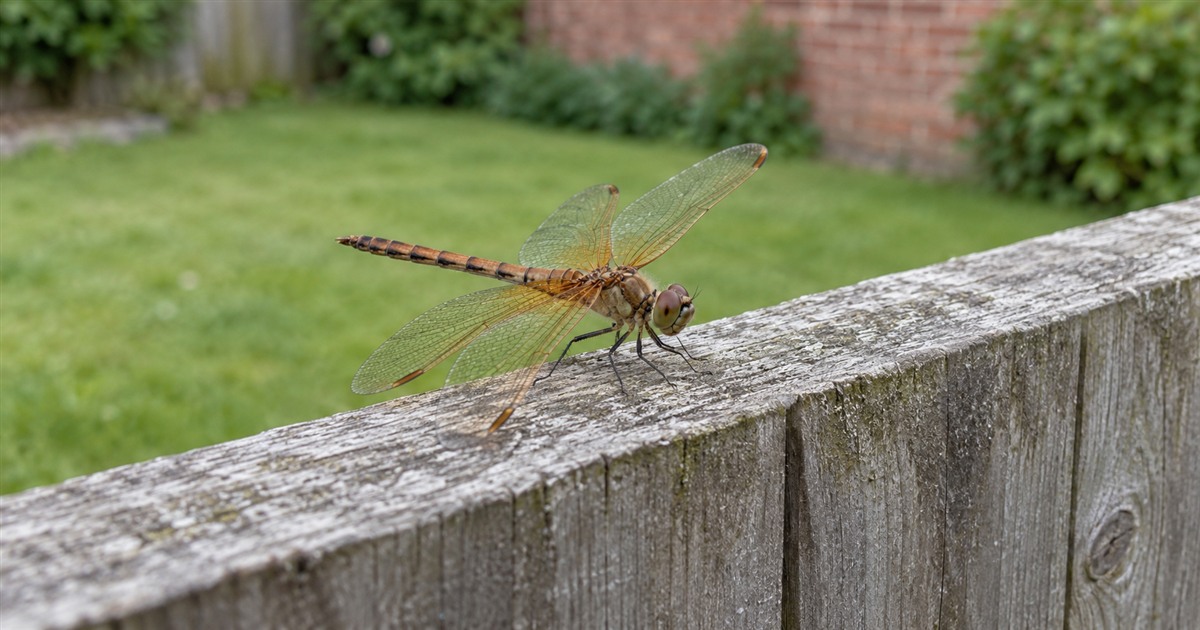
DRAGONFLY VISITS / NATURE, SYMBOLISM & REFLECTION
Do you enjoy dragonflies, or do their wide eyes and sudden movements make you a little uneasy? When one visits your garden, rests near a window or finds its way indoors, the encounter can feel surprisingly memorable. Its delicate wings and changing direction offer plenty to wonder about.
You may connect a dragonfly with change, adaptability or spiritual growth. You can welcome that personal meaning without needing to prove that the visit was arranged for you. A dragonfly at your home is not, by itself, evidence of a spirit message, a prediction or a warning. Natural behavior and a meaningful personal response can exist side by side.
Why might a dragonfly visit your home?
There may be an ordinary explanation: an adult could be feeding, moving through the area or resting. Nearby water can be relevant, but seeing one away from a pond is not automatically extraordinary. The British Dragonfly Society explains that adult dragonflies can be found well away from water and hunt flying insects.
You might notice one insect only once, or several visits during a period when you spend more time outdoors. Before deciding the visits form a message, note what you actually saw: where it rested, whether it was flying or still, and whether there were insects or water nearby. You do not have to identify the species to appreciate the encounter.
If you want to learn more, take a photograph from a comfortable distance rather than chasing it. A local nature group or identification guide may help. Keep a tentative identification tentative.
Why change and transformation are fitting metaphors
A dragonfly’s life really does involve a striking change of form. The British Dragonfly Society describes three stages: egg, aquatic larva and adult. Timing varies by species and conditions. Unlike a butterfly, a dragonfly has no pupal or chrysalis stage; the adult emerges at the final larval molt.
That transition can inspire reflection about parts of your life that are changing. It does not tell you that change must happen suddenly or that your present circumstances are wrong. Much of a process may be quiet and unseen, while the part other people notice arrives later.
Try asking, “What is developing in my life even if it is not ready to show?” You might think of a skill you are practicing, an idea you are shaping or a conversation you need time to prepare for. A useful next step could be small: gathering information, making space for practice or asking someone a practical question.
Our article on the meaning of a butterfly sighting explores a related transformation image. The two insects have different life cycles; neither one supplies a deadline for your personal growth.
Adaptability and enjoying a present moment
The dragonfly’s agile movement can become an image for flexibility. Rather than treating the sighting as a command to change everything, consider where a modest adjustment might help. Could a plan have a backup? Could you approach a task in a different order? Could you ask for a clearer explanation before choosing?
The invitation to pause also belongs here. You might stop for a moment, notice the color and shape, and let that brief attention be enough. You do not have to be cheerful, carefree or grateful on demand. Worry is not proof that you have missed a spiritual lesson.
For example, someone overwhelmed by a full week might take the encounter as a reminder to choose one manageable task and postpone a nonessential commitment. That is an illustrative choice, not a message the insect has verified. Adaptability can include maintaining a helpful routine or leaving a decision unchanged.
If you feel a spiritual connection or remember someone
A dragonfly image may feel personally significant in a dream, on a piece of artwork or during an unexpected outdoor visit. If you use animal-guide language in your spiritual practice, you can explore what the image brings up without assigning yourself a fixed personality or special ability. You are not required to believe that a guide has chosen you.
Our guide to exploring an animal-guide connection offers a broader way to begin. Your own associations may differ from a meaning list, and they can change with time.
If the visit reminds you of someone who has died, the comfort you feel can matter. You might recall a garden you shared, a favorite color or a conversation about nature. A memory does not need proof of contact to be tender and worthwhile.
Some people interpret such encounters as signs from a loved one. That remains a belief, not confirmation that the person sent the dragonfly or is communicating a particular instruction. Not seeing one does not mean you have been forgotten. For more gentle context, read experiences people interpret as messages from deceased loved ones.
Make room for cultural differences
Dragonfly stories and symbols do not have one meaning shared by all Indigenous peoples or all spiritual traditions. Claims about a community’s ceremonies, medicine practices or sacred prohibitions need that community’s own context; a general symbolism list cannot supply it.
If a particular tradition interests you, learn from sources created or endorsed by the relevant community and respect what is not offered for public use. For your own reflection, it is enough to say, “The dragonfly reminds me of change.” You do not need to borrow a sacred title or ceremony to make the moment meaningful.
If the dragonfly is indoors or resting nearby
For a local wild dragonfly that has entered through a door or window, the British Dragonfly Society recommends opening an exit and giving it a chance to find its way out. Do so only where it is safe for your household. Avoid chasing or repeatedly disturbing it.
A resting dragonfly is not necessarily in trouble. The same guide advises leaving it alone; temperature, digestion or recent emergence may explain a pause. You do not need to make it fly, land on you or return to demonstrate a connection.
If an insect appears to have emerged from imported aquarium plants, seek local expert advice instead of assuming it should be released. Its origin matters. Do not move dragonflies between ponds or keep one as a spiritual keepsake.
A three-note reflection after the visit
Separate the encounter from the meaning you give it:
- What happened? “A dragonfly rested on the garden fence for a few minutes.”
- What did it bring to mind? “I associated it with the change I am considering.”
- What is one grounded choice? “I can ask for more information before making that decision.”
You can also choose no action at all. A dragonfly visit can be a beautiful natural moment, a welcome personal symbol or both. Let it invite curiosity without turning it into an obligation to decode your future.
The Native American symbolism of the dragonfly being associated with healing is very enriching. It adds a new layer of meaning to observing these creatures.
I never thought about the taboo of killing dragonflies in Pueblo traditions. It’s a good reminder of the reverence different cultures have for nature.
Indeed, the connection to shamanism and healing practices in different cultures is very insightful.
The idea that dragonflies can be travelers of dimensions and realities is fascinating. It makes me reflect on the deeper meanings of seemingly ordinary sightings.
Yes, it certainly adds a mystical dimension to our everyday experiences with nature.
The comparison between the life stages of dragonflies and butterflies is quite apt. Both are indeed masters of metamorphosis.
I find the idea of dragonflies being messengers from the spirit world intriguing. It’s a different way to look at these creatures.
The article provides an interesting perspective on the symbolism of the dragonfly, particularly in relation to change and transformation.
I agree. The link to spiritual growth and adaptability is quite fascinating.
I appreciate the emphasis on living in the moment and seeing beyond our limitations, inspired by the dragonfly’s behavior.
It’s enlightening to read about the dragonfly’s ability to see in 360-degree angles. It emphasizes the need to broaden our own perspectives.
The detailed explanation of the dragonfly’s physical abilities and life cycle is quite educational. It enhances my understanding of their symbolic meanings.