

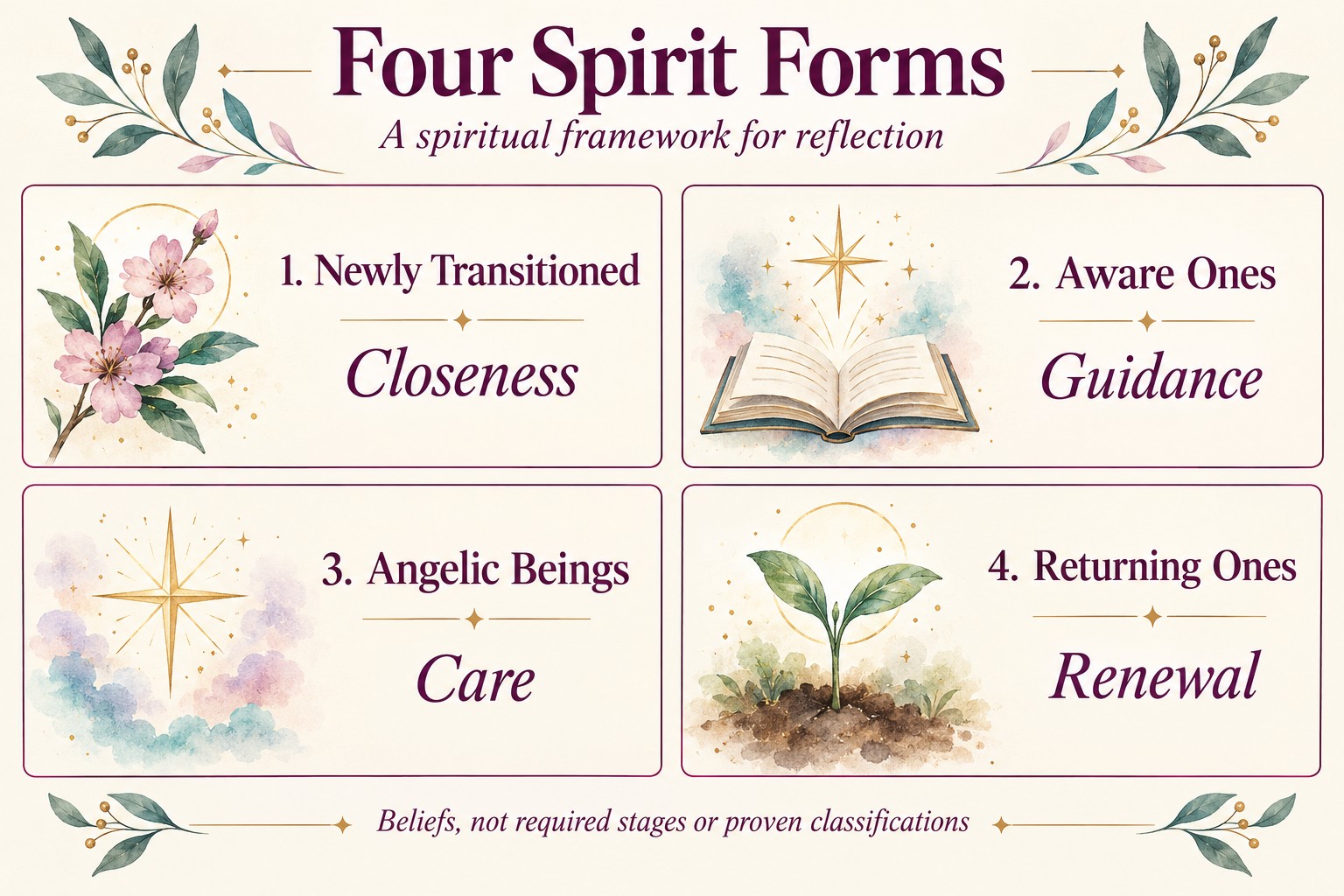
FOUR SPIRIT FORMS / A FRAMEWORK FOR REFLECTION
Wondering how a loved one’s spirit might continue can bring both hope and questions. The four spirit forms explored here—Newly Transitioned, Aware Ones, Angelic Beings and Returning Ones—offer one way to think about closeness, guidance, care and renewal.
These labels are a spiritual framework, not a scientifically established classification or a universal teaching. They are not four stages everyone must pass through. You can find a theme meaningful without needing to decide which category describes someone you love.
For a broader look at spiritual continuity and remembrance, explore your soul’s journey. Here, we will focus on what each of the four labels suggests and how to hold it gently.
1. Newly Transitioned: the theme of closeness
Within this framework, “Newly Transitioned” describes the idea of a spirit still associated with familiar people, places or routines after death. Believers may connect this theme with a vivid dream, an evocative scent or a sudden memory that feels unusually close.
Imagine remembering a grandfather through the smell of garden soil or the sight of ripe tomatoes. That association can invite affection and a story about him. It does not establish that he sent the scent, nor does an animal reacting to a room prove a spirit is present.
There is no timetable here for how long a spirit stays near, and the label should not imply that a loved one is trapped or confused. If you do not experience signs, you have not failed to notice them. Your relationship is not measured by unusual sensations.
A gentle reflection: Which ordinary place, object or activity helps me remember this person with warmth? You might cook a familiar recipe, tend a plant or share a memory. Let the activity be enough without waiting for confirmation.
2. Aware Ones: the theme of guidance
“Aware Ones” represents the belief that a departed person understands their transition and may offer comfort or guidance. In this interpretation, the emphasis moves from familiar presence to a sense of loving companionship.
You might find it meaningful to recall how the person encouraged you or handled a challenge. Asking “What quality did they bring to my life?” keeps the reflection connected to the relationship you actually knew. Patience, humor or generosity may be easier to carry forward than an imagined instruction about the future.
A comforting impression does not reveal another person’s private thoughts or make a major choice for you. If a reader describes a loved one as a guide, you can ask what they mean and remain free to disagree. Our article on spirit guides explores different ways people understand spiritual support.
A gentle reflection: What kind of encouragement would help me today, and how can I express it through a practical action? That might mean asking for support or giving yourself time before responding to a difficult message.
3. Angelic Beings: the theme of care
The “Angelic Beings” label emphasizes benevolent help and protection. Someone might describe a timely reminder or welcome assistance as angelic. You can appreciate that interpretation without declaring that every lucky event was supernatural intervention.
The word “angel” needs care because it carries different religious meanings. For example, the Catholic Catechism’s teaching on angels describes them as spiritual creatures and messengers of God. That teaching should not be collapsed into a claim that deceased relatives automatically become angels. Use language that respects your own faith and the distinctions it makes.
Spiritual reassurance does not guarantee that harm cannot happen. Finding a gas station when you need one may feel fortunate, but checking fuel and planning a route are still important. If you feel prompted to be cautious, respond through sensible safety steps rather than assuming a voice has established a future accident.
A gentle reflection: Where can I combine hope with ordinary care? A prayer before a journey can sit beside checking the weather, resting and arranging reliable transportation.
4. Returning Ones: the theme of renewal
“Returning Ones” points toward reincarnation: the belief that a soul may take another embodied life. Within that belief, return may be associated with learning or renewed connections. It is not a destination all spiritual traditions agree on.
Family resemblance, a familiar expression or a child’s personality can stir powerful feelings. These do not establish that a baby is a deceased relative reborn. Let children have their own identities rather than giving them the responsibility to finish an adult’s relationship or spiritual story.
You can hold reincarnation as a hopeful possibility without predicting who will return, when it will happen or how you must recognize them. Nor should “soul lessons” excuse harm or suggest that someone deserved illness, abuse or loss.
A gentle reflection: What does renewal mean for my life now? You might begin a project, reconnect with a value or offer care to the next generation without assigning anyone a past-life identity.
Four themes, not a ladder of spiritual achievement
The cover graphic summarizes the labels and themes:
- Newly Transitioned: closeness.
- Aware Ones: guidance.
- Angelic Beings: care.
- Returning Ones: renewal.
The numbered order helps organize the article; it does not rank souls or show a proven sequence. Someone you love is not “behind” because you associate them with one theme rather than another. You do not need a paid reading to place them in a category.
When a description resonates, ask what it helps you remember, appreciate or choose. If it creates fear, guilt or pressure, step back. A framework should make room for compassion, not turn uncertainty into a problem you must pay to solve.
Questions to bring to a medium or spiritual adviser
If you discuss these ideas in a reading, keep the conversation open:
- Are you using these labels personally, or drawing on a particular tradition?
- What is an interpretation here, and what can actually be checked?
- Can we explore the theme without deciding my loved one’s spiritual status?
- Can I leave this question unanswered and decline further sessions?
A reader should not tell you that a loved one cannot be at peace unless you buy additional work. No session can guarantee contact, a reincarnation identity or closure. For everyday boundaries around mediumship, see Life On the Other Side.
Keep remembrance and support close
You can cherish spiritual hope and still miss someone’s physical presence. The NHS bereavement guidance notes that people experience loss differently and encourages seeking support when coping is difficult. A classification does not need to explain your grief before you deserve care.
Choose the theme that feels helpful today, or leave all four aside. Remember a quality, share a story or ask someone for company. Whatever you believe about spirit forms, love can find a meaningful expression in the ordinary life you are living.
The article provides an organized framework for understanding different spirit types. It’s fascinating to consider how these spirits might impact our daily lives.
Indeed, the concept of spirits influencing our reality could open up numerous research opportunities in both science and theology.
The idea of spirits intervening in human affairs reminds me of historical accounts where divine or supernatural interventions were credited for certain events.
It’s interesting to see how different cultures interpret the concept of spirits and their roles. This article provides a specific cultural lens that could be compared with others.
While the descriptions of spirit types are detailed, the evidence supporting these claims could be further elaborated. Scientific validation would be beneficial.
Agreed. Empirical studies and controlled experimentation could provide more concrete support for these spiritual concepts.
Research into mediums and their ability to communicate with different types of spirits could add a fascinating dimension to psychological studies.
Understanding spirits as described in the article requires a balance between belief and rational analysis. It would be valuable to study these phenomena from both perspectives.
The classification of spirits into four distinct types is intriguing. It invites further exploration into the realm of spiritual transitions and how they might influence our interactions with the metaphysical world.
The notion of life as a cycle of birth, death, and rebirth is a longstanding philosophical perspective. It allows for a deeper contemplation on the purpose of life and the continuity of the soul.
Absolutely, it challenges us to think about the moral implications of our actions and their potential impact on future incarnations.
It also poses interesting ethical questions regarding the responsibilities of individual souls across different lifetimes.